
日本加速扩军备武 防卫预算申请额再创新高
According to news from Japan on the 19th, the Japanese Ministry of Defense plans to apply to the Ministry of Finance for a defense budget for the fiscal year 2027 that will reach a record high. Recently, the Japanese government has accelerated its military expansion and armament, raising concerns both domestically and internationally.
The process of Japan's "re-militarization" has clearly accelerated
Reporter Li Weibing: According to news from Japan on the 19th, the total amount of the budget application for the fiscal year 2027 by the Japanese Ministry of Defense will increase to 10 trillion yen, setting a new record. The budget includes the development of underwater launch hypersonic missiles that are difficult to be attacked by the enemy as a means of attacking enemy bases, as well as advancing research to enable unmanned submarines to have long-range missile launch capabilities. Additionally, the budget application includes the development of low-cost, rapidly producible attack drones with long-range flight capabilities, as well as advancing research to enhance analysis and command control capabilities through "tactical AI satellites." Furthermore, previous reports indicated that the Japanese Ministry of Defense plans to introduce American artificial intelligence to assist commanders in decision-making speed through battlefield analysis, target selection, and order issuance.
Analysis indicates that Japan is accelerating its escape from the constraints of the peace system
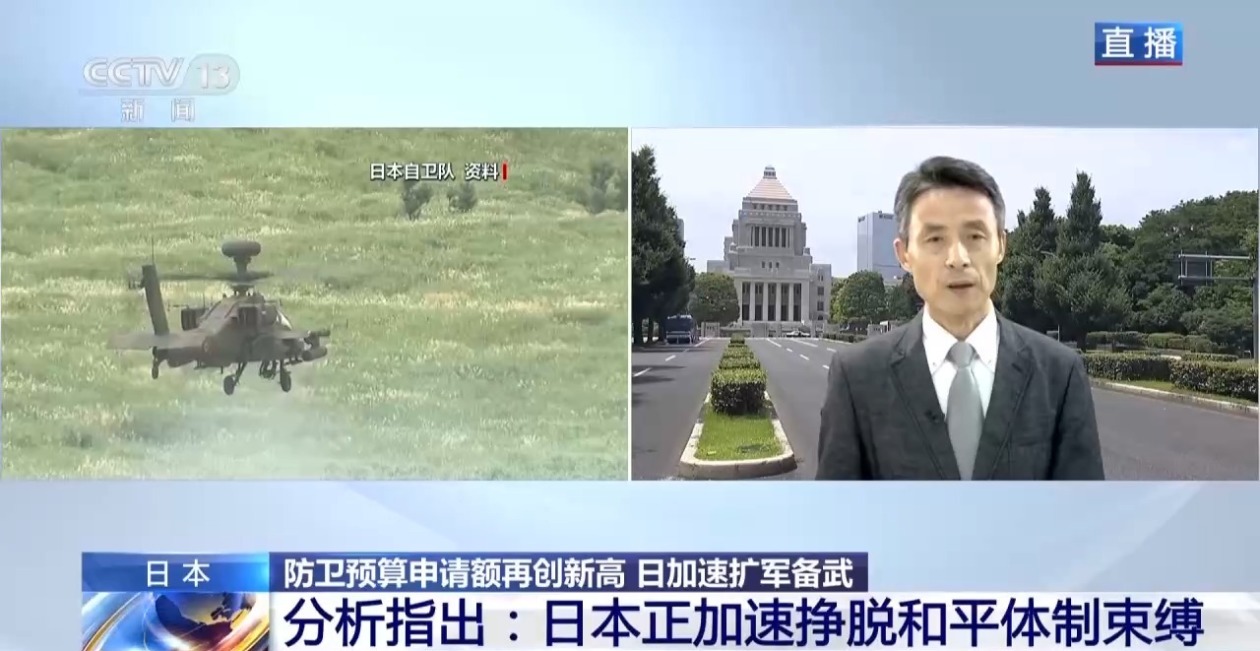
Reporter Li Weibing: Since the rise of Kishi Nobuo, Japan's re-militarization process has shown a clear trend of acceleration: In March of this year, Japan officially deployed the Type 25 land-based anti-ship missile in Kumamoto Prefecture, with a range of about 1,000 kilometers, far exceeding Japan's territorial range and possessing obvious offensive attributes; in April, the Japanese government passed a cabinet resolution to lift the ban on the export of lethal weapons; in July, it officially established the "National Intelligence Agency"; in August, the Japanese Ministry of Defense released the 2026 version of the "Defense White Paper," claiming to further seek "the capability to attack enemy bases." Analysts point out that the various operations of the Kishi administration in expanding military preparations send a clear signal: Japan is accelerating its escape from the constraints of the post-war peace system and reshaping the post-war military framework, having abandoned its strategic positioning of strictly defensive posture in favor of seeking proactive offense.
The Kishi administration continues to deny and beautify its history of aggression
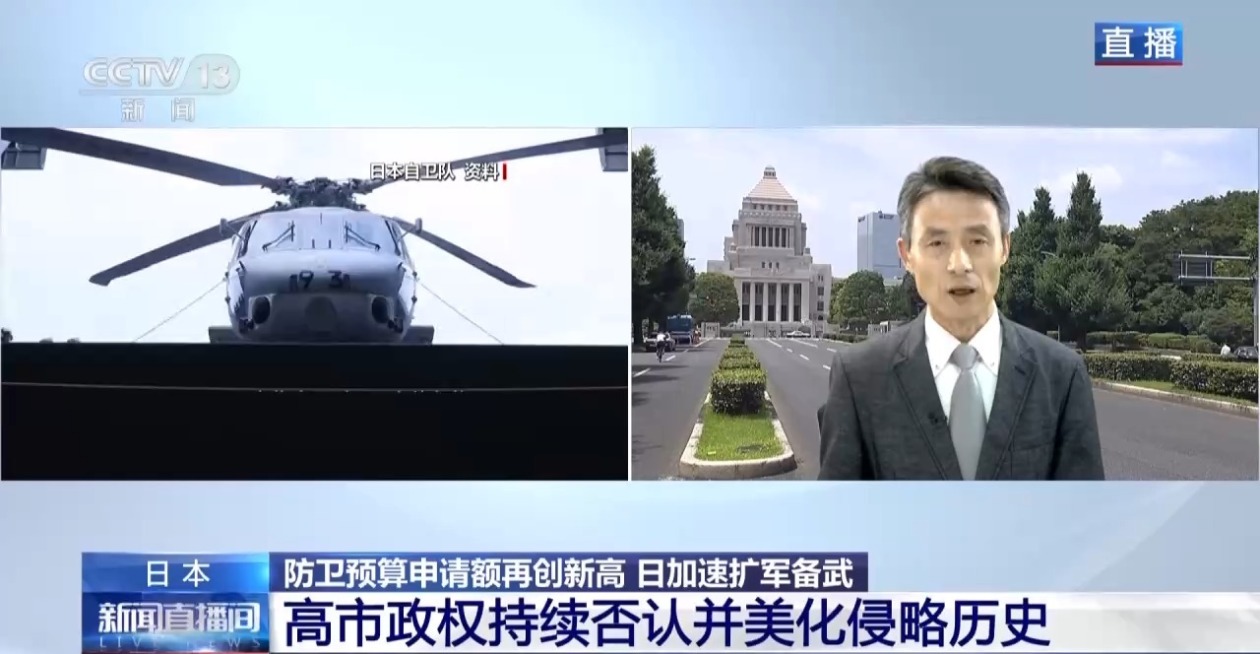
Reporter Li Weibing: Alongside the military expansion and re-militarization, the Kishi administration's political orientation also includes denying and beautifying its history of aggression. On August 15, Japan's unconditional surrender day, Kishi Nobuo offered a ritual fee called "Tama-tsu-ryō" at the Yasukuni Shrine, which represents Japan's militaristic history of aggression, and four cabinet members, including Defense Minister Kōizumi Shinjiro, visited the shrine for worship. More than 80 years after the war, representatives of the Japanese government not only fail to deeply reflect on their history of aggression but also plot to amend the peace constitution, continuously pushing for military expansion and arming, gradually leading Japan in a dangerous direction of "new militarism."
The dangerous trends of the Kishi administration have triggered ongoing protests domestically and internationally
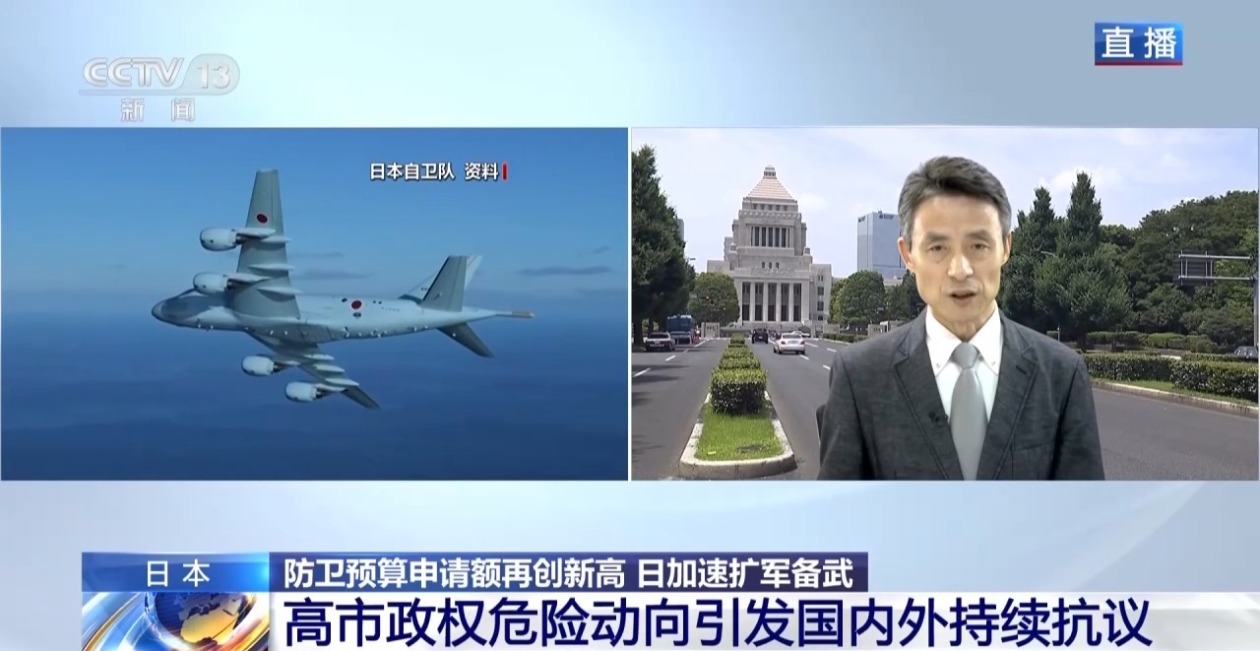
Reporter Li Weibing: The dangerous trends of the Kishi administration have received ongoing protests from the peace-loving and progressive people in Japan and have raised alarms among peace-loving people worldwide. "Oppose war," "Protect Article 9 of the Constitution," "Kishi Cabinet step down"… The Japanese people are protesting the Kishi administration's military expansion and constitutional amendments through rallies and study sessions, calling on the Japanese government to face history and avoid repeating the mistakes of war.

Reporter Li Weibing: Russian Deputy Foreign Minister Ryabkov stated that the Kishi Nobuo government's belligerent posture is harming the security interests of neighboring countries, including Russia, and has a negative impact on the stability of the Asia-Pacific region. The Korean Central News Agency pointed out that Japan is "accelerating its transformation into a war state," and the international community should remain vigilant and must not allow Japan to become a military power. An article in the European magazine "Modern Diplomacy" argues that the so-called post-war "peaceful nation" image established by Japan based on its Article 9 of the "Peace Constitution" has long been a mere facade. Instead, it has been replaced by "new militarism" driven by radical right-wing ideology.
News Link: American Palantir Technologies
According to reports from Japan, the Japanese Ministry of Defense plans to introduce American artificial intelligence to assist commanders in decision-making speed through battlefield analysis, target selection, and order issuance. Among them, American Palantir Technologies has been listed as one of the candidates for cooperation.
Palantir Technologies has close ties with the U.S. military
Palantir Technologies was founded in the United States in 2003 and is a technology company that provides support to the U.S. government and related agencies through big data analysis and artificial intelligence technology. Its products are widely used in various fields such as intelligence analysis, military weapon development, and healthcare. The company has close ties with the U.S. military, having received investment from the CIA early in its development. Its government clients mainly include the CIA, FBI, NSA, Department of Homeland Security, and Department of Defense. At the end of July 2025, Palantir signed a long-term contract worth up to $10 billion with the U.S. Army to provide data support and software services for U.S. Army operations over the next decade.
Palantir develops the "Maven Intelligence System" for U.S. military use

According to relevant news from the U.S., the U.S. military uses the "Maven Intelligence System" battlefield intelligence platform developed with Palantir as a military planning tool, which incorporates the "Cloud" model from the American AI company Anthropic. The "Maven Intelligence System" can collect data from monitoring devices, logistics facilities, sensors, and intelligence departments to generate directive suggestions for commanders' decision-making reference. When formulating strike plans, the system can propose target suggestions, provide precise location coordinates, and prioritize targets based on urgency. When combined with "Cloud," the system can accelerate operational progress, weaken the enemy's counterattack capabilities, turning what would have taken weeks to plan into "real-time processing" actions.
Multiple sources indicate: The attack on an Iranian elementary school is related to the "Maven Intelligence System"

On February 28 of this year, the U.S. and Israel launched a large-scale military operation against Iran, resulting in an airstrike on the Mina'ab Elementary School in Iran, causing at least 175 deaths, most of whom were children. Multiple sources indicate that the original target planned by the U.S. military was a base of the Iranian Islamic Revolutionary Guard Corps adjacent to the Mina'ab Elementary School. The Mina'ab Elementary School had been separated from the Iranian Islamic Revolutionary Guard Corps camp ten years ago and converted into a school, but due to outdated intelligence in the U.S. military database regarding multiple Iranian targets, the "Maven Intelligence System" still designated the school as a strike target. In response, senior officials from Palantir stated that the battlefield intelligence platform is merely a support tool, and the responsibility for decision-making lies with the U.S. military.
Israel applies Palantir products in the Middle East battlefield

It is reported that, in addition to the U.S. military, Israel will deepen its cooperation with Palantir in 2024 and apply Palantir's developed artificial intelligence products in strikes against Lebanon, Iran, and the Gaza Strip, including airstrikes against senior members of Hezbollah in Lebanon and incidents involving the explosion of Lebanese communication equipment.
日本防卫省计划申请创纪录的10万亿日元预算,专注于军事扩张和现代化。这包括开发高超音速导弹、无人潜艇和攻击无人机。政府正在逐步摆脱战后和平主义立场,国内对军事化努力的抗议活动正在增加。
- 日本2027财年的防卫预算将达到创纪录的10万亿日元。
- 预算包括高超音速导弹和攻击无人机的开发。
- 日本正在加速其军事能力,逐步摆脱战后和平主义立场。
- 政府计划引入美国的人工智能技术用于军事决策。
- 国内对日本军事化努力的抗议活动正在发生。