
陆军第八十二集团军某旅“强渡乌江模范连”:制胜未来战场,每次任务都是“强渡”(强军路上·走进长征英雄连队)
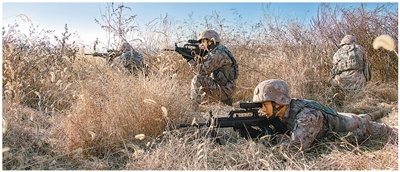
The soldiers of the company are conducting counter-reconnaissance training.
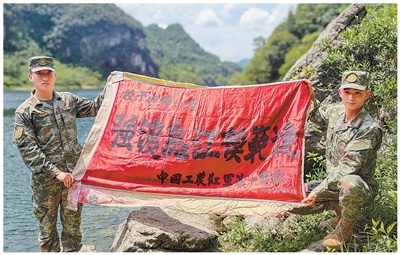
The soldiers of the company retrace the Long March route and take a photo with the battle flag by the banks of the Wu River.
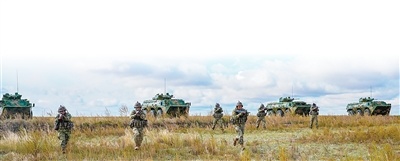
The soldiers of the company are conducting offensive combat drills.
All the above images are provided by the interviewees.
This year marks the 90th anniversary of the victory of the Long March of the Chinese Workers' and Peasants' Red Army.
Looking back at the 25,000-mile Long March, the heroic Red Army soldiers fought bloodily at the Xiang River, crossed the Chishui River four times, cleverly crossed the Jinsha River, forcefully crossed the Dadu River, and seized the Luding Bridge... The revolutionary predecessors, with their firm ideals and beliefs, opened up a path to survival in desperate situations and forged brilliance in suffering, giving rise to a number of heroic companies with outstanding military achievements, such as the "Model Company of Crossing the Wu River" and the "Dadu River Company." Every glorious battle flag is engraved with heroic stories that resonate with the mountains and rivers.
Starting today, this newspaper launches a series of reports titled "Entering the Heroic Companies of the Long March," interviewing these heroic companies that established merit during the Long March, revisiting classic battle scenes, and showcasing the spirit and demeanor of the new era soldiers inheriting the great spirit of the Long March and striving for military excellence.
——Editor
"Traversing the world is difficult, especially crossing the Wu River."
The Wu River, like a dark blue dragon, cleaves through the northern land of Guizhou from west to east, roaring and surging. Breaking through the Wu River was a life-and-death battle, a legendary battle for the Red Army. The "Model Company of Crossing the Wu River" was one of the heroic companies that undertook the task of crossing and achieved remarkable feats.
In early autumn, the political instructor of the "Model Company of Crossing the Wu River," Feng Xiaohan, followed in the footsteps of the Red Army, entering the depths of the Wumeng Mountains and the banks of the Wu River. The knife-like cliffs and the rushing river water are breathtaking.
The Wu River crossing point is deep and turbulent, with hidden reefs. Local people have passed down the saying: to cross the Wu River, one must have "two big and one good"—a clear sunny day, a large wooden boat, and a good boatman, all of which are indispensable.
However, over 90 years ago, this company had none of these. Faced with a hail of bullets, how could they cross this natural barrier? "What our predecessors relied on was the spirit of 'striking hard and charging forward bravely,'" Feng Xiaohan said.
Crossing the natural barrier, blood and courage forged the heroic title
In the honor room of the "Model Company of Crossing the Wu River," two "family heirlooms" are quietly displayed: a battle flag of the "Model Company of Crossing the Wu River" and a lamp from the Monkey Field Conference.
"How can a battle flag and a lamp pass on the legacy of the company?" Feng Xiaohan often asks the soldiers and himself, "What I see is how a unit, in the darkest night, steadfastly follows its faith and keeps moving forward."
In January 1935, after the Monkey Field Conference, enemy troops surged in, preparing to encircle the Red Army at the Wu River. If the Central Red Army could not cross the river quickly, the tragedy of blood staining the Xiang River a month earlier could repeat itself.
The light of the Monkey Field Conference illuminated the direction for the breakout. "At all costs, open the crossing passage!" Zhang Yunyi, then deputy chief of staff of the Central Revolutionary Military Commission, rushed to the Jiangjie River crossing with urgent orders, accompanied by personnel carrying the lamp from the Monkey Field Conference, stepping out a path to the riverbank in the heavy darkness.
Today, this lamp can no longer be lit, but the faith beneath it has never extinguished.
"Our company was originally the first company of the 'Ye Ting Independent Regiment,' the first armed force under the control of our party," Feng Xiaohan said. "Every charge by our predecessors is etched into the bloodline of the company."
As a spearhead company, the first company immediately decided that, no matter the cost, they must ensure the main force crosses the river smoothly. Seventeen brave soldiers stepped forward, splitting into three bamboo rafts, risking their lives to cross, using their blood and lives to interpret what it means to "strike hard and charge forward bravely."
Previously, the soldiers executing the swimming operation had also successfully infiltrated behind enemy lines, cooperating internally and externally to tear open the Wu River defense line. The Red Army eliminated the enemy on the opposite side with the shortest time and the least sacrifice, and built a floating bridge across the Wu River to ensure the main force crossed smoothly.
"By January 6, 1935, the entire Central Red Army had crossed the Wu River, leaving the Kuomintang 'pursuit army' behind in the areas east and south of the Wu River. The Red Army's prestige shook northern Guizhou," the company historian explained with excitement.
"At that time, how difficult it was for the Red Army to cross the river!" After 91 years, the company squad leader Feng Peishu stood at the Wu River crossing, seeing the steep ridges on both sides and the straight cliffs pressing down on the river surface, like high walls trapping the entire river in the middle.
A party history expert accompanying him said, "Currently, dams have been built upstream and downstream of the crossing, but back then, the Wu River in winter was deep and the current was rapid, combined with the rapids and dangerous shoals formed by visible and hidden rocks, controlling the bamboo rafts was extremely difficult."
"In the past, I had heard the story of crossing the Wu River over and over again. But standing at the crossing, looking at those restored bamboo rafts, I was still deeply shocked," Feng Peishu said.
What kind of bamboo rafts were they? They were made of bamboo with wooden boards sandwiched in between, secured with bamboo strips. "The Red Army used simple bamboo rafts to break through the heavily guarded natural barriers," Feng Peishu lamented, "I used to think that 'striking hard and charging forward bravely' was just a slogan, but standing here, I finally understood the weight behind it."
Corporal Qian Fadong, whose home is in Zunyi, Guizhou, with the Wu River right at his doorstep, often heard the elders point to the river and say, "The Red Army crossed here back in the day."
When he joined the army and went to the company, it was his first time entering the honor room, and he saw the old map on the wall, with the words "Chashan Pass" prominently displayed. From a boy by the Wu River to a successor of the heroes who crossed the Wu River, the Wumeng Mountains and the Wu River nurtured him and instilled in him a strong sense of mission.
During a live-fire exercise, the vehicle suddenly jolted violently, and the target disappeared from the sight. Qian Fadong quickly stood up to search again, hitting his nose hard against the turret edge, causing a nosebleed. He didn't have time to wipe it, gritting his teeth to re-acquire the target and fire, hitting all of them.
"Why didn't you call for a stop at that time?" After leaving the training ground, a comrade asked Qian Fadong while applying medicine to him.
"Back then at the Wu River, the Red Army predecessors didn't stop in the face of a hail of bullets. If they had stopped, the entire battle might have turned out differently," Qian Fadong replied.
On leave back home, Qian Fadong visited the Red Army Martyrs Memorial at the village entrance. He recalled the map in the honor room, the surging waters of the Wu River, the time spent sweating in the barracks, and even more so, the brave battles fought by the Red Army predecessors. At that moment, his belief in rooting himself in the military camp became even more resolute.
On the training ground, the spirit of daring to fight and win is passed down
Time flows on. That thrilling river crossing battle has passed for 91 years, but the spirit of "striking hard and charging forward bravely" continues to resonate in the hearts of the company soldiers.
In July this year, in the heart of the Central Plains, under the scorching sun. During a live troop confrontation exercise, the company was executing a dispersal and concealment task in the mountainous forest when they suddenly received the order: "Quickly send out an advance team to scout the route!"
Prior to this, squad leader Shi Linlin had already combined training experience to simulate various anticipated situations. However, halfway through the advance, urgent reports came over the radio: "The bridge ahead has been blown up!" "A small group of enemies is harassing on the opposite bank!" "An enemy drone has been spotted 200 meters to the left!" Three layers of danger overlapped, catching the soldiers off guard.
Taking a detour of 40 kilometers through the mountains was safe but would delay the opportunity for battle. Crossing on the spot was fraught with difficulties but could ensure timely arrival.
Company commander Huang Shifeng decisively ordered: "Cross!" With fire support, engineers building bridges, and counter-drone measures... In less than 20 minutes, a mechanized bridge spanned the riverbank, and the follow-up troops streamed in.
"91 years ago, our predecessors crossed the natural barrier on bamboo rafts, braving a hail of bullets. Today, we have advanced equipment that can turn the natural barrier into a thoroughfare. However, the victory genes of our predecessors are still being passed down," Shi Linlin said.
The moments when history shines into reality are always particularly moving. Every "crossing" on the training ground is a solemn tribute to that night at the Wu River.
To carry the spirit of "striking hard and charging forward bravely" into future battlefields, new skills and new actions are still needed.
In a confrontation exercise a few years ago, Corporal Wu Chengming's squad was responsible for eliminating the remaining enemies. As the advance troops just crested the hill, they were hit hard by hidden blue forces, suffering heavy losses.
"Why didn't we use drones for reconnaissance?" At the debriefing meeting, Wu Chengming's question hit the nail on the head. The equipment had just been issued, and no one could use it proficiently, which became an awkward reality. From then on, the company formed a drone equipment research and training group, and Wu Chengming volunteered to take the lead.
During that time, Wu Chengming trained daily with a simulator, often staying up until one or two in the morning, and his comrades joked that he had developed "panda eyes." During assembly training, to make the welding stronger, he practiced repeatedly, burning blisters on his index and middle fingers. "Today our equipment is more advanced, but the spirit of 'striking hard and charging forward bravely' cannot be lost!"
Efforts have not been in vain. In a recent urban offensive and defensive exercise, Wu Chengming operated a drone at speeds exceeding 80 kilometers per hour, accurately flying into a wall aperture just 3 centimeters taller than the drone, destroying the target in one fell swoop.
"Technology is changing, the battlefield is changing, but the fighting spirit must not change," said Corporal Li Zhen, who is also charging into the field of unmanned combat. "What we need to do is use new technology to inherit the old spirit and win future wars."
During an exercise, Li Zhen reported "safe" after observing with binoculars, but the team was ambushed by hidden blue forces, suffering heavy losses. From then on, he put down his preconceived notions and practiced drone operation diligently. Repeated takeoffs and landings, and numerous debriefings, he gradually mastered the operation skills of various unmanned equipment.
In an August tactical exercise, a half-finished building was hard to capture. Li Zhen decisively operated the drone to scout, pinpoint, and strike in one go, eliminating the enemies hidden in the shadows, allowing the troops to complete the mission with zero casualties.
The battle flag points the way, and the mission must be accomplished to continue writing glory
In October 1936, the Red First Army awarded the first company the title of "Model Company of Crossing the Wu River." Since then, this battle flag has accompanied the company through its tumultuous years, inspiring generations of soldiers to overcome difficulties and charge into battle.
Private Shao Weiya was a junior student at Renmin University of China before enlisting. From the first new type of regular university founded by the party to the first armed force under the party's control, he said: "Youth is not just about rushing forward, but should also pour a passionate blood for faith and mission."
Upon entering the military camp, Shao Weiya lagged in physical fitness, ranking third from the bottom in the comprehensive assessment of new recruits. After joining the company, during the first full camp mobilization, due to his nervousness, he was the last in his class to complete the task.
That night, the squad leader did not criticize Shao Weiya but took him to the battle flag: "Weiya, do you know how this battle flag came to be?"
That night, Shao Weiya thought for a long time under the battle flag. After that, he set a strict training plan for himself: while his comrades were lightly equipped, he wore full gear, and on weekend mornings, he practiced armed long-distance running alone. In the wind and rain, he was covered in mud, shouting to the sky, venting his suppressed unwillingness and stubbornness.
On the day of the competition, the instructor loudly asked under the battle flag: "Do you remember our company spirit?"
"Strike hard and charge forward bravely!" Shao Weiya shouted. When the starting gun fired, he gave it his all and ultimately won first place in the conscript group. Crossing the finish line, tears streamed down his face.
The power of the battle flag is written in the growth of every soldier.
"Each generation has its own Long March," Shao Weiya said. "Only by facing difficulties head-on and moving forward without hesitation can we overcome the 'Wu River natural barrier' we face today."
The vice squad leader, Gou Yongyong, who re-enlisted, feels particularly deeply about the "temperament" of the company: "Whenever we encounter opponents in the competition field or face major tasks that require overcoming difficulties, everyone’s eyes suddenly light up, charging forward without hesitation."
This spirit shines even brighter in foreign lands.
In 2022, the company was fully deployed to South Sudan for peacekeeping missions. During the first armed escort task, squad leader Xia Zhengping encountered a tough battle. During the reconnaissance process, local armed elements snatched their work camera and summoned a dozen armed personnel. Xia Zhengping stood in front of the opposing motorcycle, arguing for reason, demanding that the camera be returned. When the other side saw that intimidation was ineffective, they ultimately returned the camera and left.
"It's impossible not to be afraid. I have never felt so close to danger," Xia Zhengping said. "One end of the 'balance' is life, but the other end is a mission heavier than life."
That year, the company successfully completed 7 short patrols, 5 long patrols, 10 short-distance escorts, and...
陆军第八十二集团军的“强渡乌江模范连”在乌江进行侦察训练和战斗演练,以纪念红军长征90周年。该部队反思其历史意义和“拼搏进取”的精神,为未来的作战做好准备。此次训练涉及17名士兵使用竹筏,强调了他们在1935年1月原始渡河时前辈们的勇敢遗产。
- 陆军第八十二集团军的“强渡乌江模范连”进行了训练演习。
- 该部队纪念红军长征90周年。
- 历史记载详细描述了乌江渡河作为一次重要的军事行动。
- 该部队在训练中强调了“拼搏进取”的精神。
- 现代训练吸取了历史战役的教训。