
Recently, NATO confirmed that the permanent location of its third Joint Air Operations Center is situated within the Arctic Circle. At the same time, NATO has been conducting large-scale military exercises in the Arctic region. Countries such as the United States and Russia are also frequently carrying out weapon tests and combat training in the Arctic and cold regions. What new trends are emerging in the multidimensional game among the relevant parties in the Arctic region?
What is the intention?
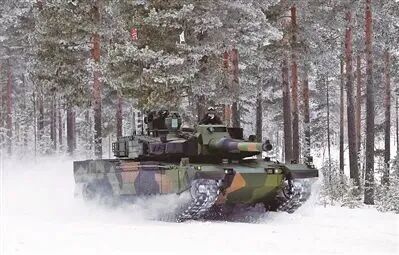
Data map: Norwegian Army conducts military exercises (Source: China National Defense News)
From March 9 to 20, the "Cold Response" military exercise, led by Norway, was held in the waters and land surrounding Norway and Finland, with participation from 14 NATO countries, including the United States, and approximately 25,000 military personnel. Previously, NATO had officially agreed to designate the air station in Bodø, Norway, as the permanent location for the third Joint Air Operations Center.
Recently, NATO has been active in the Arctic direction; what is its intention? Military observer Cao Weidong provided an analysis on this matter.
Cao Weidong:
From a military perspective, this reflects how NATO countries are engaging with Russia in cold regions. Especially after Finland and Sweden joined NATO, the Arctic region, except for Russia, is entirely composed of NATO countries, thus NATO views Russia as its primary adversary. Additionally, a new situation has emerged recently where the United States has proposed to purchase Greenland, which is an autonomous territory of Denmark. This contradiction has led to a "fork" in the objectives of NATO's internal exercises.
Temperature of Attitude
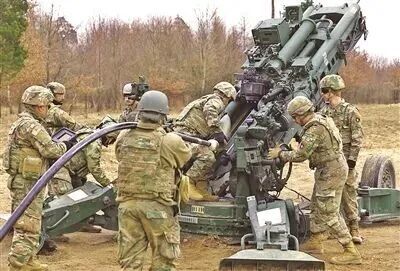
Data map: U.S. Army soldiers participate in NATO live-fire exercises (Source: China National Defense News)
Recently, the United States has been absent from NATO's "Steadfast Defender" and "Arctic Resolve" exercises, which has drawn attention to its participation in the "Cold Response" exercise. Why is there a difference in the U.S. attitude towards these NATO-organized exercises? Military observer Zhang Xuefeng provided the following analysis.
Zhang Xuefeng:
The United States will choose whether to participate in NATO exercises based on its own military needs; at the same time, NATO member countries will also decide whether to invite the U.S. to participate based on their own exercise needs and strategic objectives. The reason the U.S. did not participate in the "Arctic Resolve-2026" exercise is that it was led by Denmark and largely targeted at the U.S.'s previous series of statements regarding the occupation of Greenland.
Currently, the Greenland crisis has temporarily subsided, and cooperation between the U.S. and other Nordic countries in the Arctic region has somewhat resumed, which is why the U.S. participated in the "Cold Response" exercise this time. In a sense, the frequency of U.S. joint exercises with NATO allies can be seen as a "barometer" of U.S.-European relations.
Extreme Cold Test
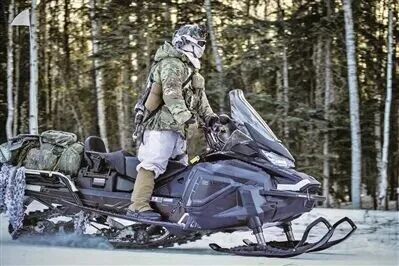
Data map: U.S. soldiers conduct snowmobile cross-country training (Source: China National Defense News)
Regarding the U.S. military's capability to operate in cold regions, Zhang Xuefeng believes that the U.S. military's combat capability heavily relies on technological and equipment advantages, but these advantages may not be fully realized in the unique climate of cold regions.
Zhang Xuefeng:
The U.S. military's technical equipment is relatively advanced, with a high degree of systematization, and it also has some units specialized in cold region operations, such as the 11th Airborne Division stationed in Alaska. However, if the U.S. military operates in high-cold areas like the Arctic Circle, the long-term deployment of a large number of advanced weapons and equipment will place extremely high demands on its logistics and equipment support. Without a complete system to support it, deploying only a small number of troops may result in the U.S. military's operational adaptability and tactical level being inferior to that of local forces that have been conducting exercises in high-cold regions for a long time.
Russian Deterrence
Zhang Xuefeng believes that Russia will continue to strengthen its military deployment in the Arctic direction in order to enhance its deterrence capability against the United States and NATO.
Zhang Xuefeng:
Russia has a clear advantage in the Arctic region. The Russian military possesses over 40 icebreakers and is the only country in the world with nuclear-powered icebreakers. Additionally, Russia has multiple military bases in the Arctic region, such as the Kola Peninsula, where two-thirds of Russia's maritime nuclear deterrent forces are stationed. In the future, one of Russia's strategies in the Arctic region will be to strengthen the deployment of important weaponry, particularly to conduct nuclear deterrence against NATO and the United States from the Arctic direction.
Reporter: Zhu Jiang, Yu Lan
北约于3月9日至3月20日举行了“冷响应”军事演习,参与人员来自14个成员国,共计25,000人,地点在挪威和芬兰。该联盟确认在北极建立了一个永久性的联合空中行动中心。同时,俄罗斯正在增强其在该地区的军事能力,旨在威慑北约的活动,特别是在美国对格林兰的利益背景下。
- 北约确认其第三个联合空中行动中心在北极的永久位置。
- “冷响应”军事演习涉及来自14个北约国家的25,000名人员。
- 美国在一些北约演习中缺席,但参与了“冷响应”。
- 俄罗斯正在增强其在北极的军事存在,以威慑北约和美国。
- 美国对购买格林兰表示了兴趣,复杂化了北约的动态。