
视频丨红旗-16F实弹打靶!陆军首次具备中远程防空反导能力
A video of a live-fire exercise for a new type of air defense weapon system of the People's Liberation Army was recently released. Notably, this exercise was conducted by a brigade of the 73rd Group Army, which mobilized thousands of kilometers from the southeastern coastal region to the northwestern Gobi Desert.
What message does this exercise arrangement convey? What special capabilities does this air defense system possess? Why did the troops stationed in the southeastern coastal region travel to the northwestern Gobi Desert for a live-fire exercise?
Is the new air defense weapon system the Hongqi-16F?
The vast northwestern Gobi Desert recently welcomed a group of "air defense vanguards" that traveled thousands of kilometers from the southeastern coast. The six-tube wheeled launcher stands proudly towards the sky, with missiles that have a smooth appearance, distinctly different from traditional air defense missiles with "wings." What exactly is this new equipment?
Military commentator Shao Yongling: At the 2024 Zhuhai Airshow, there will be a Hongqi-16FE. The model showcased this time is very similar to the Hongqi-16FE, and the most important aspect is that it features a wingless design and is mounted on a six-tube wheeled launcher. From its appearance, it is a self-use version of the Hongqi-16FE, which is the Hongqi-16F.
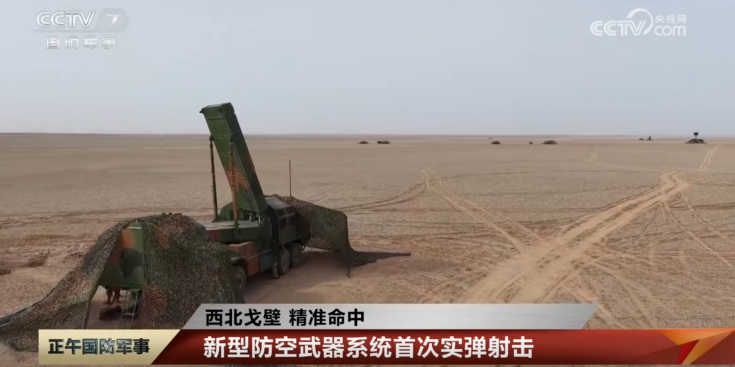
△ The first live-fire shooting scene of the new air defense weapon system
For the 73rd Group Army, a "spearhead" force stationed in the southeastern coastal region, the Hongqi-16F represents the capability for the unit to independently support a "defense umbrella" with a radius of 160 kilometers, effectively responding to dual threats from the air and missiles.
Shao Yongling: The earliest models were the Hongqi-16A and B. The A model had a range of only 40 kilometers, making it a medium-range air defense missile; the B model extended the range to 70 kilometers. Initially, it could only perform air defense, but with the Hongqi-16F, it has evolved to provide both air defense and missile defense.
The Hongqi-16A, B, C, and Hongqi-16F are two types of missiles, transitioning from medium-range to medium-long-range air defense missiles, with a range increased to 160 kilometers and an altitude of 15 to 27 kilometers.
The Army has for the first time
acquired medium-long-range air defense and missile defense capabilities
Shao Yongling pointed out that the Hongqi-16F fills the firepower gap between the Hongqi-9 long-range air defense and the Hongqi-17 short-range air defense, enabling the army's air defense system to achieve full-range coverage for the first time, and to possess medium-long-range air defense and missile defense capabilities.
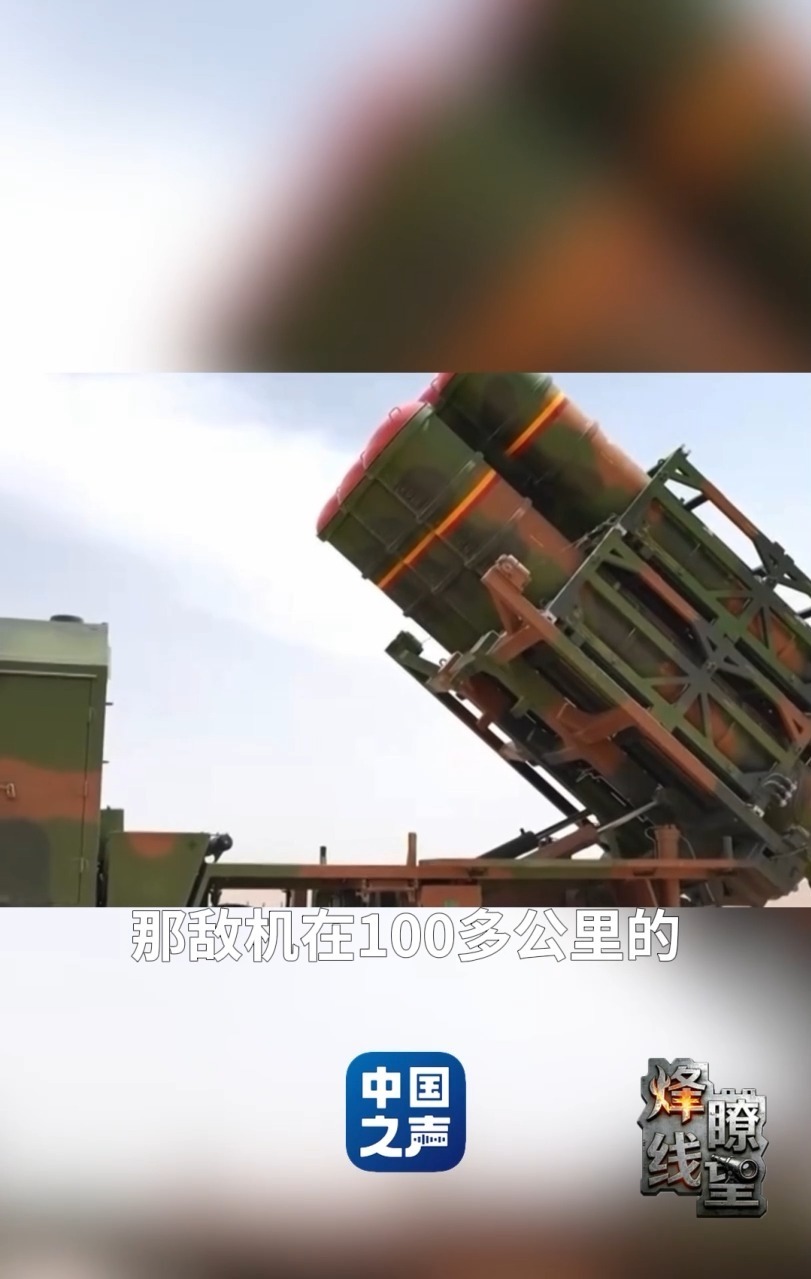
Shao Yongling: The Hongqi-16F becoming a medium-long-range air defense system and being equipped to the army is of great significance.
First, in the traditional air defense range of the army, it can strike outside the defense area. With a medium-long-range air defense and missile defense system, if enemy aircraft drop bombs from over 100 kilometers away, they can be intercepted, effectively addressing the problem at its source.
Second, army units on the battlefield face threats from tactical missiles that traditional medium-range air defense systems cannot intercept. With the Hongqi-16F, both ballistic and cruise missiles can be intercepted. The army's acquisition of medium-long-range air defense and missile defense capabilities marks an important milestone in capability evolution.
Why is the "light rod missile"
stronger without "wings"?
The most significant feature of this missile is the removal of traditional missile winglets and main wings, leading enthusiasts to refer to it as a "light rod missile." Why do traditional missiles have wings? Primarily to generate lift, facilitate turning, and stabilize the missile body.
However, when the missile speed exceeds Mach 2, the wings become a burden: shock wave drag increases significantly, efficiency decreases with speed, heat generation intensifies, and radar cross-section increases. The "light rod missile" effectively addresses these issues.
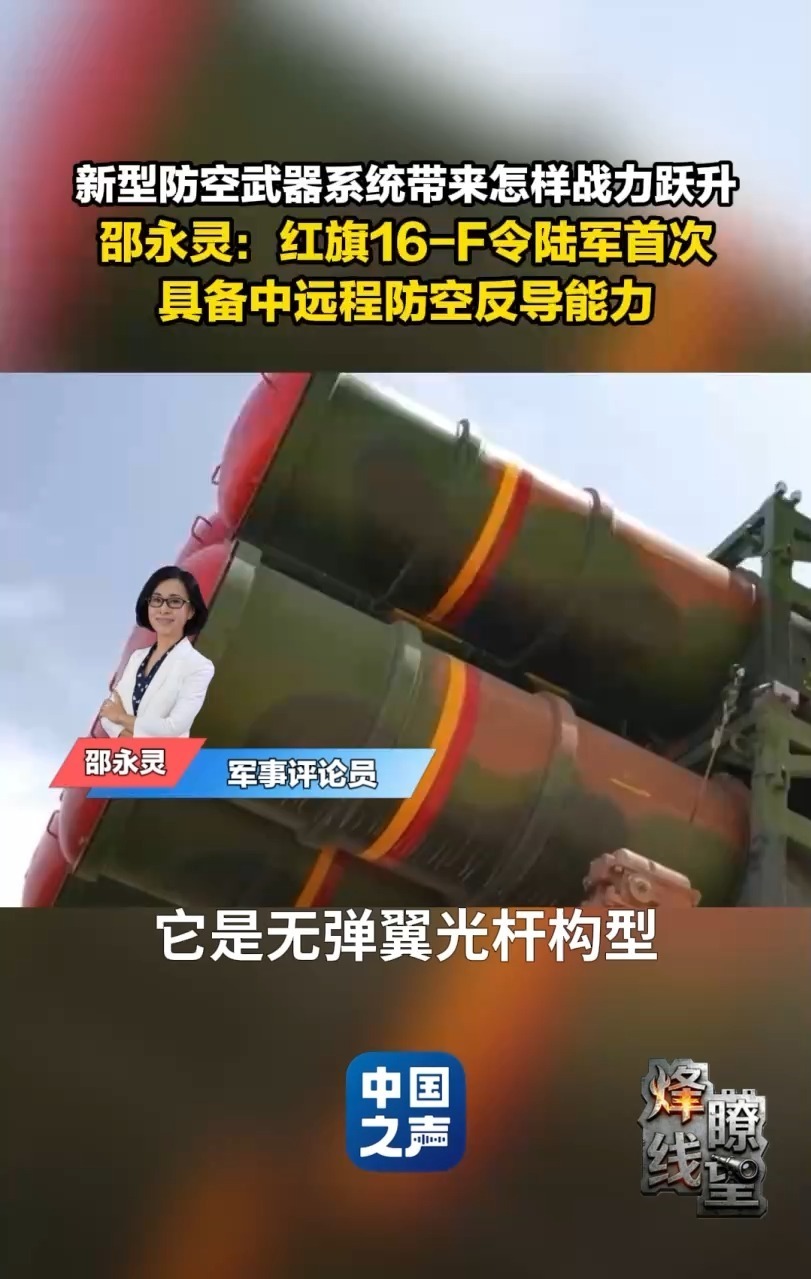
Shao Yongling: First, drag is reduced, range is increased, and speed is enhanced. The Hongqi-16F can reach a range of 160 kilometers and a speed of up to Mach 5, which is directly related to its light rod design;
Second, it has better maneuverability and can intercept from all directions, as missile defense must possess omnidirectional interception capability;
Third, it is more compact, with a smaller launch tube diameter, allowing the launcher to carry more missiles. Particularly for naval variants, using vertical launch systems on ships, the absence of winglets allows for more missiles to be loaded;
Fourth, the light rod missile has better stealth performance, with a smaller radar cross-section, making it harder to detect.
What secrets are hidden in the missile launch vehicle's shielding?
In the released footage, certain positions of the missile launch vehicle were clearly subjected to shielding. What are these shielded areas? Shao Yongling pointed out that the shielding during the exercise is primarily for technical confidentiality; however, considerations in a real battlefield are entirely different.
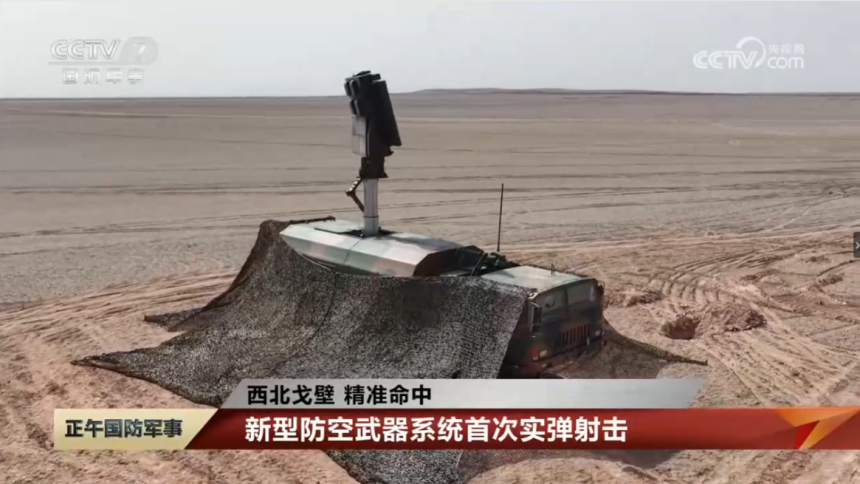
△ The missile launch vehicle with shielding
Shao Yongling: Some shielding is based on the need for technical confidentiality, some to reduce the probability of reconnaissance and identification, and some to protect equipment, as well as for tactical camouflage and deception, etc.
The radar optical window and antenna area shielding are not for confidentiality; they primarily aim to obscure radar wave characteristics, infrared radiation, and electromagnetic signals, preventing electronic reconnaissance and passive positioning. This is fundamentally based on considerations for battlefield survival.
On one side is the humid sea breeze, and on the other is the dry desert. From the southeastern coast to the northwestern Gobi Desert, the climate, altitude, and electromagnetic environment are entirely different. This live-fire exercise of the new air defense weapon system effectively tests the combat effectiveness of the new equipment and the unit's all-domain operational capabilities, showcasing a new leap in the air defense capabilities of the Chinese army.
Supervisor丨Wu Zhehua
Reporters丨Cui Tianqi, Wang Jiyun
Video丨Ning Bo
第73集团军在西北戈壁进行新型红旗-16F防空系统的实弹演习,此次演习是在从东南沿海调动后进行的。该系统能够在160公里的范围内拦截威胁,标志着陆军防空能力的显著提升。演习展示了该系统在多种环境下的先进设计和作战有效性。
- 红旗-16F防空系统的有效射程为160公里,能够拦截弹道导弹和巡航导弹。
- 演习涉及第73集团军从东南沿海调动至西北戈壁。
- 红旗-16F是新型号,增强了陆军的防空能力,填补了远程和短程系统之间的空白。
- 红旗-16F的设计去除了传统的机翼,提高了速度和隐蔽性。
- 演习展示了陆军在多样环境中进行作战的能力。