Mistral-class

🇫🇷France
2006 – Present
Spotlight

France's all-electric 21,300 t LHD trio: helicopter carrier, hospital and command ship

Mistral class LHD (BPC) Amphibious Assault Ship, Force Projection & Command Vessel DCNS (NavyRecognition)

Watch on YouTube
Overview
Mistral-class
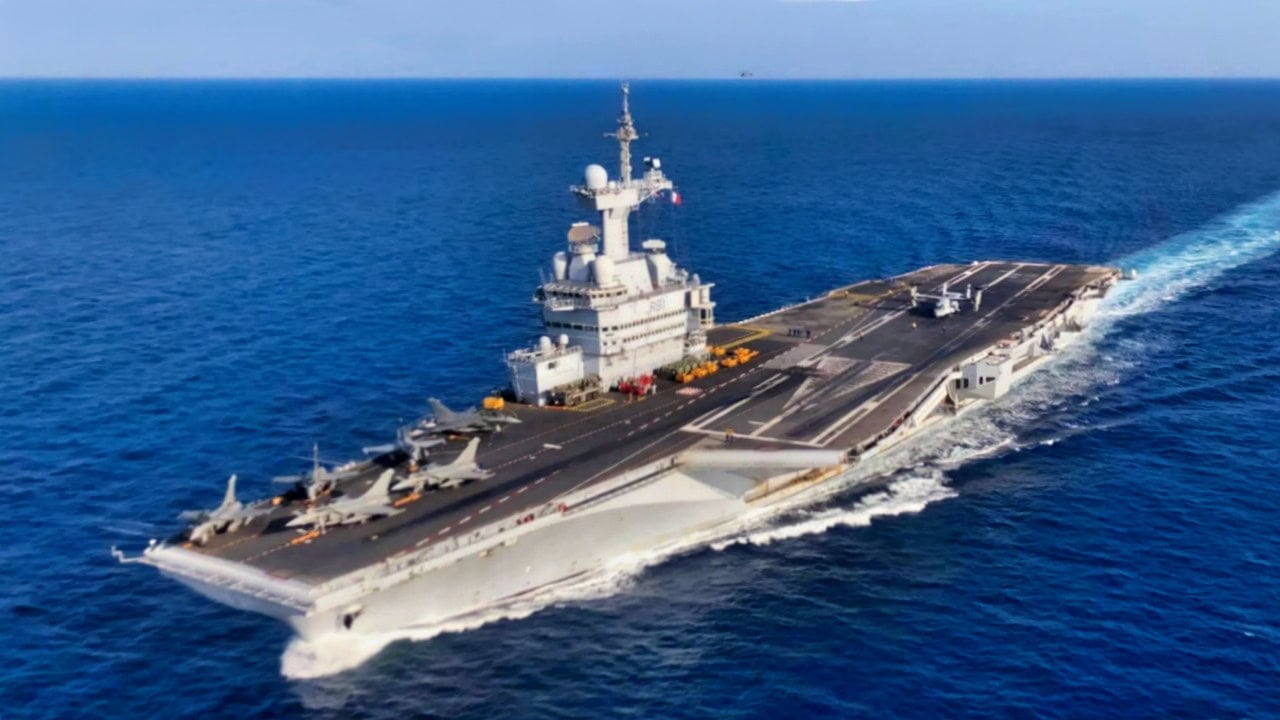
The Mistral class is a class of five landing helicopter docks built by France, capable of transporting and deploying helicopters, landing craft, vehicles, and troops.
Specifications

General

Crew160
Beam M32 m
Length M199 m
Well DeckYes
Speed Knots18.8 knots
Landing Craft4 medium-sized landing craft
Troop Capacity450
Vehicle Area Sqm6,400 sq m
Aircraft Capacity16
Displacement Tons21,500 tons
Flight Deck Spots6
Helicopter Spots6
Vehicle Capacityup to 70 vehicles including 13 Leclerc tanks
Well Deck Length M57.5 m

Other

BuilderDCNS (now Naval Group) with Chantiers de l'Atlantique / STX France, Saint-Nazaire and Brest
Armament2x Simbad/Simbad-RC Mistral SAM launchers, 30 mm and 20 mm guns, 12.7 mm machine guns
Range Nm~10,700-11,000 nm at 15 kn (economical)
PropulsionDiesel-electric; 3x Wartsila 16V32 (6.2 MW each) + 1x Wartsila 18V200 (3 MW); 2x 7 MW azimuth pods
Ships In Class5 - Mistral, Tonnerre, Dixmude (France); Gamal Abdel Nasser, Anwar El Sadat (Egypt)
Command Facilities~850 m² command centre for a Combined Joint Task Force staff of up to ~200 (reported)
Hospital Facilities69 beds (7 intensive care), 2 operating theatres, ~750 m² medical area
Flight Deck Area Sqm~5,000
Latest Developments
Apr 9, 2026strong signal
French Navy further expands CAMCOPTER® S-100 fleet

Entity 'Mistral' mentioned in report

Mar 27, 2026strong signal
MBDA plans $5.8B investment in missile production as demand soars

the production capability of the Mistral is “four times more than in 2022.”

Featured Coverage
Research Notes

French LHD built for expeditionary command and amphibious lift

high

The Mistral class gives France a flexible landing helicopter dock for force projection, command, evacuation, and humanitarian missions.

The Mistral class is a French landing helicopter dock family built around expeditionary flexibility rather than a single narrow combat role. Naval Group describes Mistral-class LHDs as ships able to transport forces, command air-sea operations, and support humanitarian missions.

This makes the class important even when it is not carrying out a contested landing. A Mistral-type ship can act as a helicopter platform, troop and vehicle transport, command ship, hospital support platform, evacuation asset, or crisis-response hub. Its value comes from volume, aviation facilities, command spaces, and the ability to connect sea-based forces with operations ashore.

For HiWars, the Mistral page should be read as an amphibious and command-platform record. Individual ship pages and export records can then explain deployment history, refits, embarked craft, aviation mix, and national operating concepts.

Aviation, well deck, command spaces, and medical support

high

Mistral-class capability comes from combining helicopters, landing craft, troops, vehicles, command facilities, and medical capacity in one hull.

The Mistral-class design combines a flight deck and aviation facilities with a well deck, vehicle spaces, accommodation, and command facilities. That combination lets the ship support amphibious movement, helicopter operations, disaster response, and joint command tasks.

The ship is not a fleet air-defense combatant and should not be evaluated like a destroyer or cruiser. Its main contribution is enabling and sustaining operations: carrying forces, coordinating a task group, moving helicopters and landing craft, and supporting people during evacuations or humanitarian missions.

This role makes escort and operating context essential. In a high-threat environment, an LHD depends on air defense, anti-submarine screening, mine countermeasures, intelligence, and logistics support from the wider force.

Power projection without a carrier air wing

high

Mistral-class ships project useful military and political presence even though they are not aircraft carriers in the fixed-wing sense.

The Mistral class is sometimes compared with small aircraft carriers because of its full-length flight deck, but its main role is different. It supports helicopters, amphibious forces, command functions, and crisis response rather than fixed-wing carrier strike operations.

This distinction matters for readers. A Mistral-class ship can be highly useful in evacuation, disaster relief, stabilization, and expeditionary support missions, while still requiring protection if used near a capable opponent. Its value is practical and political: it can put a visible, flexible French or allied presence near a crisis without needing a large carrier strike group.

Future HiWars updates should connect Mistral records to embarked helicopters, landing craft, French overseas operations, export cases, and humanitarian missions. That will make the page more useful than a simple ship-specification table.

Key parameters at a glance

high

Figures are official DCNS/Naval Group and French Navy data unless marked otherwise.

Role
Amphibious assault, command and power-projection ship (LHD / BPC)
Ships in class
5 (3 French Navy, 2 Egyptian Navy)
Full-load displacement
21,300t
Length overall
199m
Air group
16 heavy or up to 35 light helicopters; 6 deck spots
Landing craft
4 CTM/EDA-R landing craft or 2 LCAC in 57.5 m well deck
Troops
450 (900 short-term surge)
Hospital
69 beds, 2 operating theatres
Propulsion
All-electric, 2x 7 MW azimuth pods; 18.8 kn max
Range
~10,700nm at 15 kn

Program milestones

high

From the BPC program launch through the Russia affair and Egyptian transfer.

2003-07Mistral keel laid

Lead ship built under a split-work arrangement between DCN in Brest and Chantiers de l'Atlantique in Saint-Nazaire, with Thales as systems partner.

2006-02Mistral commissioned

France's first all-electric warship enters service; sister ship Tonnerre follows in December 2006. Both deploy to evacuate civilians from Lebanon that summer.

2011-01Russia contract signed

France agrees to build two ships for the Russian Navy — Vladivostok and Sevastopol — in a deal reported at about EUR 1.2 billion, with partial hull construction in St. Petersburg.

2012-12Dixmude commissioned

Third French ship, built largely at STX France Saint-Nazaire on a compressed schedule, joins the fleet after supporting Operation Harmattan-era readiness.

2014-09Russia delivery suspended

Following Russia's annexation of Crimea and the war in Donbas, President Hollande suspends handover of the completed Vladivostok.

2015-08Russia deal cancelled

Paris and Moscow terminate the contract; France reimburses Russia's payments and retains both hulls.

2016-09Egypt receives both ships

Sold to Egypt for a reported ~EUR 950 million, the pair are delivered in June and September 2016 as ENS Gamal Abdel Nasser and ENS Anwar El Sadat.

2021Recurring Indo-Pacific deployments

Tonnerre leads the Jeanne d'Arc 2021 task group to Japan for exercise ARC-21; Dixmude (2023) and Mistral (2025) continue the annual long-range training missions.

Strategic significance

medium

The Mistral class gives France one of the few genuinely multi-role expeditionary platforms outside the US Navy. In a 21,300-tonne hull it combines a six-spot flight deck for up to 16 heavy helicopters, a well deck for landing craft, a 69-bed hospital and command spaces sized for a multinational task force staff. That mix has been exercised in practice: helicopter strike operations off Libya in 2011, non-combatant evacuations from Lebanon in 2006, and hospital-ship duty by Dixmude off Egypt during the Gaza crisis in late 2023. Compared with the larger US Wasp and America classes, the design trades aviation depth and self-defence armament for lower cost and crew size, and it carries no fixed-wing aviation.

The cancelled Russian sale remains the class's most consequential political episode. The 2011 contract for Vladivostok and Sevastopol was, at the time, the largest Western arms sale to Moscow since the Cold War; its suspension in 2014 and cancellation in 2015 set a precedent for how NATO members weigh export revenue against alliance security, a debate that resurfaced after 2022. The resale to Egypt at a reported EUR 950 million limited France's financial loss and made the Egyptian Navy the second operator of large-deck amphibious ships in the Mediterranean and Red Sea, although observers note Egypt's air group and doctrine for the two ships have matured slowly.

Since 2021 the class has anchored France's visible naval presence in the Indo-Pacific through the annual Jeanne d'Arc training deployments, which pair an LHD with a frigate on a five-month cruise that routinely includes port calls in India, Southeast Asia and Japan and exercises such as ARC-21. For a resident Indo-Pacific power with overseas territories, the ships offer a politically flexible instrument — capable of disaster relief as readily as amphibious rehearsals — though their modest self-defence fit means they depend on escorts in any contested environment.

Videos

Egypt's first French-made warship arrives in Alexandria (New China TV)

Watch on YouTube

Mistral class: France's export warship whose only sale nearly went to Russia (Bilibili)

Watch on Bilibili

France's Jeanne d'Arc 2025 deployment: when training meets practice (Bilibili)

Watch on Bilibili
Sources & References
UNITS
NameCountryStatusService YearDescription
FS Dixmude (L9015)
🇫🇷France
ACTIVE2012 – PresentMistral-class BPC
FS Tonnerre (L9014)
🇫🇷France
ACTIVE2007 – PresentMistral-class BPC
FS Mistral (L9013)
🇫🇷France
ACTIVE2006 – PresentLead Mistral-class BPC helicopter carrier
Related Discussions

No discussions about Mistral-class yet

Start the first discussion