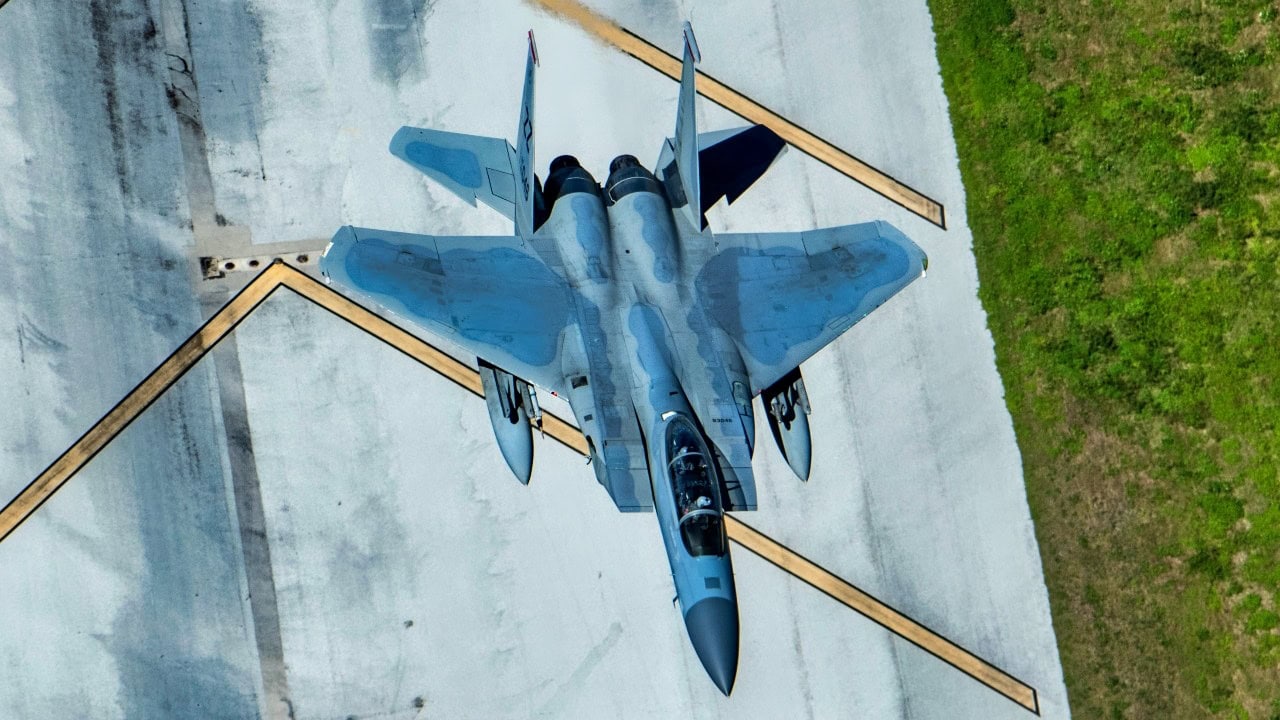
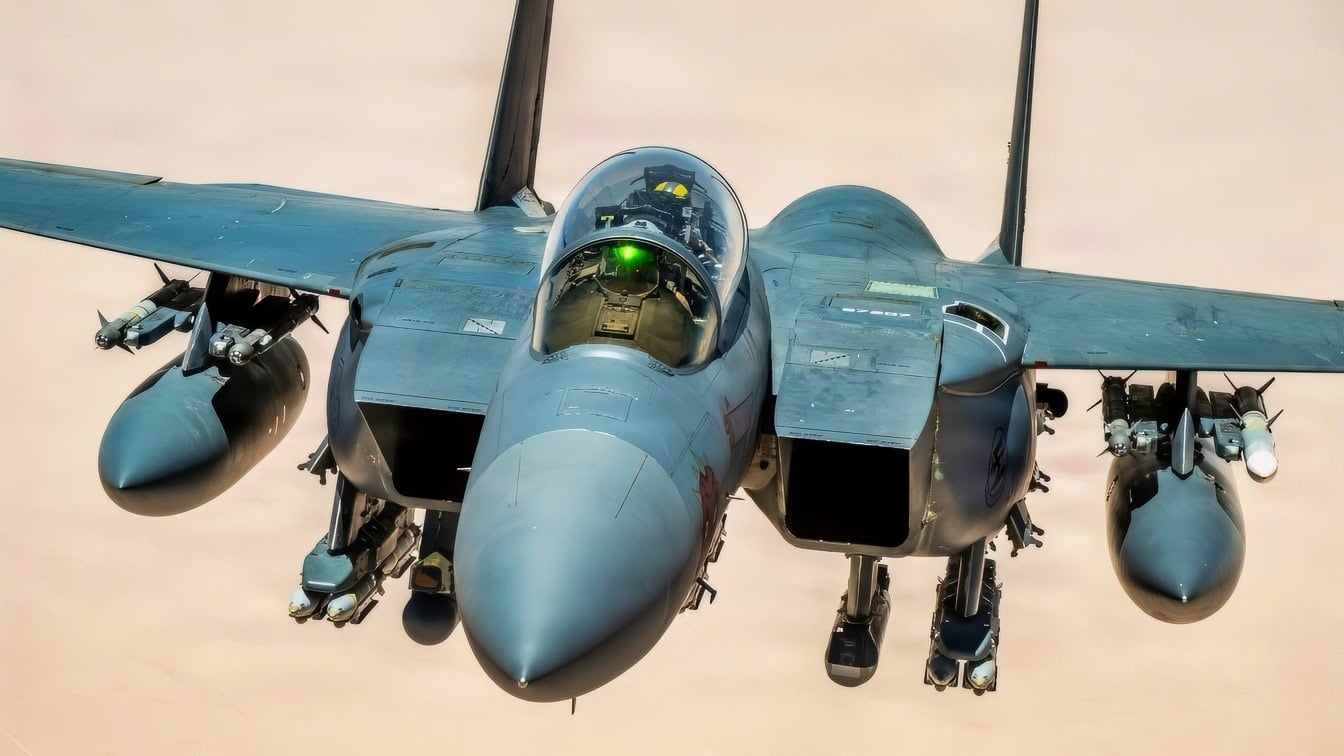
F-15E Strike Eagle

🇺🇸United States
The Boeing Company
1989 – Present
Spotlight

The USAF's dual-role deep-strike workhorse: CFTs, a WSO in back, 35+ years in combat

U.S. Air Force: The F-15E Strike Eagle POV (We are the Air Force)

Watch on YouTube
Overview
F-15E Strike Eagle
The F-15E Strike Eagle is an American all-weather multirole strike fighter derived from the McDonnell Douglas F-15 Eagle. It is designed for long-range, high-speed interdiction without relying on escort or electronic warfare aircraft.
Specifications

General

Crew2
Engines2
StealthNo
Range Km3,900 km
Internal BayNo
Max Payload Kg11,113 kg
Max Speed Mach2.5 Mach
Cruise MissilesAIM-9 Sidewinder, AIM-120 AMRAAM, AIM-7 Sparrow
Nuclear CapableYes
Combat Radius Km~1,270 km (est., mission-dependent)
Service Ceiling M18,288 m
Internal Gun20mm M61A1 rotary cannon
Max Speed Kmh2,655 km/h
Survivability FeaturesTEWS, Loral AN/ALR-56 Radar warning receivers, Northrop Grumman Electronic Systems ALQ-135 Internal Countermeasures System, Marconi AN/ALE-45 Chaff/Flares dispenser system

Other

RadarAN/APG-70 pulse-Doppler; fleet upgraded to AN/APG-82(V)1 AESA
Height5.64 m (18.5 ft)
Length19.45 m (63.8 ft)
Wingspan13.05 m (42.8 ft)
Powerplant2× Pratt & Whitney F100-PW-220 or F100-PW-229 afterburning turbofans, 25,000–29,000 lbf class each
Targeting PodsLANTIRN navigation/targeting suite; Sniper ATP and Litening on dedicated pylons
Max Takeoff Weight36,741 kg (81,000 lb)
Latest Developments
Sep 28, 2026strong signal
US, UK test SM-6, other missiles on SINKEX target frigate

Additional US and UK units involved in the exercise included the Royal Navy frigate HMS Portland, US Navy and Royal Air Force P-8 maritime patrol aircraft, and US Air Force F-15E Strike Eagles, among others.

Sep 25, 2026strong signal
Only 2 F-16XLs Were Ever Built — One Flew Alongside an SR-71 Blackbird to Help NASA Measure Sonic Booms

The F-15E was selected by the U.S. Air Force in 1984 for several significant reasons.

Aug 31, 2026strong signal
US Air Force chief of staff discusses ‘regional situation’ with Israeli military officials

Entity 'F-15E Strike Eagle' mentioned in report

Aug 21, 2026strong signal
A US Air Force F-15E Pilot Was Shot Down Twice in 30 Days: First by a Kuwaiti Fighter, Then by an Iranian Missile Deep Inside Iran

three U.S. Air Force F-15E Strike Eagles flying in support of the Kuwaiti defense were mistakenly shot down by a Kuwaiti F/A-18 Super Hornet in what U.S. Central Command later called a “friendly fire incident.”

Featured Coverage
Research Notes

Strike-focused Eagle with a two-crew cockpit

high

The F-15E turns the Eagle airframe into a long-range all-weather strike fighter while retaining serious air-to-air capability.

The F-15E Strike Eagle is not simply an F-15C with bombs. It is a two-seat, all-weather strike fighter derived from the Eagle family, pairing a pilot with a weapon systems officer and adding mission equipment for deep attack and precision strike.

The U.S. Air Force describes the F-15E as designed to perform air-to-ground missions while maintaining air-to-air capability. That dual role explains why the aircraft became a major U.S. strike platform even after stealth aircraft entered service.

For HiWars, this variant page should explain the difference between the F-15 air-superiority lineage and the Strike Eagle mission set. The parent F-15 page covers the family; the F-15E page should focus on deep strike, crew workload, sensors, conformal fuel, and precision weapons.

Range, payload, sensors, and precision attack

high

F-15E capability comes from combining a large fast airframe with conformal fuel, targeting systems, precision weapons, and crew division of labor.

The Strike Eagle uses the large F-15 airframe to carry fuel, sensors, and weapons for long-range attack. Its two-person crew lets one aviator fly and fight the aircraft while the other manages sensors, targeting, weapons, and navigation during complex strike missions.

This makes the F-15E especially useful in operations where range, payload, and repeated weapons employment matter. It can carry a large load compared with many fighters, but its survivability in high-end air-defense environments depends on tactics, electronic warfare, standoff weapons, and support from other aircraft.

A useful record should therefore avoid treating the F-15E as either obsolete or magical. It is a powerful non-stealth strike fighter whose value depends heavily on the surrounding force package and threat environment.

Strike Eagle in the F-15EX transition

high

The F-15E remains important because the broader Eagle fleet is being modernized while the F-15EX adds a new payload and avionics path.

The F-15E's role should be read alongside the continuing Eagle modernization story. Boeing's F-15EX page shows that the Eagle design remains relevant for payload-heavy missions, rapid weapons integration, and missions where stealth is not the only requirement.

That does not mean the F-15E and F-15EX are identical. F-15E records should track airframe age, radar and avionics upgrades, weapon clearances, squadron assignments, and how the Strike Eagle fleet is managed as newer aircraft enter service.

HiWars should connect this page to F-15EX, export Strike Eagle derivatives, and operations where F-15E aircraft carried much of the precision-strike burden.

Key parameters at a glance

high

Figures follow the official U.S. Air Force fact sheet; estimates are marked.

Role
Dual-role strike fighter (air-to-ground interdiction + air-to-air)
Crew
2 — pilot and Weapon Systems Officer (WSO)
Length
19.45m
Wingspan
13.05m
Max takeoff weight
36,741kg
Powerplant
2× P&W F100-PW-220/-229 afterburning turbofans
Max speed
Mach 2.5clean, at altitude
Conformal fuel tanks
2× CFTs, ~750 US gal fuel each plus tangential weapon stations
Radar
AN/APG-70, upgraded to AN/APG-82(V)1 AESA
USAF fleet
~218 aircraft (reported, 2024)

Program milestones

high

Publicly documented milestones of the dual-role F-15E variant.

1984-02Wins Dual-Role Fighter competition

The USAF selects the F-15E over the F-16XL in the Enhanced Tactical Fighter / Dual-Role Fighter program, choosing a two-seat Eagle derivative for deep interdiction.

1986-12First flight

The first production F-15E flies on 11 December 1986 from St. Louis, featuring strengthened structure, CFTs and a rear cockpit for a Weapon Systems Officer.

1988-04First delivery to the USAF

Deliveries begin to the 405th Tactical Training Wing at Luke AFB; Seymour Johnson AFB's 4th Wing becomes the first operational Strike Eagle wing.

1991-01Combat debut in Desert Storm

F-15Es fly night interdiction and Scud-hunting missions over Iraq using LANTIRN, establishing the type's all-weather precision-strike role.

2014AN/APG-82(V)1 AESA fielding

The Radar Modernization Program begins fielding the APG-82(V)1 AESA across the fleet, replacing the mechanically scanned APG-70.

2024-04Iranian drone shootdowns over the Middle East

On 13–14 April 2024, F-15Es from the 494th and 335th Fighter Squadrons down dozens of Iranian one-way attack drones launched at Israel, with crews even attempting LJDAM intercepts after expending missiles.

Strategic significance

medium

The F-15E converted an air-superiority airframe into the U.S. Air Force's principal long-range interdictor. Its defining variant features — conformal fuel tanks with tangential weapon stations, a second cockpit for a Weapon Systems Officer, terrain-following radar and the LANTIRN (later Sniper/Litening) targeting suite — let it strike deep at night in all weather without dedicated escort. Since 1991 it has carried a disproportionate share of USAF strike sorties, from Desert Storm through Afghanistan, Iraq and Syria, while remaining one of the few U.S. dual-capable aircraft associated with the B61 nuclear gravity bomb.

The April 2024 defense of Israel underscored the dual-role design's continuing relevance: two Strike Eagle squadrons downed dozens of Iranian one-way attack drones with AIM-9 and AIM-120 missiles, and crews improvised laser-guided-bomb intercepts after emptying their missile rails. The episode demonstrated the airframe's flexibility against emerging low-end threats, but also highlighted magazine-depth limits that any non-stealthy fighter faces in saturation attacks.

Looking ahead, the roughly 218-strong fleet sits at the center of a force-structure debate. AESA radar and the EPAWSS electronic-warfare upgrade keep newer -229-engined jets credible, yet the Air Force has proposed retiring older aircraft as the F-15EX enters service. Against modern integrated air defenses the F-15E would likely operate from standoff range or in permissive airspace; compared with stealthy strike platforms it trades survivability in contested environments for payload, range and a proven two-crew weapons workflow.

Videos

US Air Force F-15E Strike Eagle, a Pilot Tour (Jamie Hunter – Aviacom)

Watch on YouTube

F-15E: Over 11 Tonnes of Ordnance Across the Wing Stations (军武大帝频道)

Watch on Bilibili
Sources & References
Related Discussions

No discussions about F-15E Strike Eagle yet

Start the first discussion