
052D-class destroyer conducts live-fire exercises 180 kilometers off Okinotorishima, new burden for maritime surveillance in 2026
 Tanaka Takashi
052D Class Destroyer Conducts Live-Fire Exercise 180 Kilometers Off Okinotorishima, New Burden for Maritime Surveillance in 2026
[Tokyo] Another troublesome point has been added to the Japan Maritime Self-Defense Force's surveillance line. According to reports from the AP and announcements from the Japanese side, on July 20, a Type 052D missile destroyer of the Chinese Navy, specifically a Luyang III class, conducted live-fire exercises in waters approximately 180 kilometers southwest of Okinotorishima. This is reportedly the first time Japan has publicly confirmed live-fire exercises by Chinese vessels within its exclusive economic zone.
Firing Conducted Among a Four-Ship Formation
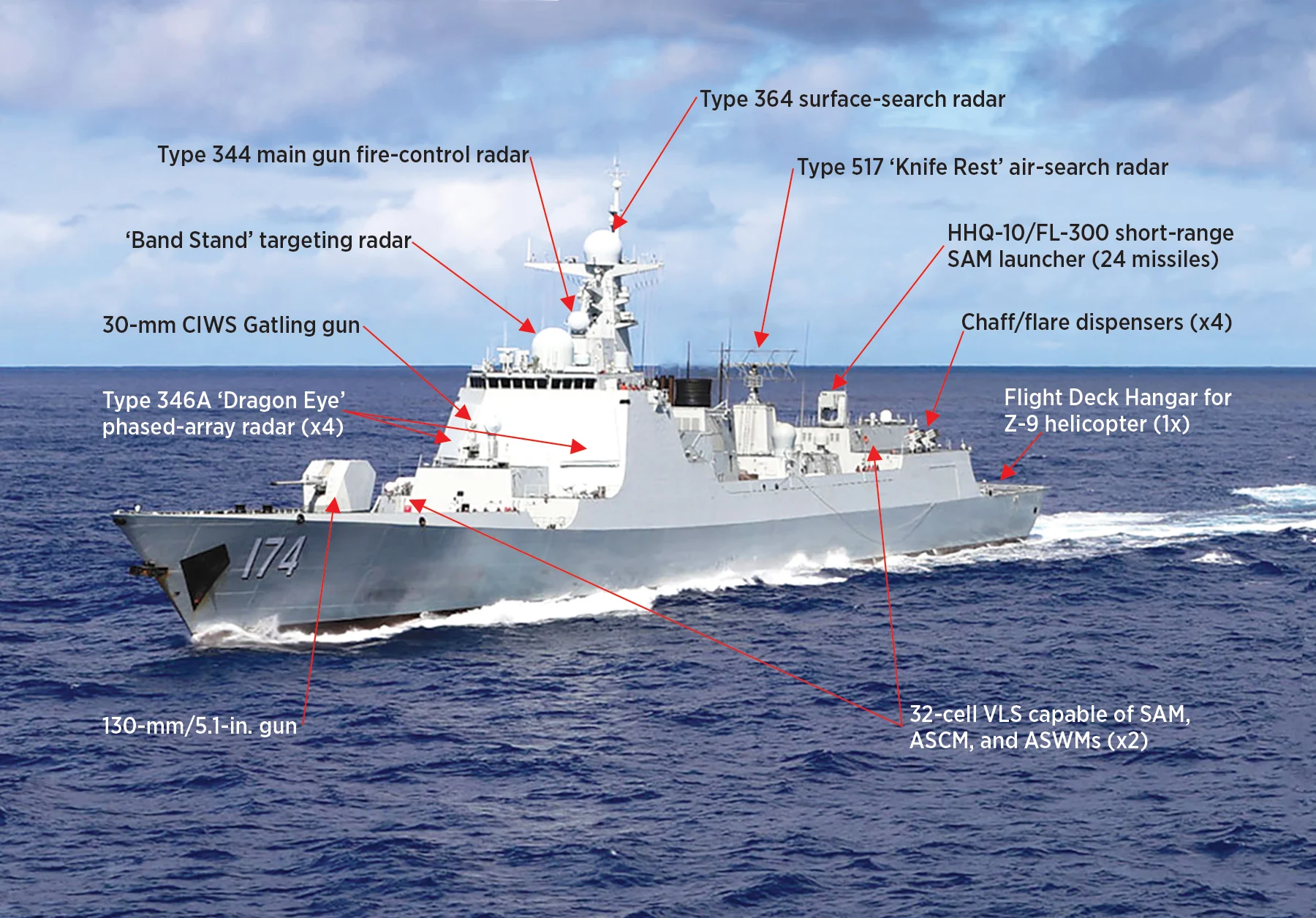
Importantly, this was not an independent action. The Japanese Joint Staff Office explained that the vessel was operating alongside two other Chinese ships and one Russian Navy frigate. The formation is said to have previously moved south between Okinawa and Miyako Islands, and after passing through the first island chain, conducted the firing in the Philippine Sea.
The Type 052D is the main air defense destroyer of the Chinese Navy, generally equipped with a 64-cell vertical launch system, a 130mm main gun, and phased array radar. It is unclear at this stage of reporting whether the firing involved the main gun or missiles. However, since the fleet reportedly issued a navigational safety warning just prior, it should be viewed as a pre-planned training exercise.
Operational Burden More Concerning Than Legal Protests
Military training in exclusive economic zones cannot be immediately deemed illegal under international law. The Japanese government is aware of this, and thus conveyed its concerns to the Chinese side primarily as safety issues for nearby vessels. However, from a military operational perspective, the real issue is not whether it is legal or illegal, but how much burden it places on routine surveillance and monitoring.
Okinotorishima is an uninhabited atoll, and China has long maintained a position of not recognizing the island as a baseline for its exclusive economic zone. Chinese Foreign Ministry spokesperson Lin Jian also countered that Japan's concerns are unfounded. In other words, this live-fire exercise serves not only as a naval training but also has the character of militarily visualizing legal claims surrounding Okinotorishima.
Qualitative Change in Sino-Russian Cooperation
Defense Minister Shinjiro Koizumi highlighted this action as indicative of deepening military cooperation between China and Russia in a speech in the UK. According to reports, after completing joint exercises on July 13, some vessels continued joint cruising in the Pacific. The fact that actions involving firing remained after the exercises cannot be overlooked.
During the Cold War, the Soviet Navy was clearly a target for surveillance around Japan. While current Sino-Russian cooperation is not as integrated, there are different challenges for the Japan Maritime Self-Defense Force. Chinese vessels are increasing their frequency of operations from the Nansei Islands into the western Pacific, coinciding with joint actions involving Russian ships and bombers. The resources for monitoring, including escort ships, P-1 patrol aircraft, and land-based radar, are not infinite.
Implications for SLOC Defense
The area around Okinotorishima may appear as a small point on a map to the general reader. However, from the perspective of maritime traffic routes, or SLOC, it is part of the surveillance space connecting Guam, the Philippine Sea, and the Nansei Islands. If live-fire exercises become routine here, there will be an increase in navigational warnings for civilian vessels, decisions for aircraft to reroute, and the Japan Maritime Self-Defense Force's information-gathering missions will also increase.
In my view, the essence of this situation is not that the Chinese Navy fired a shot. It lies in the fact that, outside the island defense emphasized by the Japan-U.S. alliance, specifically to the southeast of the Nansei Islands, the adversary has begun to mix "training" with "assertion." While not as conspicuous as territorial intrusions, such gray burdens accumulate.
The true challenge is not merely the legal dispute over whether Okinotorishima is an island or a rock. It is how much the Japan Maritime Self-Defense Force can absorb the risk of live-fire training across the entire western Pacific while maintaining its peacetime surveillance system.
Major Information Sources
- AP news report, July 21, 2026, live-fire exercise by Chinese 052D destroyer off Okinotorishima
- Reported movements of vessels as announced by the Japanese Joint Staff Office, passing between Okinawa and Miyako and firing approximately 180 kilometers southwest of Okinotorishima
- Counterarguments regarding Sino-Russian military cooperation reported from statements by the Chinese Foreign Ministry and the Ministry of National Defense
On July 20, 2026, a Chinese 052D-class destroyer conducted live-fire exercises 180 km southwest of Okinotorishima, involving a formation of four ships, including two other Chinese vessels and a Russian frigate. This marks the first confirmed instance of such exercises within Japan's exclusive economic zone, raising concerns about maritime security and regional military dynamics.
- A Chinese 052D-class destroyer conducted live-fire exercises 180 km southwest of Okinotorishima.
- The exercise involved a formation of four ships, including two other Chinese vessels and a Russian frigate.
- This is the first confirmed instance of live-fire exercises by Chinese ships within Japan's exclusive economic zone.
- The exercise was reportedly pre-planned and included safety notifications to nearby vessels.
- The event highlights increasing military cooperation between China and Russia.