
136 ships in ten days — Ukrainian sea drones are breaking Russian logistics
 Dmitri Volkov
136 ships in ten days — Ukrainian naval drones are breaking Russian logistics
One hundred thirty-six ships in ten days — a figure that would be considered a statistical error by port inspection in peacetime. In war, this is no longer an error, but a symptom. The commander of the Ukrainian Unmanned Systems Forces, Robert "Madyar" Brovdi, stated on July 15 that from July 6 to July 15, 136 ships of the Russian "shadow fleet" were hit: 116 in the Sea of Azov and another 20 in the Black Sea, including 17 oil tankers, two gas carriers, and one tugboat (Ukrinform, July 15, 2026). Even if some of Kyiv's phrasing requires the usual military discount for propaganda presentation, the scale of the phenomenon can no longer be explained by a few successful raids.
The naval war has shifted from a symbolic phase to a logistical one
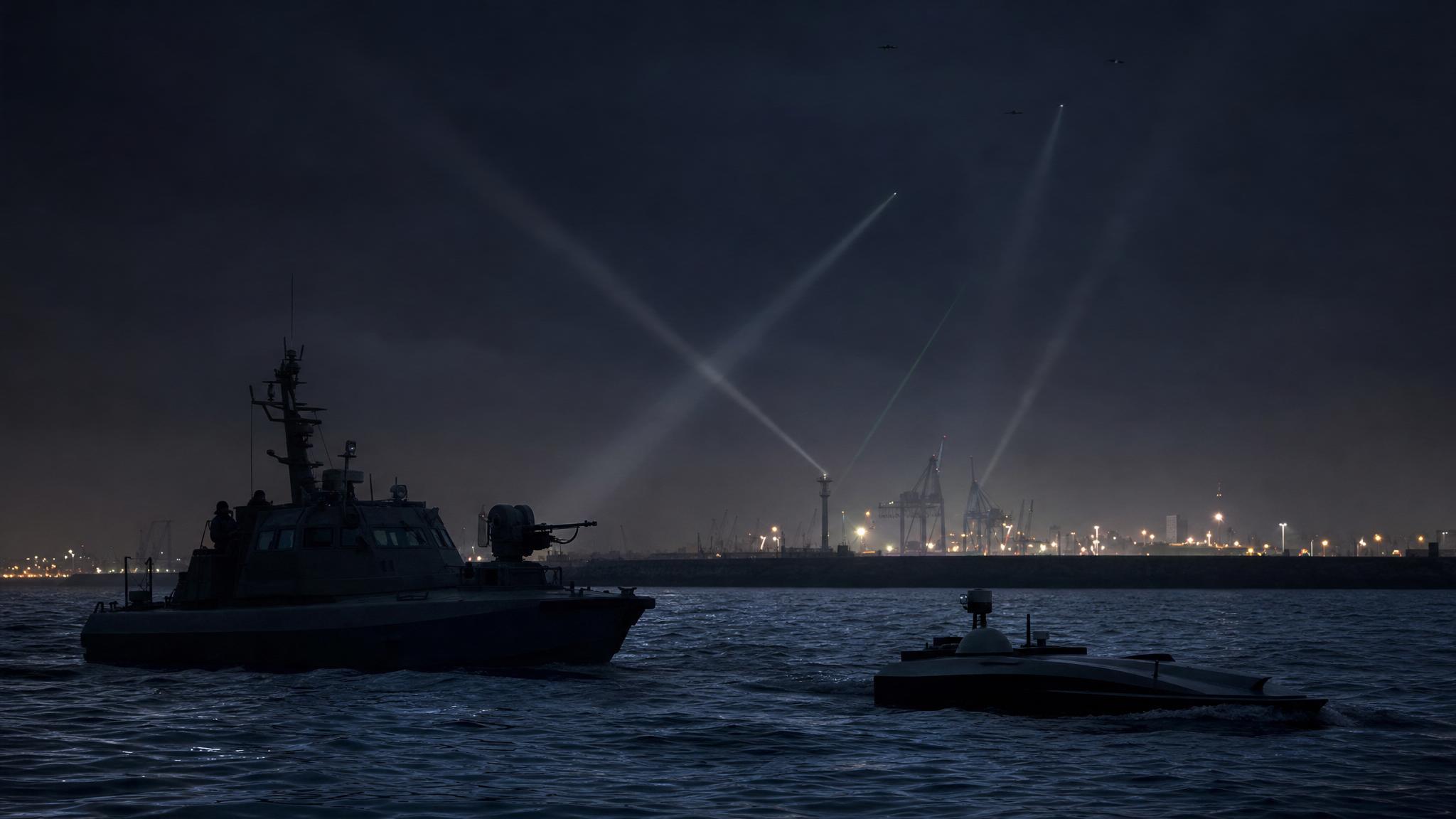
Until recently, Ukrainian naval drones were primarily perceived as a means of demonstrating the defeat of ships from the Black Sea Fleet: an attack on a base, an explosion alongside a ship, impressive video footage. In other words, as a weapon of political shock. The July series of strikes shows a different stage. The targets are not only combat units but also the logistical fabric of war — tankers, gas carriers, tugs, auxiliary vessels, commercial routes that service the Russian military economy and occupied territories. In the old Soviet dictionary, this would be called fighting the operational rear of the enemy. Only now, this task is performed not by a squadron, but by a cheap distributed swarm of maritime and aerial platforms.
Geography is particularly important. The Sea of Azov, after 2022, was often described in Moscow as an "internal water body," an almost closed strategic basin under Russian control. This confidence was based on two assumptions: the dominance of coastal infrastructure and the ability to cover shipping from Crimea, Novorossiysk, the Rostov direction, and the occupied coast. The Ukrainian campaign undermines this very perception. If, in such a space, 116 ships are reported hit in ten days, then the problem lies not in one weak point of defense, but in the inability to build a continuous system for detecting, tracking, and destroying small targets.
“Barracuda” and the new tactic of linking maritime and aerial drones
The episode of the Ukrainian fleet's use of the maritime drone "Barracuda" deserves attention not because of the explosion itself. According to the Ukrainian side, the unmanned boat stealthily approached an abandoned vessel where Russian units had set up an observation post, after which it used a module of unguided rockets against coastal shelters. Then, the carrier platform of the UAV was activated, launching reconnaissance and FPV drones to clarify and strike camouflaged positions (Ukrinform, July 14, 2026).
This is no longer a classic "kamikaze boat." It is a small maritime node of the reconnaissance-strike contour. Its value lies not only in its combat component but in the fact that it brings sensors and small strike assets to where the enemy is accustomed to thinking in terms of the coastline, mine barriers, and patrol boats. The Russian school of naval defense is traditionally strong in missile-artillery lockdown of the water area but weaker in dealing with mass cheap targets that change trajectories faster than the headquarters can issue combat orders. In this sense, the Black Sea has become a laboratory for the same process that has long been visible on land in Donbas: an expensive asset is defeated by a cheap one, and then the cheap one itself becomes part of a more complex network.
The Russian response appears powerful but asymmetric
Russia responds with the usual set: missile and drone strikes on Ukrainian cities, ports, and infrastructure. On the night of July 15, Russia launched two Kh-59/69 missiles and 122 drones of types Shahed, Gerbera, Italmas, and "Parody"; the Ukrainian side reported the neutralization of 101 drones, while hits from missiles and 18 UAVs were recorded in 19 locations (Ukrinform, July 15, 2026). On the front line during the same period, the Ukrainian General Staff reported 253 combat engagements, 79 airstrikes, 250 guided bombs, and more than 10,000 uses of kamikaze drones in a single day. These figures demonstrate the intensity of the Russian machine of violence but do not answer the main naval question: how to protect logistics when the enemy strikes not at a single flagship but at the entire system of fuel and cargo circulation?
Here, a structural difference emerges. The Russian army knows how to increase fire pressure — sometimes monstrously wastefully, but consistently. It is much worse at solving the tasks of adaptive defense of distributed objects: ships, terminals, oil depots, transshipment points, repair sites. This requires not only air defense systems and machine guns at the docks but a unified network of surveillance, rapid data exchange between civilian port services, the FSB, the navy, the National Guard, and regional authorities, as well as discipline in execution. It is precisely in these inter-agency seams that the Russian system traditionally loses time. In the Soviet army, this was compensated by mass and verticality; in modern Russia, the vertical remains, but the mass is often simulated by reporting.
The Russian problem is not that a naval drone cannot be shot down. It can be shot down. The problem is that the organizational deficit cannot be eliminated by a minister of defense's order.
Fuel becomes an operational vulnerability
Strikes on ships coincide with a broader Ukrainian campaign against Russian oil refineries, terminals, and supply routes. The Independent reported on July 15 that Russia is considering redirecting cargo from the Sea of Azov due to the increasing frequency of Ukrainian attacks, and also noted fires at facilities in Bashkortostan and Krasnodar Krai following Ukrainian strikes. Al Jazeera previously linked strikes on oil infrastructure to fuel shortages in Crimea and pressure on Russian consumer markets. In a military economy, such things rarely work instantly. A tank brigade does not stop the day after an attack on a tanker. But after weeks and months, the costs of delivery, insurance, security, and repairs begin to turn into an additional tax on war.
For Russia, this is more unpleasant than losing a single large ship. A ship can be turned into a myth, the dead can be honored, and details can be concealed. Logistic erosion is harder to hide: it manifests in queues, disruptions, rising prices, changes in routes, and the need to divert forces to protect what was previously considered the rear. The war gradually consumes the distance between the front and the economy. The Ukrainian bet is clear: if it is impossible to quickly break through the land defense, it is necessary to make the Russian retention of space more expensive at every kilometer — from the Pokrovsk direction to the raid of a tanker in the Sea of Azov.
What comes next
The likely Russian response will be threefold. First, an increase in physical security for ports and ships — network barriers, patrol boats, fire points, and a stricter movement regime. Second, administrative pressure on shipowners and captains to maintain the appearance of normal shipping. Third, retaliatory strikes on Ukrainian ports, drone production facilities, and energy infrastructure. All of this is already familiar and partially effective. But none of these responses addresses the main problem: Ukraine has imposed a low-cost naval war on Russia, where the defender pays more than the attacker.
My cautious prediction is as follows: in the coming weeks, Moscow will manage to reduce the number of successful hits by concentrating security on key routes, but it will not restore the previous freedom of movement in the Azov-Black Sea basin. The Russian military machine will retain the ability to strike at Ukraine with missiles, bombs, and drones. However, its rear confidence will diminish. For a state that loves to talk about the depth of strategic space, this is particularly ironic: there is depth, but safe rear areas are becoming increasingly scarce.
Ukrainian naval drones targeted 136 Russian vessels between July 6 and 15, 2026, disrupting logistics in the Azov and Black Seas. This operation included attacks on oil tankers and gas carriers, indicating a shift in Ukrainian tactics to undermine Russian supply lines. In response, Russia is contemplating changes to its cargo routes due to the increased frequency of these attacks.
- 136 Russian vessels were targeted by Ukrainian naval drones from July 6 to 15, 2026.
- 116 vessels were hit in the Azov Sea and 20 in the Black Sea.
- The attacks included oil tankers, gas carriers, and tugboats.
- Ukrainian tactics have evolved to target logistical support rather than just military units.
- Russia is reportedly considering redirecting cargo due to increased Ukrainian attacks.