
15 PLA Military Aircraft Cross the Taiwan Strait Median Line, 2026 Gray Zone Operations Shift to Normalized Attrition
 Li Minghui
15 PLA Aircraft Cross the Taiwan Strait Median Line, 2026 Gray Zone Operations Shift to Normalized Attrition
From 6:00 AM on September 15 to 6:00 AM on September 16, Taiwan's defense department reported the detection of 15 PLA military aircraft, 8 PLA naval vessels, and 2 civilian ships around the Taiwan Strait, with 12 of the aircraft crossing the median line of the Taiwan Strait and entering Taiwan's northern, southwestern, and eastern airspace. The Taiwanese side dispatched fighter jets, warships, and shore-based missile systems for monitoring. While the single-day figure is not the highest in recent times, the ratio is quite interesting—12 out of 15 aircraft crossed the line, indicating a shift in focus from "whether there is activity" to "how the activity is organized."
What Do 12 Crossings Indicate?
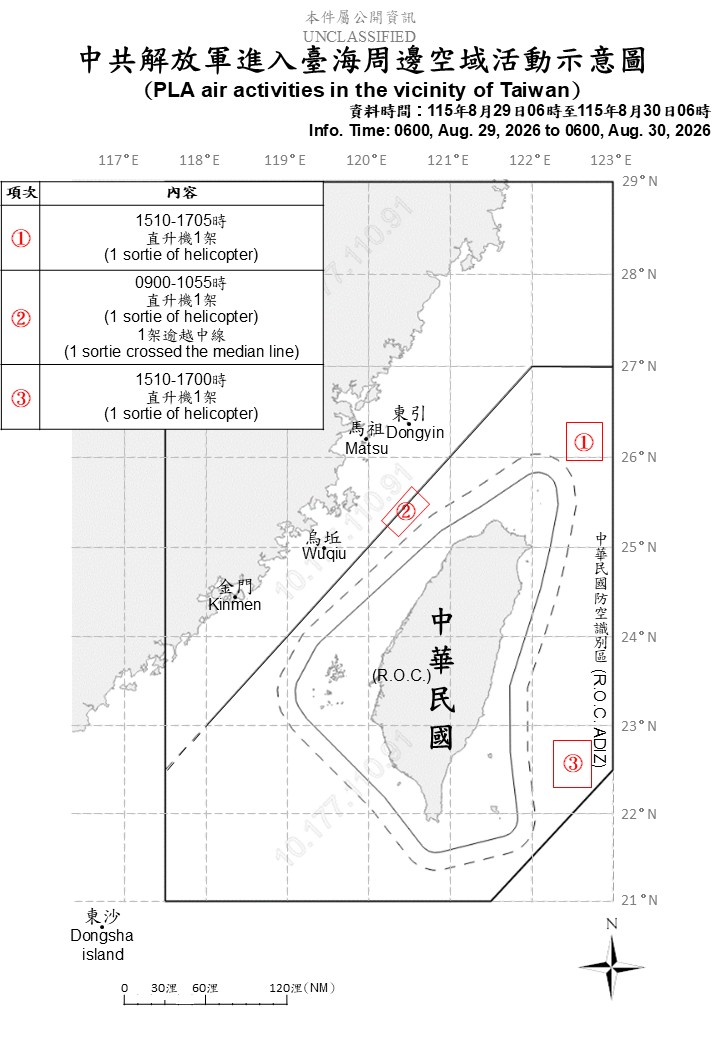
The diagram released by Taiwan's defense department on September 16 shows that the related activities covered the northern, southwestern, and eastern directions. The public report did not disclose the types of aircraft, so this batch cannot simply be equated to J-16 or J-10 formations, nor can it be inferred that complete aerial assault training has occurred. What can be confirmed is that the distribution of airspace crossings has become part of pressure design: the PLA does not need to deploy large formations every time; it can force Taiwan to maintain continuous alert and identification through different directions and time windows.
Taiwan's Taiwan News previously cited data from Taiwan's defense department stating that similar activities had occurred multiple times in early September, with 18 aircraft, 8 warships, and 1 civilian ship recorded on September 10, of which 13 crossed the median line. When comparing the 15 aircraft on September 16 with previous data, the numbers fluctuate, but the pattern of air-sea coordination and accompanying civilian ships has not disappeared. This is a typical gray zone operation: it does not cross the threshold for war but continuously alters the opponent's daily operational costs.
The Real Attrition is on the Ground and in Logistics
For Taiwan, the most direct pressure is not where a particular aircraft flies, but the need to maintain high levels of early warning, combat readiness, fuel supply, pilot rotation, and shore-based radar over the long term. Each time Taiwan dispatches fighter jets in response, it incurs costs far exceeding those of a single drone or civilian ship patrol. If the PLA layers the use of manned aircraft, warships, and civilian ships, it can turn "deterrence display" into a low-intensity but sustained resource exchange.
From the perspective of PLA construction, such actions are also testing the joint operational system. Military aircraft activities need to maintain basic synchronization with naval vessels, shore-based sensors, and command chains, while civilian ships undertake a lower-risk forward presence. Public data cannot prove that each activity has the same operational intent, but long-term repetition itself is training: pilots become familiar with flight routes, commanders accumulate samples of Taiwan's responses, and logistics departments obtain real consumption curves from high-frequency deployments.
Do Not Interpret Every Crossing as a Signal of Imminent Conflict
My judgment is that the activity on September 16 resembles institutionalized pressure rather than mobilization for imminent conflict. The report from Taiwan's defense department only provided the number of aircraft and general airspace, without disclosing aircraft types, weapon loadouts, or formation tasks; in the absence of this information, directly interpreting the 12 aircraft crossings as "blockade rehearsals" is not rigorous. On the contrary, it is more noteworthy that such actions have become sufficiently normalized that a decrease in daily numbers will not lead Taiwan to lower its alertness.
When the U.S. and its allies discuss risks in the Taiwan Strait, they often focus on aircraft carriers, long-range missiles, and large-scale exercises. However, for the PLA, a more tedious question that truly tests modernization is whether it can sustain such multi-directional patrols for months or even years without overextending pilots, engines, and maintenance systems. If the answer is affirmative, the way the military balance in the Taiwan Strait changes may not be through a sudden crisis, but rather Taiwan being forced to pay increasingly higher air defense bills over the long term.
Sources and Information Boundaries
- The activity report from Taiwan's defense department on September 16, reprinted by GlobalSecurity.org, recorded 15 military aircraft, 8 warships, and 2 civilian ships.
- Taiwan News reported on September 10, supplementing with data on 18 military aircraft and crossings of the median line in early September.
- This article does not make definitive judgments on the specific aircraft types, weapon loadouts, and task formations that have not been disclosed.
What is truly worth tracking is not how many aircraft will appear next time, but whether the PLA can turn such low-intensity, high-frequency actions into a sustainable industrial process.
Fifteen People's Liberation Army aircraft and eight naval vessels were detected near Taiwan, with twelve aircraft crossing the median line of the Taiwan Strait between September 15 and 16, 2026. This operation reflects a shift towards normalized gray zone tactics, increasing pressure on Taiwan's defense forces. The Taiwanese military responded by deploying fighter jets and naval vessels to monitor the situation, indicating a sustained operational challenge.
- 15 PLA aircraft and 8 naval vessels were detected near Taiwan.
- 12 aircraft crossed the median line of the Taiwan Strait.
- The operations are part of a pattern of gray zone tactics by the PLA.
- Taiwan's defense forces responded with fighter jets and naval vessels.
- The activities are designed to increase Taiwan's operational costs.