
2026 GJ-11 Stealth Drone Reveals New Images, PLA Reconnaissance-Strike Integrated Capability Enters Internal Payload Verification Stage
 Li Minghui
New Images of the GJ-11 Stealth Drone Released in 2026, PLA's Reconnaissance-Strike Capability Enters Internal Payload Verification Stage
On November 9, the South China Morning Post noted that Chinese state media released a set of new images of the GJ-11 "Sharp Sword" stealth drone. The most noteworthy aspect of the images is not the aircraft's exterior shape, but the visible details of the weapon bay on the underside of the aircraft. For a flying-wing drone that has long remained in the testing and demonstration phase, the disclosure of the bay doors, mounting positions, and mission equipment indicates that what is now being observed is not just "can it fly," but "can it carry mission payloads to complete combat cycles."
What Do the New Images Reveal?
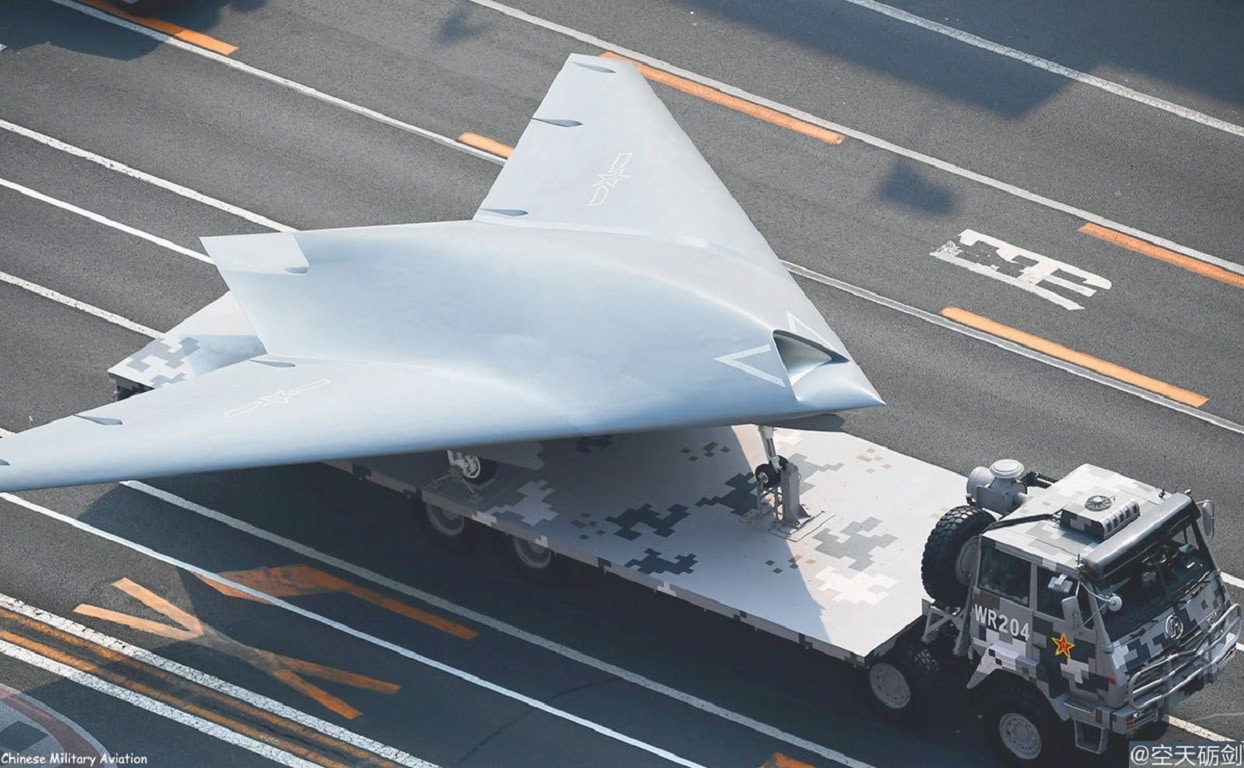
The GJ-11 adopts a tailless flying-wing layout, with its core value lying in reducing radar and infrared signatures, and exchanging a larger airframe volume for range, fuel, and mission equipment space. Publicly available information has not confirmed its maximum takeoff weight, engine model, or actual range; the numbers circulating online cannot be taken as definitive. However, from the images, it can be inferred that the underside bay at least reserves space for internal munitions or reconnaissance equipment, which is a different matter from ordinary remote-controlled target drones or purely technical demonstrators.
It is important to maintain restraint here: a promotional image cannot prove that the GJ-11 has achieved combat readiness, nor can it demonstrate that it possesses the same level of sensor fusion as manned fighter jets. What it can prove is that China's aviation industry is moving stealth drones from being "flight platforms" to "mission platforms."
Why Does the PLA Need Such a Platform?
For the PLA, the significance of the GJ-11 is not merely the addition of another drone. Manned stealth fighters like the J-20 undertake air superiority, long-range interception, and high-value target strike missions, with numbers and pilot training always constrained by costs; stealth drones can take on high-risk roles such as forward reconnaissance, electronic support, decoying, and limited strikes. In the Taiwan Strait or the direction of the first island chain, allowing unmanned platforms to enter the adversary's defense zone can delay the exposure of manned aircraft to a later stage.
More importantly, there is the issue of system integration. For the GJ-11 to be truly useful, it must be integrated with space-based communications, early warning aircraft, ground command stations, and manned aircraft formations, rather than executing a pre-set flight path in isolation. Its value is akin to adding a consumable sensor node to the aerial combat network. The challenge lies in anti-jamming communications, autonomous decision-making in case of loss of connection, and cross-platform target allocation, which are precisely the aspects that the public images cannot address.
How Far Is It from Demonstration to Mass Production?
Li Minghui believes that assessing the progress of the GJ-11 should not only focus on whether new videos appear, but should also observe three signals: whether there are continuous batches of airframes and ground support equipment, whether there are public traces of airport operations or troop training, and whether tests related to weapons, data links, and manned aircraft coordination can be seen. The challenge with drones has never been just to produce a prototype, but to ensure it can be stably maintained, rapidly deployed, and maintain communication in high-intensity environments.
China's military industry has advantages in the large-scale production capabilities of unmanned aerial vehicles and aviation manufacturing, but there may still be shortcomings in engine performance, the lifespan of low-observable materials, and software reliability. In simple terms, producing a flying wing does not equate to creating a fleet of "loyal wingman" drones. If the GJ-11 continues to appear only as a demonstrator, it indicates that the project is still in capability validation; if it appears alongside weapon bays, ground stations, and production hangars, it may signify that the PLA is beginning to establish new aerial combat units.
The Next Detail Worth Tracking
The South China Morning Post reported this set of images around the anniversary of the establishment of the PLA Air Force, and the timing itself carries promotional significance, but promotion does not equate to fabrication; the key is to distinguish between "what is disclosed" and "what has not yet been disclosed." Currently, there is no reliable evidence to prove that the GJ-11 has been deployed to frontline units, nor is there evidence showing that it has completed operational weapon delivery.
Main sources: South China Morning Post, November 9, 2026 report on new images and weapon bays of the GJ-11; daily public data on PLA activities in the Taiwan Strait released by Taiwan's defense department; corresponding GJ-11 images from the HiWars asset library, source report ID 19775. The above materials provide cross-references for the model and images, while specific performance parameters remain to be confirmed.
What is truly worth paying attention to is not how much this image presentation has shown, but whether the next public release will feature munitions separation, manned aircraft coordination, or batch support vehicles—that would mark the watershed moment for the GJ-11 transitioning from a testing project to a combat system.
The GJ-11 stealth drone has entered the internal payload verification stage, as reported by Chinese state media on November 9, 2026. This development indicates a transition from testing to operational capability for the People's Liberation Army (PLA). The drone is designed to enhance reconnaissance and strike capabilities while integrating into a broader military network. However, there is currently no evidence of its deployment to frontline units or completion of operational weapon delivery.
- The GJ-11 stealth drone has been publicly showcased with visible details of its weapon bay.
- The drone is designed to reduce radar and infrared signatures while increasing operational range and payload capacity.
- The PLA aims to integrate the GJ-11 into a broader military network for enhanced operational capabilities.
- There is no confirmed evidence that the GJ-11 has been deployed to frontline units or completed operational weapon delivery.