
2026 PLA Air Activities in the Taiwan Strait Decrease by 51% as China's Coast Guard Moves East, Reshaping Gray Zone Pressure
 Li Minghui
2026 PLA Activities in the Taiwan Strait Decrease by 51% as Chinese Coast Guard Moves East, Reshaping Gray Zone Pressure
[Taiwan Strait Observation] One of the most easily misinterpreted numbers regarding the Taiwan Strait this year is not how much the PLA's aircraft activities have increased, but rather that they are decreasing. A recent special report from the Asia Society's China Analysis Center, titled "PLA Watch," indicates that from January 1 to August 19, 2026, Taiwan recorded 1,763 PLA aircraft sorties, a decrease of 51.1% compared to 3,603 sorties during the same period in 2025. Meanwhile, the number of official Chinese mainland vessels recorded by Taiwan rose from 183 to 457, an increase of 149.7%. This does not indicate a disappearance of pressure, but rather a shift in the tools used to exert it.
From High-Frequency Aircraft Deployments to Regular Coast Guard Presence
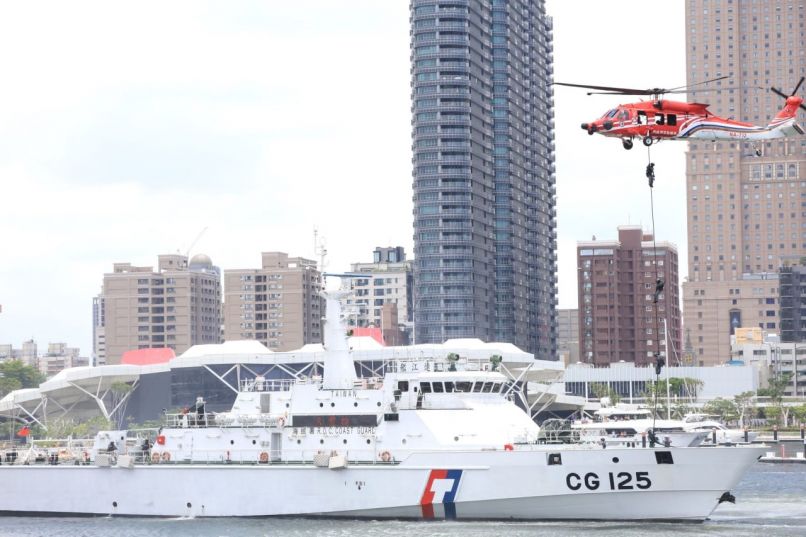
The CG125 in this image is a Taiwan Coast Guard vessel, not a Chinese Coast Guard ship, but it aptly illustrates the new scenario in the Taiwan Strait game: Coast Guard and maritime patrol forces are becoming the frontline. The report shows that the activity of official mainland vessels recorded by Taiwan significantly accelerated after June, averaging about 3.9 vessels per day, compared to only about 0.9 vessels from January to May. The focus of activities has also expanded from the areas around Kinmen, Matsu, Dongsha, and Taiping Island to the waters east of Taiwan.
Interestingly, the nature of aircraft activities has not changed significantly. In both 2025 and 2026, the proportion of aircraft crossing the median line of the Strait or entering Taiwan's Air Defense Identification Zone was about 71.3%. This means that the PLA is not using fewer sorties to conduct more aggressive single operations, but rather is reducing the overall frequency of air activities while allowing the Coast Guard to take on more sustained presence tasks.
Strategic Calculations Behind the Numbers
From a combat perspective, deploying aircraft consumes flight hours, maintenance resources, and pilot training cycles; Coast Guard vessels can maintain a longer on-site presence at a lower cost. As long as Chinese Coast Guard vessels operate under the guise of law enforcement patrols, they can package military pressure as administrative jurisdiction disputes, forcing Taiwan's Coast Guard, Navy, and civilian vessels to continuously respond at the edge of the rules. In simple terms, this is about using a cheaper, more durable system to provoke a more expensive response from the other side.
However, I do not agree with simplifying this to a mere transfer of pressure from aircraft to the sea. The report also points out that of the 1,840 fewer aircraft sorties, only a small portion can be offset by the newly added official vessels; when adding up aircraft, PLA Navy vessels, and official ships, the total observed activity actually decreased by about 30%. Therefore, a more accurate assessment is that the composition, geographical location, and legal attributes of the pressure are changing, rather than a simultaneous increase in total activities in the Taiwan Strait.
Why the Eastern Waters Are Worth Monitoring
The eastern waters of Taiwan have traditionally been viewed as a relatively safe strategic rear, facing the western Pacific and external support directions. The expansion of Chinese Coast Guard fleets to the east is primarily testing the response speed and sustained law enforcement capabilities of Taiwan's Coast Guard, and secondly, bringing the narrative of so-called Chinese jurisdiction into the eastern waters of Taiwan. On July 4, the Chinese side used the term "normalized law enforcement patrols," which is not just a common propaganda slogan but is seeking administrative and legal packaging for sustained presence.
This raises a practical issue: if Taiwan responds with naval vessels, it could easily be portrayed by Beijing as a militarization escalation; if only Coast Guard vessels handle the situation, they may face pressure in terms of tonnage, quantity, and sustained deployment capabilities. If the U.S. and Japan intervene to provide intelligence support, they must also confront the gray area where Coast Guard actions fall below the threshold of armed conflict.
The Real Bottleneck Is Not Whether Ships Can Be Built
The expansion of the Chinese Coast Guard is not mysterious; the key lies in whether it can maintain rotation, supply, maintenance, and command chains over the long term. The construction speed of large Coast Guard vessels is no longer the main shortcoming; the real difficulty is integrating the information chains of the Coast Guard, maritime affairs, fisheries administration, and the PLA Navy, while maintaining clear boundaries of authority during a crisis. If law enforcement vessels increasingly approach Taiwan's eastern side without stable intelligence and logistical support, they may merely be high-profile patrols rather than mature blockade tools.
Therefore, what needs to be observed next is not whether a few Coast Guard vessels appear on a certain day, but whether these fleets can establish fixed routes, handover mechanisms, and inter-departmental coordination. The data from 2026 has already indicated a direction: Beijing is reducing some high-visibility aerial consumption and shifting more pressure into maritime administrative actions. The real unanswered question is whether Taiwan and external support forces can prevent this "normalization" from ultimately becoming a fait accompli without escalating Coast Guard friction into military conflict.
References
- Asia Society Center for China Analysis, "PLA Watch Special Issue," 2026
- Taiwan Ministry of National Defense Daily Taiwan Strait Dynamics Report, January to August 2026
- South China Morning Post Military Special Page, November 2026
The People's Liberation Army (PLA) reduced its aircraft activity in the Taiwan Strait by 51.1% from January 1 to August 19, 2026, while the Chinese Coast Guard increased its presence significantly. The number of Chinese vessels operating in the area rose from 183 to 457, indicating a strategic shift towards maritime enforcement. This change poses new challenges for Taiwan's maritime response capabilities without escalating tensions into military conflict.
- PLA aircraft activity decreased by 51.1% from 2025 to 2026
- Chinese Coast Guard vessel activity increased by 149.7%
- PLA aircraft crossing the median line remains consistent at 71.3%
- Chinese Coast Guard operations are expanding into Taiwan's eastern waters
- Taiwan faces challenges in responding to increased maritime pressure without escalating military conflict.