
2026 PLA Sichuan Ship First Tests GJ-21 Drone, Type 076 Amphibious Assault Ship Shifts to Unmanned Combat

2026 PLA Sichuan Ship Conducts First Test of GJ-21 Drone, Type 076 Amphibious Assault Ship Shifts to Unmanned Operations
From October 30 to 31, multiple media outlets reported that the PLA Navy's Sichuan ship completed onboard takeoff and landing tests of the GJ-21 stealth attack reconnaissance drone. The key point of this news is not just the "drone going onboard," but that the Type 076 amphibious assault ship has proven for the first time that it can undertake tasks similar to those of an aircraft carrier, such as launching and recovering drones. For a vessel of approximately 40,000 tons, this means its mission boundaries are shifting from a traditional amphibious assault platform to an unmanned combat carrier.
What Did the Sichuan Ship Test?
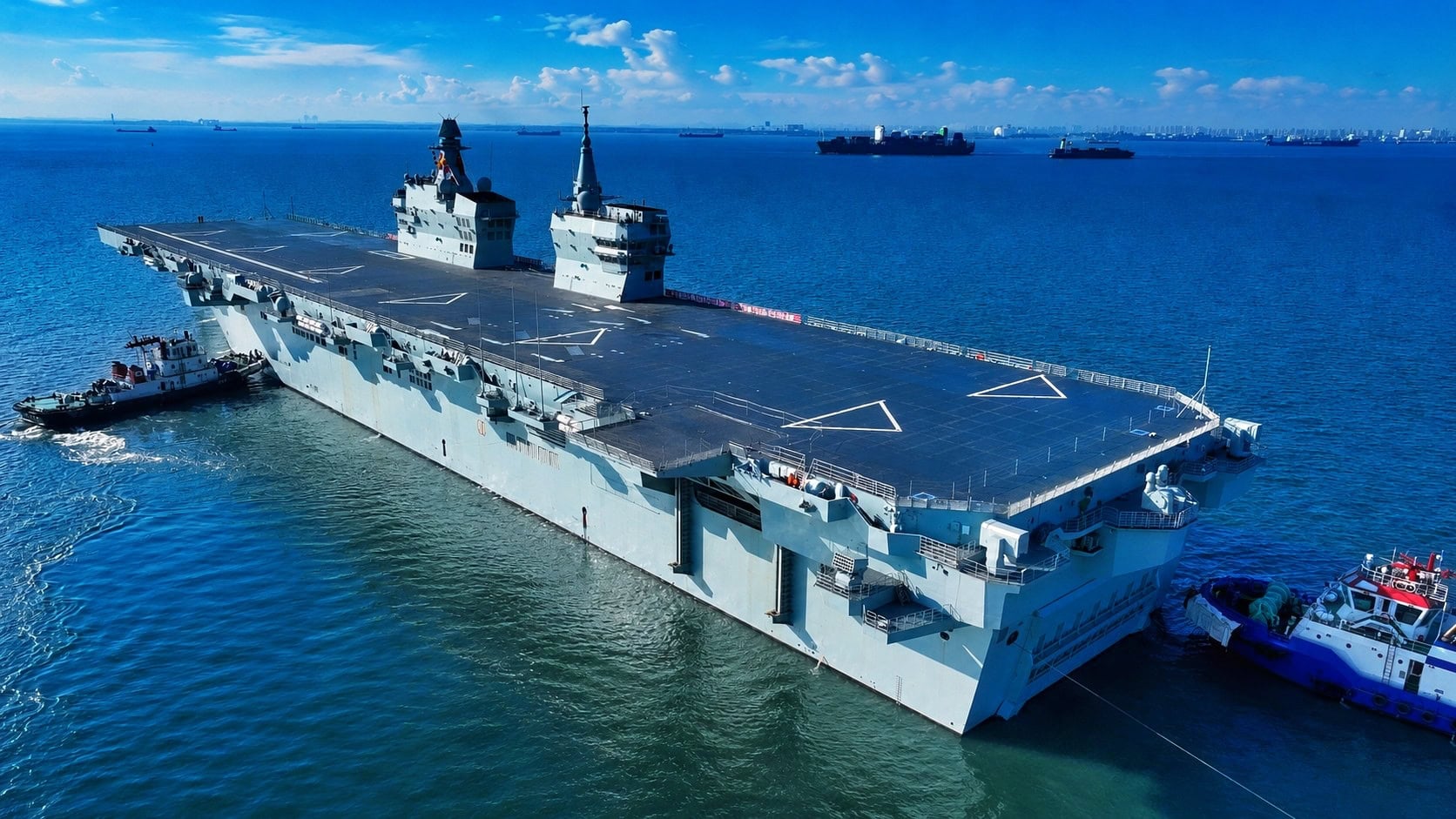
Reuters cited information from China stating that the GJ-21 completed its first onboard takeoff and landing; the South China Morning Post pointed out that the tests took place on the first Type 076 ship, the Sichuan. Publicly released footage shows that the ship features a through-deck flight deck, a bow catapult system, and an electromagnetic arrestor system. The Global Times described the GJ-21 as a large stealth armed reconnaissance drone, but currently, there is no publicly available reliable data on its maximum takeoff weight, range, payload, and engine specifications.
These "unknowns" are significant. Whether the GJ-21 primarily focuses on persistent reconnaissance or can carry precision-guided munitions for limited strike missions cannot be concluded from a single takeoff and landing. The onboard flight tests primarily validate deck scheduling, catapult control, arrestor recovery, and personnel support, rather than complete combat capability.
From Amphibious Ship to Drone Carrier
The core mission of a traditional amphibious assault ship is to transport landing troops, hovercraft, and helicopters. If the Sichuan ship can operate the GJ-21 reliably, it will add a long-range sensing link: the drone can search for surface targets, monitor islands and coastal defense zones outside the landing formation, and relay target information back to the ship or other firepower platforms. In sensor-dense environments like the Taiwan Strait and South China Sea, this capability may be more valuable than simply adding a few manned fighter jets.
The advantage of the Type 076 lies in its deck area and catapult system, while its shortcomings include protection, resupply, and sortie rates. It does not have the endurance of a nuclear-powered aircraft carrier, nor does it necessarily possess the area air defense system of a large carrier group. In simple terms, being able to launch a drone only addresses the issue of "reach"; whether it can sustain flight under electronic interference, adverse sea conditions, and enemy long-range fire will determine if it is truly a combat-capable drone carrier.
Production Capacity and System Integration Are More Critical Than Individual Aircraft Performance
The Sichuan ship's tests also reveal an easily overlooked observation window. China's military industry is integrating ships, catapults, drones, data links, and deck support into a system, rather than pursuing the parameters of a specific aircraft in isolation. If a second or third similar ship emerges in the future, and the GJ-21 achieves stable production, the PLA could obtain distributed aerial reconnaissance nodes that are cheaper than traditional aircraft carriers.
However, the current publicly available evidence is only sufficient to prove that "key tests have been completed," and it does not demonstrate that combat readiness has been achieved. The engine life, stealth maintenance, onboard turnaround time, and anti-jamming communication of the GJ-21 remain aspects that are not visible to the outside world. The author believes that the next step worth monitoring is not whether the Sichuan ship can launch another drone, but whether it can continuously complete multiple sorties, high sea state, and nighttime tests—if these data are never made public, the unmanned combat value of the Type 076 will remain at the potential level.
Sources
The People's Liberation Army Navy conducted tests of the GJ-21 stealth reconnaissance drone aboard the Sichuan amphibious assault ship on October 30-31, 2026. This event marks a significant development as the 076 ship demonstrates capabilities akin to an aircraft carrier. The GJ-21's specifications remain undisclosed, and further testing is needed to assess its operational effectiveness in various conditions.
- The Sichuan ship completed tests of the GJ-21 stealth reconnaissance drone.
- This marks the first time the 076 amphibious assault ship has demonstrated capabilities similar to an aircraft carrier.
- The GJ-21 drone's specifications, such as maximum takeoff weight and range, remain undisclosed.
- The testing indicates a shift in the role of the 076 ship towards unmanned combat operations.
- Future tests will determine the operational capabilities of the GJ-21 under various conditions.