
2026 PLA Type 076 Sichuan Ship First Launch and Landing of Attack-21 Stealth Drone Pushes Amphibious Ship Towards Maritime Aviation Node
 Li Minghui
2026 PLA Type 076 Sichuan Ship Successfully Launches and Recovers the Attack-21 Stealth Drone, Pushing Amphibious Ship Towards Maritime Aviation Node
On October 30, China National Radio Military disclosed a detail more noteworthy than "the Type 076 amphibious assault ship is undergoing sea trials": the first shipborne reconnaissance-strike integrated stealth drone of our military, the "Attack-21," successfully launched and recovered for the first time on the Sichuan ship. The official announcement did not disclose the complete number of flights, payload, and control distance, but the keywords "fixed-wing, stealth, reconnaissance-strike integrated, shipborne launch and recovery" are enough to indicate that the positioning of the Sichuan ship is changing.
From Amphibious Assault Ship to Drone Mother Ship
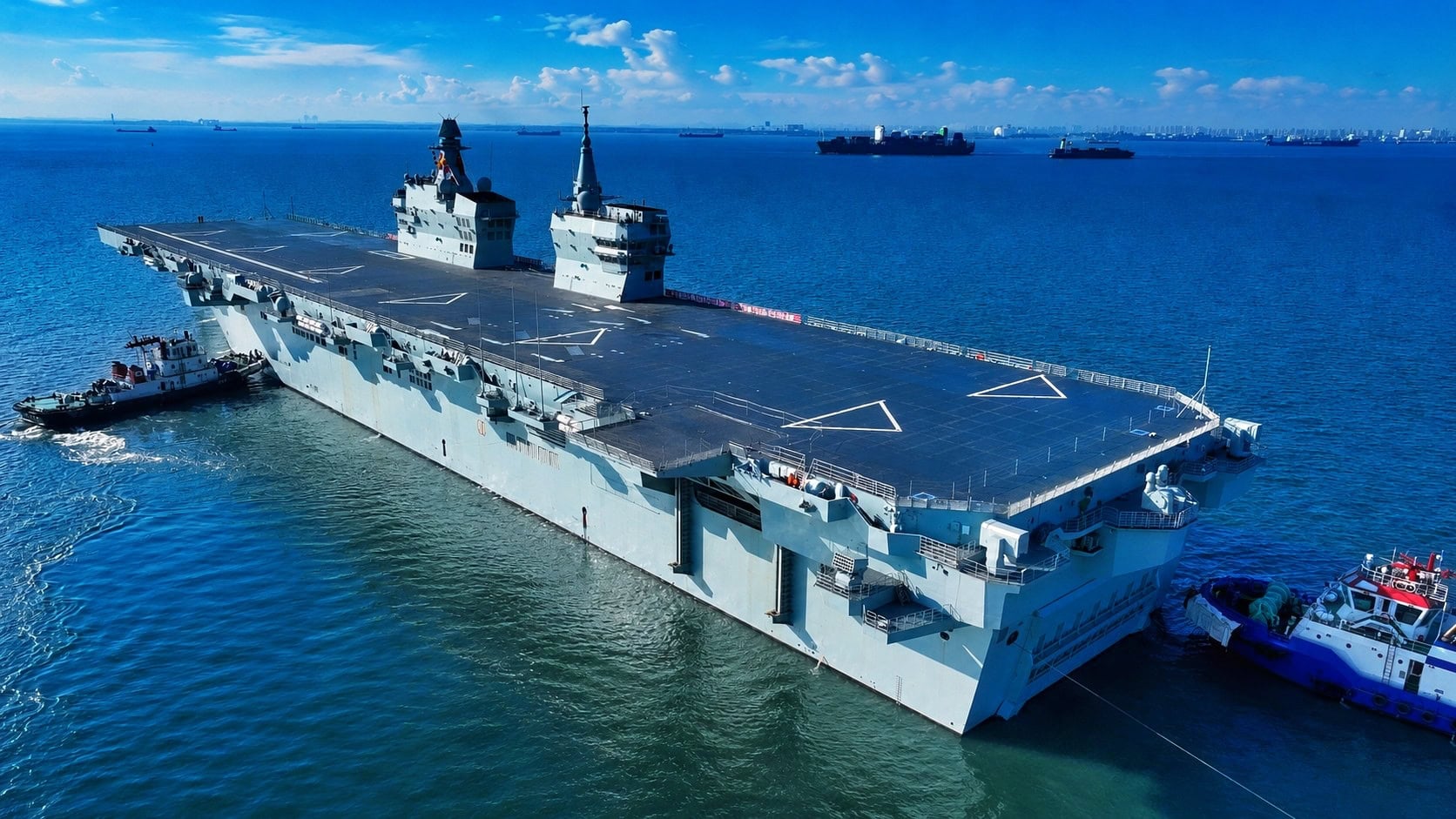
The core mission of a traditional amphibious assault ship is to transport landing forces, helicopters, and hovercraft, with aviation operations constrained by the types of onboard aircraft and deck scheduling. The Type 076 Sichuan ship adopts a through-deck design and an aviation-oriented operational concept. If the Attack-21 can stably complete launch, recovery, and deck turnover, it will no longer just be a landing operation platform but a maritime aviation node capable of projecting sensors and firepower to the sea.
The key here is not how impressive the drone's individual performance is, but rather the combination of "manned platform command and unmanned drone deployment." The Attack-21 can undertake long-range reconnaissance, target designation, and limited strikes, connecting large vessels with shore-based command networks. In simple terms, the Sichuan ship does not necessarily need to pursue the high sortie rates of manned fighter jets like an aircraft carrier; it is more likely to exchange lower personnel risk for sustained maritime situational awareness.
The Real Challenge is the System, Not Takeoff
A successful launch and recovery is an engineering milestone, but it does not equate to operational capability. For shipborne drones to enter a practical phase, issues such as landing accuracy under changing sea conditions, deck scheduling, data link anti-jamming, spare parts support, and mission planning must be resolved. Especially since the stealth shape typically compresses antenna layout, heat dissipation, and payload space, the reconnaissance-strike integration means that trade-offs must be made between the weight and power of reconnaissance sensors, communication equipment, and weapons.
From this perspective, the sea trials of the Sichuan ship are more like a "system integration test." Whether the ship, drone, shore-based nodes, and escort formations can share target information in a complex electromagnetic environment determines whether the Attack-21 is merely a showcase or a combat tool capable of sustained operations in the direction of the first island chain. The author believes that what is most worth observing in future public footage is not how fast the drone flies, but whether there are continuous sorties, coordinated formations, and payload training.
Interlocking with the PLA's Space Reconnaissance Network
This test should also be viewed in the broader context of the PLA's expansion of its maritime and aerial systems. On October 30, Taiwan News cited a report from the U.S. Defense Intelligence Agency stating that the number of Chinese satellites in orbit has increased approximately threefold since 2018, exceeding 510 in July; among them, low-orbit satellites can reacquire target area images within 30 minutes. While there are statistical discrepancies in the numbers, the trend is clear: maritime unmanned platforms are gaining more intensive space-based intelligence support.
The Ministry of Defense's press conference on October 29 also revealed that military academies are establishing unmanned intelligent engineering colleges, indicating that the construction of unmanned systems has extended from single equipment development to talent, training, and organizational systems. With the Sichuan ship carrying the Attack-21, remote sensing satellites provide wide-area clues, and shipborne drones complete near-shore confirmations. Once this link matures, the value of the Type 076 platform will no longer be limited to amphibious assaults.
It is Too Early to Draw Conclusions
A degree of restraint is necessary. The official confirmation currently only states "first successful launch and recovery," without disclosing the Attack-21's range, speed, or weapon payload, nor indicating when the Sichuan ship will achieve initial operational capability. Equating a single sea trial directly with "the commissioning of an unmanned aircraft carrier" is treating promotional language as operational assessment.
However, this public demonstration is still significant because it shifts the focus of the PLA Navy's testing from "whether there is a large deck" to "whether fixed-wing stealth drones can operate repeatedly." What is truly worth questioning is whether the next phase will see the Sichuan ship demonstrate sustained operations and cross-platform coordination, and whether the PLA can compress this expensive and complex system to a cost suitable for mass deployment.
Sources
- China National Radio Military report on the Attack-21's launch and recovery on the Sichuan ship, October 30, 2026
- Taiwan News report on the U.S. Defense Intelligence Agency's space threat report, October 30, 2026
- Chinese Ministry of Defense transcript from the routine press conference on October 29, 2026
On October 30, 2026, the People's Liberation Army Navy successfully conducted the first takeoff and landing of the Attack-21 drone on the Type 076 amphibious assault ship, Sichuan. This operation signifies a transformation in the ship's role, allowing it to function as a drone carrier rather than just an amphibious assault platform. The integration of the Attack-21 with satellite support enhances the PLA's maritime reconnaissance and strike capabilities.
- The Attack-21 drone successfully took off and landed on the Type 076 amphibious assault ship.
- This marks a shift in the role of the Sichuan ship from a traditional amphibious assault platform to a drone carrier.
- The PLA Navy is expanding its capabilities with the integration of aerial drones and satellite support.
- The successful operation is part of a broader strategy to enhance maritime reconnaissance and strike capabilities.