
A Ship Strike Near Khasab 37 km Makes the Oman Route in Hormuz a Test, Not a Ceasefire
 Ahmed Al-Rashid
A Ship Strike Near Khasab 37 km Makes the Oman Route in Hormuz a Test of No Ceasefire
At 2 AM on Tuesday, 37 kilometers northeast of Khasab in Oman, a cargo ship reported to the UK Maritime Trade Operations (UKMTO) that it had been hit by an unknown projectile. The number is small on the map, but it is located at one of the narrowest points between war and trade: the entrance to the Strait of Hormuz, through which nearly one-fifth of global oil and gas trade passed before this war.
The news did not come alone. On the same day, U.S. President Donald Trump stated that Washington and Tehran were talking again, and that negotiations were Iran's last chance before the war escalated. Tehran denied the existence of negotiations with the United States, stating that what was happening was only a discussion with Oman about establishing a temporary and safe navigation route in the strait. From a military perspective, this contradiction is not a diplomatic detail; it is the crux of the problem. Whoever has the right to define the safe route holds part of the authority over the strait.
The Strike That Reveals the Limits of Verbal Ceasefire
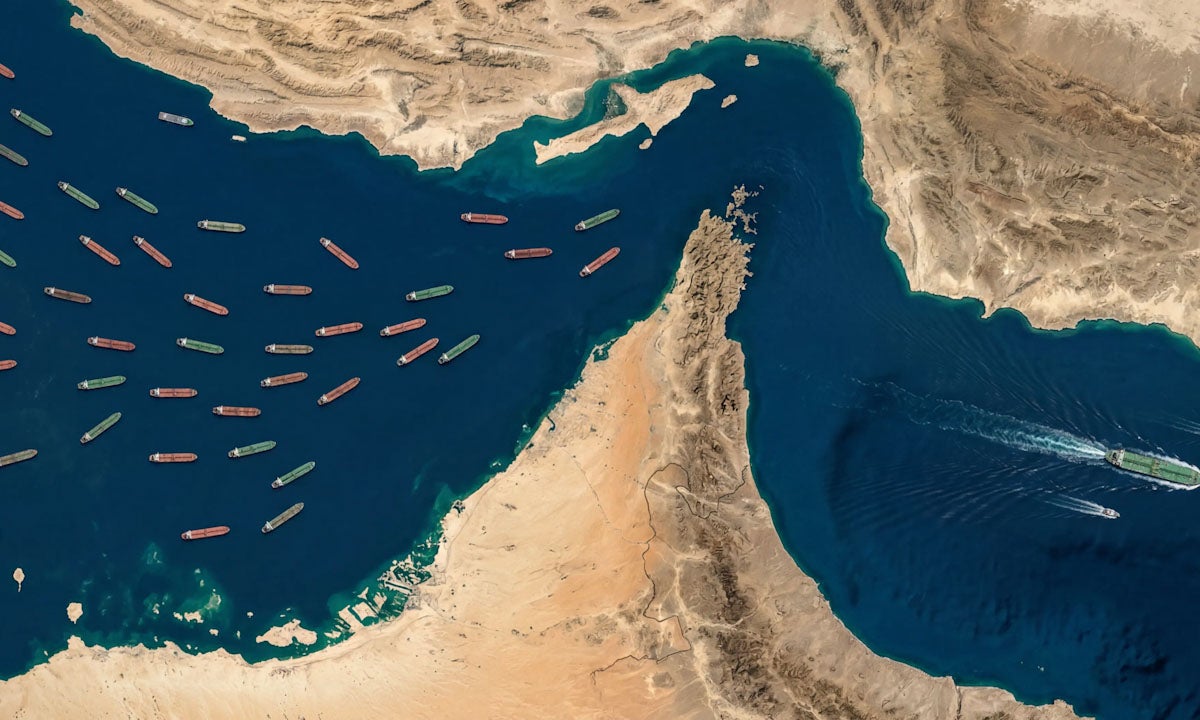
According to the Associated Press citing UKMTO, details about the ship's flag, cargo, or extent of damage have not yet been released. These gaps are significant, but they do not negate the implication. The strike occurred near Khasab, meaning in the Omani pocket that directly overlooks the head of the strait. If the attack was intentional, it is a message to anyone who thinks a temporary Omani route can suddenly turn the sea into a quiet administrative corridor. And if it was a mistake or a random projectile, the operational result does not differ much: insurance companies and captains do not deal with intentions, but with probabilities of being hit.
Here, we must distinguish between opening the strait and creating a corridor route. Opening the strait means the return of navigation to its normal commercial logic. A temporary route under Omani sponsorship or through indirect understanding with Iran means something more precise: selected ships, specific timings, prior notifications, and perhaps unannounced rules regarding cargo, destination, and escort. Any military personnel who has served in the region knows that this is not freedom of navigation, but a passage system under pressure.
Washington Talks About Negotiation While Tehran Talks About Oman
The United States wants to turn any contact into evidence that military pressure and maritime blockade are working. Therefore, Trump emphasized that Iran, whether it admits it or not, is in a negotiating track. Iran is doing the exact opposite: it denies negotiating with Washington and accepts only the Omani framework, as it wants to appear as if it is not negotiating under bombardment, but organizing navigation safety with a neutral Gulf neighbor. On the surface, this is a linguistic dispute. At its core, it is a struggle for legitimacy.
If Washington says the talks are U.S.-Iranian, then the strait becomes part of the war, deterrence, and sanctions file. If Tehran says the talks are Omani-Iranian, it pulls the subject into a narrow regional maritime framework, asking Gulf ships and capitals to practically recognize that passage requires a channel of understanding with it. This is why the phrase "temporary route" seems more dangerous than the phrase "ceasefire." A ceasefire may fail within hours. However, if the temporary route succeeds for days, it may become a precedent.
What the Strike Means for Gulf States
The Gulf is not a bystander in this equation. Qatar, Saudi Arabia, and the UAE, according to U.S. reports, pressured to avoid a broader U.S. strike. This is an understandable position; Gulf bases, facilities, ports, and energy networks lie within the range of Iranian missiles and drones and their proxies. But the problem is that reducing the U.S. strike does not necessarily mean restoring Gulf control over the corridors. It may only lead to a transfer of control from the U.S. fleet to emergency understandings that pass through Muscat and Tehran.
For Saudi Arabia and the UAE, this is an embarrassing moment for the defensive infrastructure they have spent billions of dollars on. Patriot and THAAD systems and long-range radars can be purchased, but protecting maritime trade cannot be bought as a ready-made system. It requires maritime warning, intelligence, escort, rules of engagement, and civil-military coordination with shipping and insurance companies. This is the triangle of capability I always talk about: equipment, training, and institutions. The Gulf has a lot of equipment, but the joint institutions that manage a crisis in a strait of this magnitude are still less mature than the level of danger.
The Omani Route Is Not a Complete Maritime Solution
Oman has an advantage that many do not have: the ability to talk to Iran, the United States, and the Gulf without appearing as a warring party. This is a real political value. However, it does not give Muscat alone the military capability to guarantee a corridor in a sea crowded with coastal missiles, fast boats, drones, and miscalculations. If there is no clear verification mechanism, every ship will ask the same question: who guarantees that the next projectile will not consider it outside the allowed route?
There is also a geographical problem. Khasab is not just an Omani city on the map; it is a head overlooking a narrow corridor, and any incident near it directly links Omani sovereignty to global navigation security. The more reliance on a route near the Omani coast increases, the more political pressure on Muscat grows. And the more pressure there is on it, the major powers try to use Omani neutrality not just as mediation, but as a cover to manage risks that no one wants to bear publicly.
Beyond a Single Incident
A single ship strike should not be exaggerated into a final judgment on the future of the war, but ignoring it is more dangerous. Naval wars do not always require a major battle to change commercial behavior. Sometimes, a report from UKMTO, rising insurance rates, and a company's decision to reroute two ships around the Cape of Good Hope is enough, and then the exception becomes the norm. Therefore, the real indicator in the coming days will not only be the number of missiles or statements but the number of ships willing to pass through any potential Omani route, the conditions of that passage, and who escorts them.
In my estimation, Iran is not only looking to close Hormuz. A complete closure provokes the entire world and harms its Asian allies. The smarter card is to turn the strait into a door with a guard, not a closed door. Washington wants to break this logic by showing that the only acceptable channel is negotiation under U.S. pressure. And the Gulf states want oil and gas to flow without their territories becoming a direct response arena. These are three goals that do not align.
The problem in Hormuz today is not whether the strait opens or closes, but who decides the meaning of opening and who pays the price of passage.
This is why the strike on the ship near Khasab seems bigger than a limited maritime incident. It is an early test of the idea of a temporary route: will it be a bridge towards de-escalation, or a silent acknowledgment that navigation in Hormuz is no longer a public right but a negotiating privilege? In the Middle East, as the old military saying goes, a safe route that no one can guarantee becomes a delayed ambush.
Sources
- Associated Press via SRN News, August 4, 2026, report on the cargo ship strike near Khasab and the contrasting U.S. and Iranian narratives regarding the talks.
- UKMTO, maritime alert about a ship being hit by an unknown projectile 37 km northeast of Khasab.
- Statements from U.S. President Donald Trump and Iranian Foreign Ministry spokesman Ismail Baqaei regarding the Omani route and talks with Washington.
- Coverage from Al Jazeera, BBC, and Google News RSS regarding the window for talks and the debate over reopening Hormuz.
A cargo ship was struck by an unknown projectile near Khasab, Oman, at 2 AM on Tuesday, as reported by UKMTO. This incident raises concerns about maritime safety in the Strait of Hormuz, where significant global oil and gas trade occurs. U.S. President Trump indicated renewed talks between Washington and Tehran, while Iran denied negotiations with the U.S., claiming discussions were limited to Oman.
- A cargo ship was struck by an unknown projectile near Khasab, Oman.
- The incident occurred at 2 AM on Tuesday.
- The UKMTO reported the strike to maritime operations.
- U.S. President Trump mentioned renewed talks between Washington and Tehran.
- Iran denied negotiations with the U.S., stating discussions were only with Oman.