
AFRICOM warns of 10 ISIS and al-Qaeda networks in Africa after 75% withdrawal
 Marie Dubois
AFRICOM alerts on 10 ISIS and al-Qaeda networks in Africa after 75% withdrawal
Washington, May 21, delivered a phrase that was rarely heard so clearly in a U.S. hearing: according to General Dagvin Anderson, commander of the United States Africa Command, “the epicenter of global terrorism is in Africa.” The statement is brutal. It is also operational. It speaks not only of jihadist doctrine but of landing strips, radio relays, smuggling routes, ports, mines, and local partners who see or do not see what is happening twenty kilometers from their post.
Before the Senate Armed Services Committee, Anderson described a continent that is rising in the global economy while simultaneously suffering the parallel rise of terrorist networks. DefenceWeb reports that at least ten organizations designated by the U.S. State Department as foreign terrorist groups are now operating on the continent, including six affiliated with ISIS. The AFRICOM chief added that ISIS leadership is African and that al-Qaeda finds part of its economic engine in Africa. This is not a strategic footnote. It is a staff map.
The black hole created by Western withdrawal
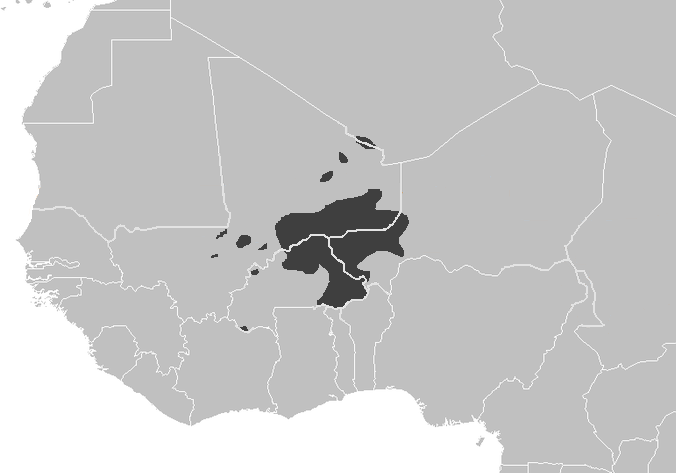
Illustrative map of the Sahelian area related to jihadist activities, used as a geographical reference and not as a document from the U.S. hearing.
The most important passage of the hearing is not the denunciation of ISIS or al-Qaeda. We know the enemy. The hard point lies elsewhere: Anderson speaks of a 75% reduction in AFRICOM's regional posture over ten years, combined with the withdrawal of several allies. In his vocabulary, this creates a “black hole of intelligence.” For a former field officer, this expression is more concerning than a list of armed groups.
A black hole of intelligence in the Sahel means that one does not know early enough which katiba has left the Gourma bush, which convoy is moving from Gao to Kidal, which drone workshop has changed villages, or which local imam has just been replaced by a more radical preacher. One can always send a drone or a detachment later. But, as Anderson said, one cannot “deploy trust” in an emergency. Trust is built before the crisis.
The Sahel is no longer an isolated theater
The novelty of 2026 is connectivity. Anderson mentions a link between al-Shabaab, al-Qaeda's East African branch, and the Iran-backed Houthis. Caution is warranted: the exact modalities of this link are not public, and a political hearing sometimes simplifies very indirect chains. But the general idea is consistent with what is observed from Mali to Somalia. Jihadist groups are not centralized armies; they are networks that exchange methods, instructors, financial flows, and narratives of victory.
In May, Middle East Eye described the persistent pressure exerted by the Azawad Liberation Front and the Group for the Support of Islam and Muslims (JNIM) against the Malian state, with Kidal, Gao, Bamako, and logistical axes as points of tension. DefenceWeb and Africa Defense Forum have also documented the increasing use of drones by Malian insurgents, including attacks against Malian army bases and Africa Corps. This detail matters: the cheap drone transforms a mobile group into an observer, propagandist, and sometimes precision artillery operator.
On the ground, this disrupts the old timelines of counterinsurgency. Previously, a forward post feared an armed pick-up at dawn. Now it must fear a fiber-optic drone, a propaganda video published within the hour, and then an ambush on the resupply route. The threat does not only progress in kilometers. It progresses in decision speed.
Washington wants to return without becoming Barkhane again
The American discourse comes after a decade of Western contractions in Africa. France has left Mali, Burkina Faso, and Niger under political pressure, sometimes with bitterness, sometimes with relief on the African side. The United States has also lost access, particularly in Niger. The Sahelian juntas have promised that military sovereignty, supported by Moscow or non-Western partners, would restore security to the populations.
The result is more ambiguous. National armies are still fighting. Some units are fighting hard. But capitals have often replaced an imperfect Western presence with a more opaque architecture, less accountable, and not always more effective. Africa Corps can protect a palace or accompany a convoy. It cannot, on its own, rebuild a sub-prefecture administration, pay a reliable informant in a border market, or restore the trust of a Fulani village collectively accused of complicity.
AFRICOM does not publicly propose a massive return. Anderson speaks instead of relationships with capable and willing partners, non-traditional intelligence, force protection, technological experimentation, and training such as the International Military Education and Training. This is a less visible approach than a permanent base. It is politically more acceptable. It also has a limit: without physical access and local relays, sensors do not replace human eyes.
Competition goes through secondary routes
Anderson also placed China and Russia in the same picture. Beijing seeks critical minerals and infrastructure; Moscow exploits instability to extract resources, influence, and sometimes manpower. This is true, but competition is not only played out in mining contracts or UN votes. It is played out in the ability to be useful at the right moment: intelligence transmitted before an attack, a medical evacuation, a radar delivered with maintenance, a trained officer who knows how to call the right interlocutor.
This is where the United States still has cards to play. Many African armies do not want to choose a single protector. They want equipment, training, intelligence, and political leeway. In coastal countries like Ivory Coast, Benin, Togo, or Ghana, the issue is not to reproduce Barkhane in miniature. It is to close the corridors between the rural north, border parks, and major ports without turning every border village into an occupied zone.
The next test will be coastal as much as Sahelian
Anderson's phrase should therefore be read as a warning rather than a budget request. If African terrorist networks are gaining strength while the Western posture contracts, the risk is not only a spectacular attack against a capital. The more likely risk is a normalization of insecurity: cut-off roads, taxed markets, closed schools, escorted convoys, administrative borders present on paper but negotiated every week with armed men.
I am wary of simple solutions in the Sahel. Too often, it has been promised that a few special forces, a few drones, or a few agreements with a strongman would suffice. From experience, a theater is first lost at the margins: a route that is no longer taken, a village chief who no longer calls, a patrol canceled for lack of fuel. The “black hole” described by AFRICOM begins there.
In the coming months, we will need to look less at victory statements and more at secondary axes: Kidal-Gao, Tillabéri-Dori, Fada N'Gourma-Porga, Korhogo-Burkinabe border. If African and Western partners do not repair the intelligence chain before the next jihadist push, they will discover the attack only when the video is already online.
AFRICOM warns of the increasing presence of ISIS and al-Qaeda networks in Africa, particularly following a 75% reduction in its regional military posture. General Dagvin Anderson emphasized that the epicenter of global terrorism has shifted to Africa, with at least 10 terrorist organizations now operating on the continent. The report also notes the rising use of drones by insurgents in Mali and the growing connections between various jihadist groups across the region.
- AFRICOM identifies 10 terrorist networks in Africa, including 6 linked to ISIS.
- General Dagvin Anderson states that the epicenter of global terrorism is in Africa.
- There has been a 75% reduction in AFRICOM's regional posture over the past decade.
- The report highlights the growing connectivity between jihadist groups across Africa.
- Drones are increasingly used by insurgents in Mali for attacks.