
After ten years of sharpening the sword, how does the People's Navy safeguard peace in the South China Sea?
July 12, 2026, marks the tenth anniversary of the so-called "South China Sea Arbitration Ruling." A decade has passed, and the illegal ruling continues to have a toxic influence. The facts occurring in the South China Sea indicate that the so-called "ruling" has persistently eroded political mutual trust among countries in the South China Sea, hindered regional cooperation processes, and to some extent intensified tensions in the South China Sea, becoming an important negative factor affecting regional peace and stability.
Defending sovereignty requires a combination of legal standing and military strength. Over the past ten years, the People's Navy has accelerated its transition from "near-sea defense" to "far-sea defense," taking concrete actions to safeguard regional peace and stability.
“Training in our own backyard”
PLA frequently appears in the South China Sea
Where does the leap in development over the past decade come from? Military expert Song Xiaojun told China Voice's "Fengxian Liaowang" that the confidence stems from the most extensive and profound national defense and military reform since the founding of the People's Republic of China.
Song Xiaojun: Since 2015, China has undergone the most extensive and profound national defense and military reform since the founding of the People's Republic of China. This reform has integrated the navy into three theater commands. The navy in the theater is no longer a standalone service; it is supported and empowered by other military branches, significantly amplifying its combat capabilities. Over the past ten years, the development of the People's Navy has made the Chinese people very proud and has attracted global attention.
Since June of this year, the PLA theater forces have continuously strengthened patrol and alert operations in the air and sea around Huangyan Island, effectively responding to various infringement provocations, resolutely defending national sovereignty and security, and firmly maintaining peace and stability in the South China Sea. In late June, the Fujian aircraft carrier crossed the Taiwan Strait from north to south heading towards the South China Sea, while the US, Japan, the Philippines, and other countries were conducting joint military exercises such as "Brave Shield" and "Resolute Dragon." Defense Ministry spokesperson Zhang Xiaogang pointed out: "This is a routine training exercise for the Fujian. We will continue to organize such activities in the future."
Over the past decade, the shift from solo operations to joint combat, from near-sea training to far-sea joint patrols, has transformed national defense and military reform into tangible combat power. The frequency of the People's Navy's appearances in the South China Sea has increased significantly, and operations in the mid to far seas have become commonplace.
Song Xiaojun: The opportunities for the People's Navy to demonstrate its capabilities in safeguarding national maritime rights and interests have increased frequently. Continuous training in far seas and the frequency of operations in the mid to far seas are very high. Ten years ago, this was a particularly rare phenomenon, but now it has become routine. Over the past decade, the navy's long-range training, exercises in surrounding waters, and humanitarian assistance have become increasingly frequent.
Achievements in island and reef construction
Significant enhancement of maritime control
The Ministry of Defense has made it clear that the Nansha Islands are Chinese territory. China's garrison and deployment of necessary territorial defense facilities on the relevant islands and reefs in the Nansha Islands are the inherent rights of a sovereign state, which help maintain regional peace and stability and are not aimed at any country.
Over the past decade, many islands and reefs in the Nansha have completed comprehensive upgrades. China has built airports on Yongshu, Meiji, and Zhubi reefs, and some islands and reefs are equipped with radar air defense networks and anti-ship missiles. Military expert Li Yaqiang believes that over the past decade, the islands and reefs in the South China Sea have undergone a transformation from quantitative to qualitative change.
Li Yaqiang: Over the past ten years, we have made significant changes in island and reef construction. We can ensure the takeoff and landing of various types of combat aircraft, forming a very strong maritime control capability. Air warning radars, shore-based anti-ship missiles, and shore-based air defense missiles have fundamentally changed our grasp of the South China Sea situation. With these islands and reefs, we can maintain continuous combat readiness patrols and a constant state of preparedness, significantly altering the control capability and security conditions of the entire maritime area.
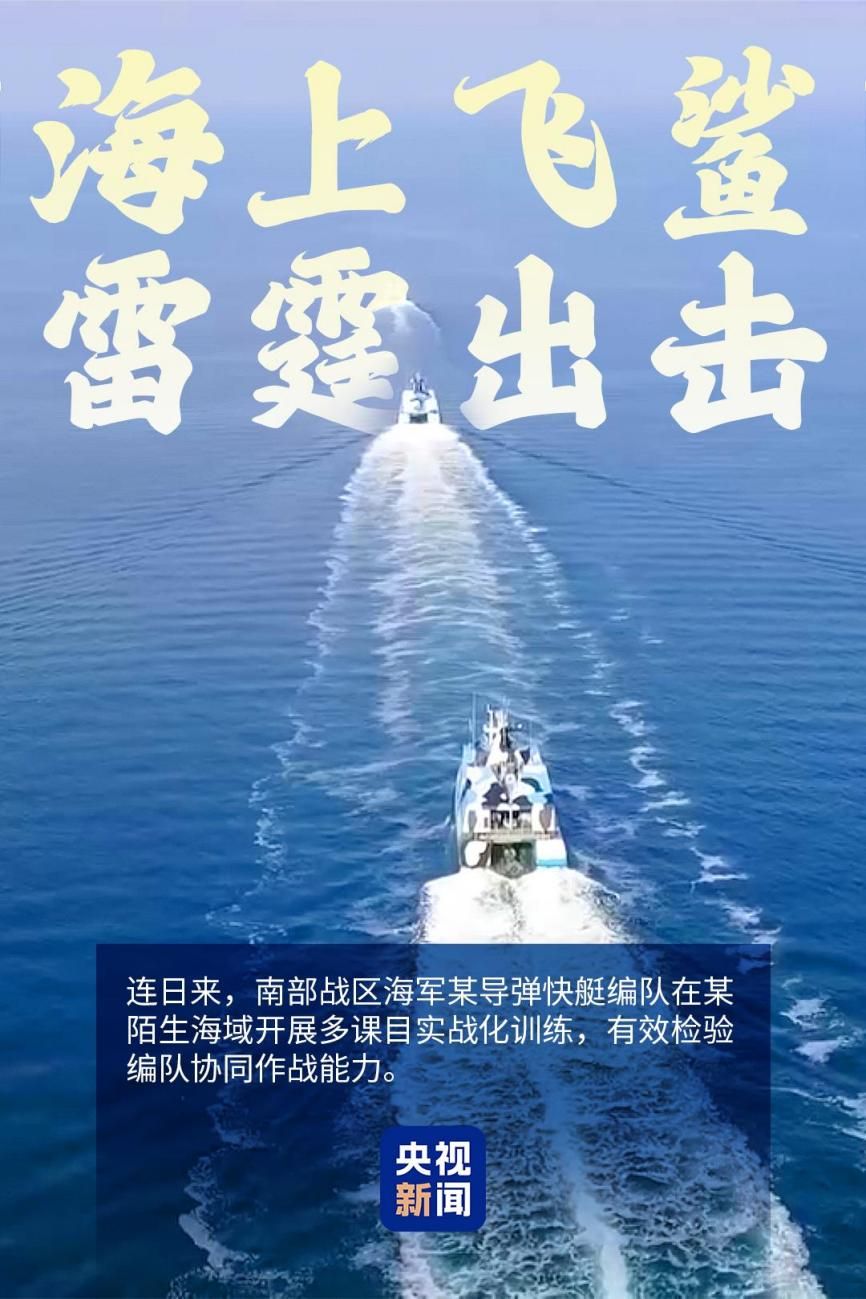
△ A missile boat brigade from a certain missile boat squadron of the Southern Theater Navy formed a fleet and conducted several days of multi-subject realistic training in an unfamiliar sea area in early July.
Surface ship strength has undergone a transformation
The navy's strength remains among the world's top ranks
Over the past decade, our surface ship strength has undergone a complete transformation. Large destroyers and various types of surface ships have become commonplace. Military expert Li Yaqiang stated that today's Chinese navy has firmly established itself among the world's top ranks.
Li Yaqiang: Over the past ten years, the navy's combat capabilities have made significant progress. The advancements in weaponry and equipment are not specifically aimed at the South China Sea. We hope to maintain friendly relations with neighboring countries around the South China Sea and build the South China Sea into a sea of peace. If any hostile forces attempt to provoke trouble in the South China Sea using military power, we now have overwhelming advantages.
With the support of electromagnetic catapult technology and the induction of various new aircraft, the People's Navy has successfully equipped the "five-piece set" for aircraft carriers, initially establishing a core carrier-based aircraft system. Military expert Song Xiaojun pointed out that the leap in physical platforms provides a solid material foundation for the navy.
Song Xiaojun: The Fujian is now the world's only conventionally powered aircraft carrier with electromagnetic catapult capabilities. The so-called "five-piece set," which military enthusiasts are very fond of, still has greater development potential. Platforms like the Fujian, equipped with electromagnetic catapult capabilities, may eventually have a "six-piece set," including laser weapons, etc. Various types of surface ships, led by three aircraft carriers and strategic nuclear submarines, have seen a very high frequency of launches, making China the country with the most new launches in the world.
Three-dimensional strikes, military-police coordination
A "combination punch" from underwater to airborne
Surface ships are the visible "hard power," but what deters opponents from acting recklessly is also the complete three-dimensional strike system constructed by the PLA. From underwater to airborne, from conventional to strategic, a set of combination punches has already taken shape.
Li Yaqiang: We are becoming increasingly strong in comprehensive air superiority, maritime control, electromagnetic control, space control, and underwater control. Especially in our surrounding waters, with shore-based support, we effectively control the vast waters within the second island chain, and our comprehensive control capabilities are unmatched by any other country in the world, even unchallengeable.
Since June, the China Coast Guard has continuously strengthened law enforcement patrols in the territorial waters and surrounding areas of Huangyan Island, handling illegal infringement vessels in accordance with the law and regulations, further enhancing control over the relevant maritime areas, and resolutely safeguarding national territorial sovereignty and maritime rights and interests. Military expert Li Yaqiang pointed out that the coordination of military and law enforcement forces is making the situation in the South China Sea more stable.
Li Yaqiang: We have always been very cautious in the use of military force. In every struggle, the People's Navy has never been absent; we have always been the strongest support for frontline law enforcement forces. If anyone thinks that China is weak and can be bullied, our counterattack will be very resolute—we will make them bear the most severe consequences. We have this confidence, and we have this capability.
Fundamental changes in the situation around the South China Sea
From island and reef strongholds to naval strength, from three-dimensional strikes to military-police coordination. A decade has passed, and the situation around the South China Sea has fundamentally changed.
Li Yaqiang: The so-called "South China Sea Arbitration" has been a decade of rapid development for our navy. The hostile and potentially hostile forces around the South China Sea are increasingly not a match for us—let alone our navy's strength; even the strength of a fleet or a ship squadron may not be able to withstand it. The possibility of hostile forces causing trouble in the South China Sea will become increasingly small.
After ten years of sharpening the sword, we are moving towards the deep blue. The People's Navy tells the world through its tracks: The South China Sea is vast, accommodating merchant ships and friendly neighbors; but the South China Sea cannot tolerate any acts of fabricating lies, intimidating the public, or inciting confrontation. Unafraid of rising winds and waves, we hope for calm seas. The People's Navy will continue to firmly safeguard its legitimate rights and interests and maintain regional peace and stability.
Reporter丨Wang Jiyun Jiang Zongquan
Video丨Ning Bo
The People's Liberation Army Navy has significantly increased its naval patrols and military exercises in the South China Sea from June to July 2026, particularly around Huangyan Island and the Nansha Islands. This increase follows extensive military reforms that have enhanced the navy's capabilities, including the establishment of new facilities and equipment on various islands. China continues to assert its sovereignty over these waters amid ongoing joint military exercises with other nations.
- The People's Liberation Army Navy has increased its presence in the South China Sea over the past decade.
- Significant military reforms have enhanced the operational capabilities of the navy.
- New military facilities and equipment have been established on islands in the South China Sea.
- Joint military exercises with other nations are ongoing in the region.
- China asserts its sovereignty over the Nansha Islands and surrounding waters.