
After the 2026 DF-17 CCTV Debut, South Pacific Test Launch Reappears: PLA Missile Deterrence Enters Continuous Display Period
 Li Minghui
After the 2026 DF-17 Debut on CCTV, South Pacific Test Launch Reappears, PLA Missile Deterrence Enters Continuous Display Period
Two details from early July are interesting when viewed together. First, Chinese state media concentrated on showcasing the Dongfeng-17 at the end of June and the beginning of July. Defense News reported on July 8 that this was the first time this type of hypersonic glide missile appeared in Chinese official English communications in this manner. Immediately following that, foreign media disclosed that the PLA Navy's submarine launched a submarine-launched ballistic missile from China's coastal waters, with a trajectory crossing approximately 7,000 kilometers southeast across the Pacific Ocean, landing near the waters of Nauru and Tuvalu. Each event can be interpreted as routine training or promotional footage; however, when viewed in the same week, it seems less coincidental.
DF-17 Display is Not Just a Simple Show of Strength
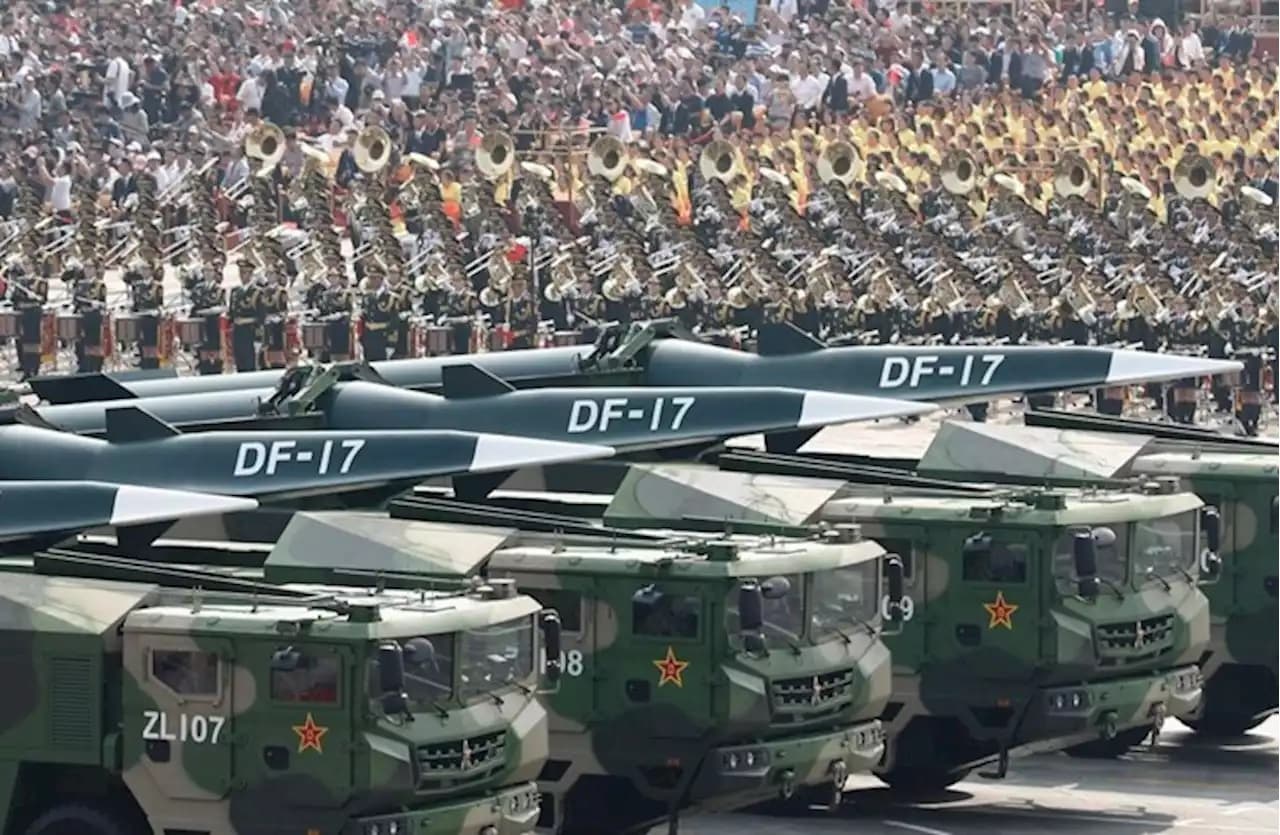
The Dongfeng-17 is not a new piece of equipment. According to publicly available information, it has been showcased at least since the National Day parade in 2019. Institutions like CSIS typically categorize it as a combination of medium-range ballistic missiles and hypersonic glide vehicles, with a range of approximately 1,800 to 2,500 kilometers, vehicle-mounted mobile launch, and warheads that can be conventional or nuclear options. The real novelty this time is that the official footage emphasizes mobile launch, all-weather capability, precision strikes, and breaking through advanced air defense systems, rather than simply showcasing the model name.
In simple terms, past discussions about the Dongfeng-17 mostly revolved around "how fast it is." This promotional footage aims to convey something closer to "how it will be used." The challenges of hypersonic glide vehicles are not just about speed, but also about the unpredictability of their mid-to-late trajectory, which creates pressure on early warning radar, fire control calculations, and interception windows. For large surface vessels, fixed or semi-fixed targets like Guam and Japanese bases, the value of the Dongfeng-17 may not necessarily be a single hit, but rather in conjunction with the Dongfeng-21D, Dongfeng-26, long-range rocket artillery, and air-launched anti-ship missiles, forcing opponents to dilute their air defense and missile defense resources.
South Pacific Test Launch Exposes a Second Line
The July 7 report from Defense News mentioned that the Chinese submarine-launched ballistic missile test flight covered approximately 7,000 kilometers, carrying a simulated warhead. Beijing stated that the launch was safe, standardized, and professional, and that relevant countries were notified in advance. The reactions from New Zealand and Australia focused on the spirit of the Rarotonga Treaty, arguing that the missile's landing point near the South Pacific nuclear-free zone would undermine political trust regarding nuclear weapon-related activities in the region.
In my opinion, the military signal from this test launch is more noteworthy than the diplomatic controversy. A flight distance of 7,000 kilometers indicates that the PLA's sea-based nuclear deterrence is continuing to validate long-range ballistic capabilities, measurement and control links, and landing area control. The greatest concern for submarine-launched ballistic missiles is not "can it be launched," but whether the submarine, missile, command communication, and testing support can reliably form a closed loop. Public information is still insufficient to determine which type of missile it is, nor can it be inferred how frequently it is on combat patrol, but it at least indicates that China is willing to place some of its strategic missile capabilities further into the Pacific for external observation.
The U.S. is Filling the Mid-Range Air Defense Gap in Guam
At the same time, the U.S. military is also responding. Defense News reported on July 10 that the U.S. Marine Corps successfully intercepted an aerial target using the Medium-Range Intercept Capability (MRIC) system at the Blaz Camp in Guam. This system incorporates Israeli Iron Dome technology, with each trailer-mounted launch unit capable of carrying 20 interceptors, and a publicly stated range of approximately 2 to 43 miles, aimed at filling the gap between Stinger man-portable air defense and Patriot long-range air defense.
- The Dongfeng-17 addresses the rapid penetration issue in area denial.
- The submarine-launched ballistic missile test addresses the credibility of sea-based deterrence.
- MRIC addresses the mid-range protection issue for forward bases under threats from cruise missiles, drones, and rockets.
These three matters differ in technical levels but point to a common reality: the Western Pacific is shifting from a platform competition to a competition of munitions and interception windows. Aircraft carriers, destroyers, and amphibious ships are certainly important, but what truly determines whether the first wave of strikes can withstand the assault is often the detection, identification, allocation, and interception chain within seconds after radar activation.
Shortcomings Remain in Production Capacity and System Coordination
A bit of cold water is needed. The Dongfeng-17 appears advanced, but hypersonic glide vehicles have high requirements for materials, thermal protection, guidance, and production consistency. The outside world often cites estimates that China has about 1,300 missiles and 300 launch vehicles; however, this is not a single model number for the Dongfeng-17 and cannot simply be converted into a scale of salvo that can be used in the Taiwan Strait direction. What truly determines deterrence strength is how many can be reliably deployed, loaded, concealed, communicated, and re-launched during wartime.
Another easily overlooked variable is that the missile defense side is also adapting. MRIC cannot intercept high-end targets like the Dongfeng-17, but it can protect forward airfields, supply points, and distributed operational nodes, forcing the PLA to use more expensive and scarce munitions to target more smaller objectives. The offensive side may seem to have the initiative, but in reality, it is also being led by the opponent's low-cost defense system.
The key point of this signal is not that China has showcased another "wonder weapon," but that the PLA has placed medium-range hypersonic, long-range submarine-launched ballistic missiles, and conventional area denial narratives into the same time window.
Therefore, I am more concerned about the next unanswered question: If the Dongfeng-17 has entered a normalized promotional phase, will China provide more information closer to actual combat formations in the next round of public displays, such as how a rocket army brigade integrates with naval reconnaissance, air force air superiority, and joint operations centers? This would be more revealing than simply looking at the range of a single missile.
China showcased the DF-17 hypersonic glide missile and conducted a submarine-launched ballistic missile test in July 2026, with the missile landing near Nauru and Tuvalu. This demonstration highlights the PLA's focus on advanced missile capabilities and strategic deterrence in the Pacific. Concurrently, the U.S. military is enhancing its mid-range interception systems in response to these developments.
- The DF-17 was publicly showcased by Chinese media for the first time in an English context.
- A submarine-launched ballistic missile was tested, traveling approximately 7000 kilometers.
- The missile landed near the waters of Nauru and Tuvalu, raising concerns about nuclear trust in the region.
- The PLA emphasizes the DF-17's capabilities in precision strikes and evading advanced air defense systems.
- The U.S. military is enhancing its mid-range interception capabilities in response.