
After the 2026 Fujian Ship, the Fourth Chinese Aircraft Carrier May Reach 339 Meters: PLA's Long-Distance Deployment Tests Fleet Supply
 S.W
S.WAfter the Fujian, the Fourth Chinese Aircraft Carrier May Reach 339 Meters, Testing the PLA's Long-Distance Deployment and Fleet Supply
On September 24, the South China Morning Post cited satellite image analysis from Janes, stating that the next Chinese aircraft carrier being built at the Dalian Shipyard is expected to be approximately 336 to 339 meters long, close to the 333 meters of the U.S. Ford-class carriers, and about 20 meters longer than the already commissioned Fujian. This figure is striking, but I believe the real question to analyze is not "who is longer," but rather why the Chinese Navy needs a larger aircraft carrier.
What Does Increased Size Mean First?
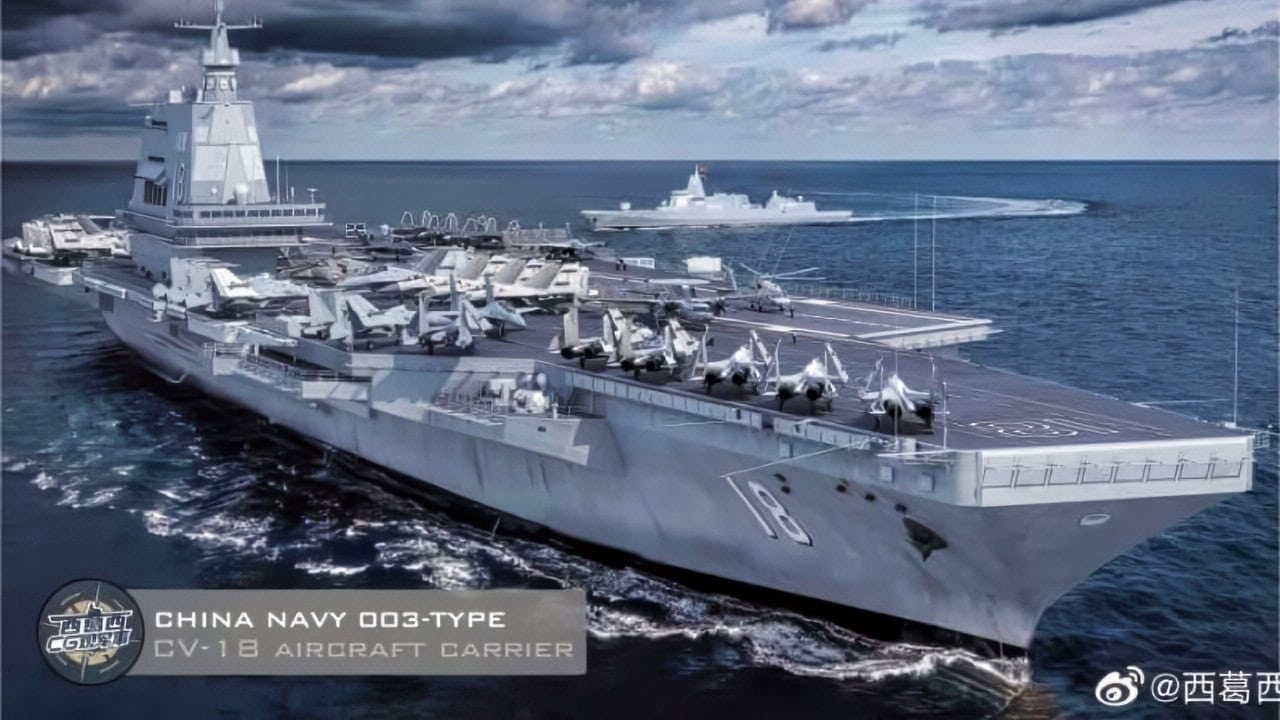
Public information shows that the Fujian has already adopted an electromagnetic catapult and arrestor system, allowing for more effective operation of fixed-wing early warning aircraft, carrier-based fighter jets, and large drones. If the new ship continues to enlarge the flight deck and hangar, the benefits may not just be the ability to park more aircraft, but could also include increased speed of aircraft scheduling, ammunition loading capacity, and maintenance space. The combat effectiveness of an aircraft carrier depends on how many sorties can be completed each day, rather than how many aircraft are statically displayed on the deck.
However, a question must be raised here: satellite images can measure the shape but cannot confirm the power system. There is widespread discussion about whether this ship will use nuclear power, but currently, there is not enough public evidence to draw a conclusion. Equating "a longer hull" directly with "nuclear carrier confirmed" is not rigorous.
From the Fujian to the Next Generation Carrier
The commissioning of the Fujian has addressed issues such as electromagnetic catapults, joint operations of carrier-based aircraft, and training for large aircraft carriers; if the next aircraft carrier further expands, it will test whether the industrial system can convert single-ship technology into stable fleet capability. The construction pace of aircraft carriers in Dalian and Shanghai has already demonstrated that China has the capability to continuously launch large surface vessels, but an aircraft carrier is not just a single ship; it also requires escort destroyers, supply ships, carrier-based aircraft pilots, maintenance facilities, and overseas supply nodes.
- Hull and Power: Determine the basic limits of speed, endurance, and high-intensity operations.
- Carrier Air Wing: Determine whether the electromagnetic catapult system can be converted into effective sortie rates.
- Comprehensive Support: Determine whether the aircraft carrier can operate continuously for weeks or even longer after leaving the near seas.
The South China Morning Post recently pointed out that the Chinese Navy is advancing discussions on more long-distance deployments; The Diplomat noted that the PLA has increased reconnaissance, drone, and coast guard activities east of Taiwan. When these two threads are viewed together, the goal of aircraft carrier construction is no longer just to deter near-shore operations in the Taiwan Strait, but also to push sensors, air forces, and surface vessels beyond the first island chain.
Production Capacity Advantages Still Need Supply Verification
In terms of quantity, China's shipbuilding industry can quickly complete large hulls; in terms of operational sustainability, the shortfall may lie in nuclear power experience, the lifespan of carrier-based aircraft engines, high-frequency maintenance of catapults, and long-range supply networks. In simple terms, building a 339-meter ship is an engineering problem, but ensuring it can operate continuously in the Western Pacific with a complete air wing is a systemic issue.
This is also where I reserve my opinion on the claim that "the fourth aircraft carrier is about to change the naval balance." There is at least a multi-year training cycle between the launch, outfitting, sea trials, and achieving combat capability of the new ship. Meanwhile, Taiwan is incorporating its eastern ports, airports, and island chain passages into its sustained combat scenarios, and the PLA's aircraft carriers will also face a more dispersed and harder-to-suppress reconnaissance and anti-ship network.
What Piece of the Puzzle is Still Missing?
Currently, the most worth tracking is not the displacement touted in official propaganda, but three observable indicators: whether the new ship exhibits nuclear power-related structural features, whether the carrier air wing is expanding in sync, and whether the Chinese Navy can establish a stable long-distance supply and maintenance chain. If these three aspects do not advance simultaneously, the size advantage may remain on paper. The real question is, where is this aircraft carrier prepared to sail, and can China's military industry provide it with a sufficiently long "logistical tail."
Sources
Main sources: South China Morning Post, September 24, 2026, "China’s next carrier could be its longest"; Janes satellite image analysis; The Diplomat, September 2026, "The Battle for Taiwan’s East"; South China Morning Post, September 22, 2026, report on China's Type 052D destroyer and long-range strike in the Western Pacific.
China is constructing its next aircraft carrier in Dalian, expected to be 336 to 339 meters long, enhancing its naval capabilities. This development indicates a shift towards more extensive operations beyond the Taiwan Strait, with discussions on logistics and support for sustained deployments. Speculation exists regarding the potential for nuclear power, but no definitive evidence has been provided.
- China's next aircraft carrier is being built in Dalian and is expected to be 336 to 339 meters long.
- The new carrier may enhance operational capabilities with improved aircraft handling and maintenance.
- There is speculation about whether the new carrier will be nuclear-powered, but no conclusive evidence is available.
- The Chinese Navy is discussing more deployments in distant seas, indicating a shift in operational focus.
- The construction of the carrier raises questions about the logistics and support systems needed for sustained operations.