
After Vucic ouster, Serbia’s weapons-buying habits are under the microscope

BELGRADE, Serbia — One of Europe’s key arms purchasers, Serbia, is likely to slow down procurement and investigate the probity of recent buys after a student-led protest movement ousted the country’s long-time strongman leader in a surprise election win on Sunday.
A group formed by students to battle alleged corruption in Serbia trounced Aleksandar Vucic at the polls by half a million votes, signaling exasperation with Vucic’s 12-year, increasingly authoritarian rule.
Vucic sought to punch above his weight on the international stage by playing Russia off against the European Union by seeking EU membership and supplying arms to Ukraine, but also refusing to apply sanctions against Russia.
He also acted as a bridgehead into the Balkans for China, signing major infrastructure deals with Chinese firms.
Vucic accompanied his outreach to Europe and China with large arms purchases, including buying 12 Rafale jets from France and FK-3 and HQ-17A air defense systems as well as CH-92 and CH-95 drones from Beijing.
Serbia also purchased Hermes drones from Israel and struck a deal with Elbit to assemble drones in Serbia.
According to SIPRI, Serbia spent around 1.12 billion euros on arms procurement in 2025 and nearly 3.65 billion euros in the period 2021-25.
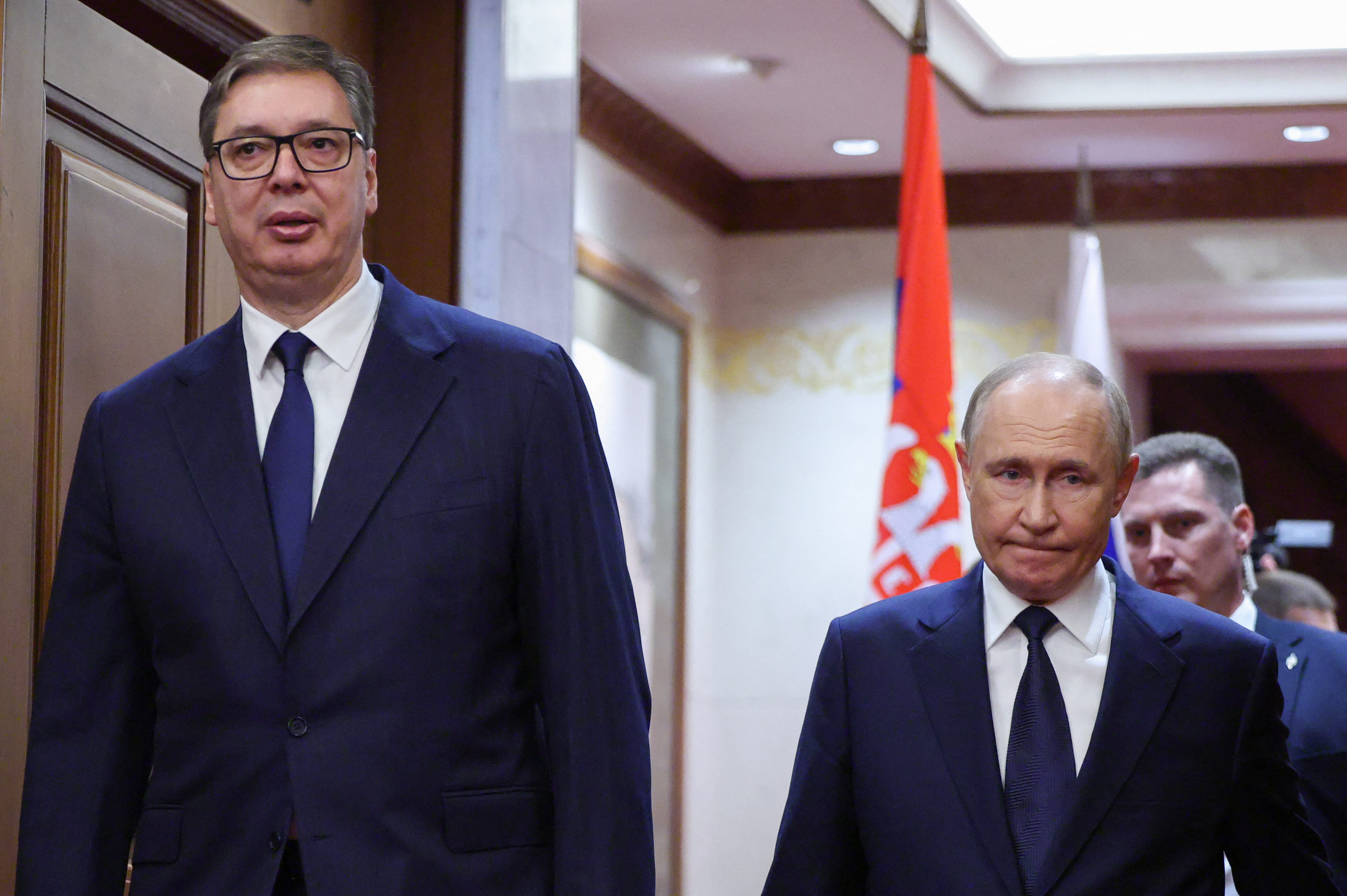 Russian President Vladimir Putin (R) walks with Serbian President Aleksandar Vucic for a meeting at the Diaoyutai State Guesthouse in Beijing on Sept. 2, 2025. (Maxim Shemetov/POOL/AFP via Getty Images)
In January, Vucic announced he would double Serbia’s military capabilities within 18 months.
But on Sunday, he was voted out of office after students put up their university professors as candidates in a national election, forging a political party with huge support but no named leader.
Katarina Djokic, a researcher at SIPRI, told Defense News the new government would stay busy in the short term focusing on expunging Vucic’s firm grip on business and politics at home, with defense pushed further down the to-do list.
“The new government will have other priorities — prominently, delivering on anti-corruption policies and reestablishing functioning political institutions, which will be challenging enough. Under such conditions, there could be less resources and less political consensus for major defense projects,” she said.
“What could reasonably be expected is a slowdown in armament expenditures in the couple of years to come,” she added.
Djokic noted that the Student List’s manifesto talks of continuing to develop its layered air defense and modernizing Serbia’s air force, but she pointed to a stress on improving the lot of personnel, with a pay rise promised.
The manifesto talks of remedying a “scarcity of qualified personnel.”
The document also says an inquiry will be set up to pore over the paperwork of Vucic’s arms accords looking for corrupt deals.
“A new commission is being formed – an independent, interdepartmental government commission for irregularities, abuses and corruption in the production, procurement and export of weapons, as part of a general audit of the previous regime’s contracts,” it states.
The manifesto adds, “We will modernize defense industry factories and turn them into smart factories, establish a National Center for Military Electronics in cooperation with technical faculties, and launch a defense software program.”
The new government may not be so well disposed to defense deals with Israel. In the manifesto’s section on foreign policy it states, “We will not be complicit in the systematic attempt to destroy the Palestinian people that Israel is carrying out in the Gaza Strip.”
Vucic was adept at linking his arms build-up to tensions with neighboring Kosovo, which was formerly a part of Serbia and never acknowledged as an independent state by Serbia.
“Depending on the new government’s regional relations, there may be less incentive to use regional tensions and “arms races” as a pretext for ordering more arms, and more advanced arms,” said Djokic.
The Student List’s manifesto does however suggests the new government will keep up demands that Kosovo is reintegrated into Serbia.
“We will fight for the preservation of Kosovo … as part of Serbia,” it states.
Following the ousting of Aleksandar Vucic, Serbia is expected to slow down arms procurement and investigate recent military purchases. The new government, formed by a student-led movement, will prioritize anti-corruption policies and may redirect resources away from defense projects. An independent commission will review past arms contracts for irregularities, while the manifesto indicates a focus on modernizing the defense industry and improving personnel conditions.
- Serbia spent approximately 1.12 billion euros on arms procurement in 2025.
- The new government plans to investigate previous arms purchases for corruption.
- A new commission will audit the previous regime's arms contracts.
- The Student List's manifesto emphasizes anti-corruption and modernization of the defense industry.
- The new government may reduce defense spending and focus on domestic political reforms.