
Anefis costs 50 soldiers in Mali — the FLA-JNIM tandem challenges Africa Corps
 Marie Dubois
Anefis costs 50 soldiers in Mali — the FLA-JNIM tandem challenges Africa Corps
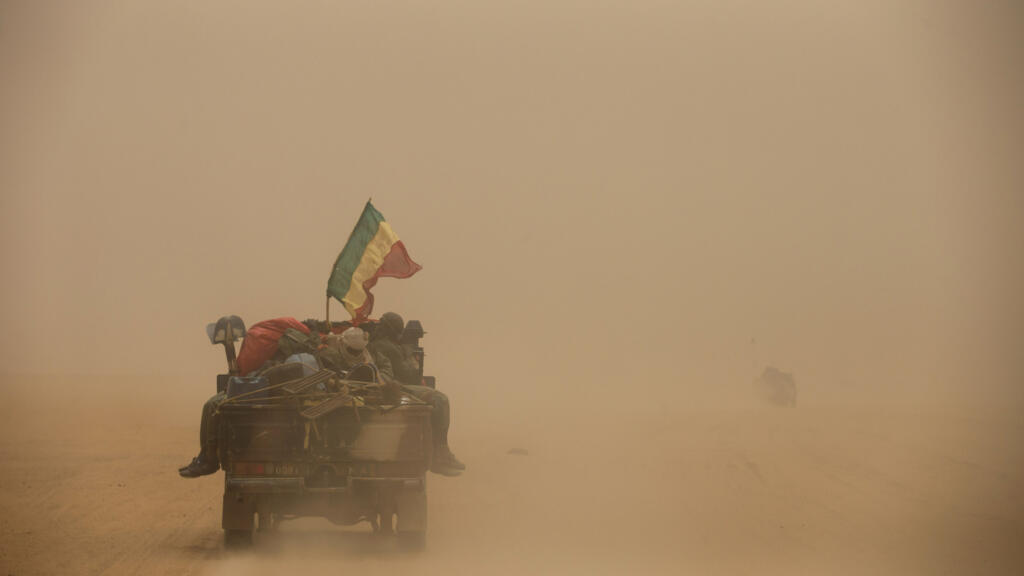
On July 18, on the Gao-Anefis axis, a mixed convoy of Malian Armed Forces and Africa Corps fell into an ambush that reportedly killed at least 50 Malian soldiers. The area is not an abstraction on a map. Anefis is located in that northern Mali where the track, dust, and distance often decide more than the statements from Bamako. Between Gao and Kidal, every logistical movement becomes a combat operation.
What makes the attack even more serious is the claimed signature. According to Al Jazeera, the operation was jointly claimed by the Front for the Liberation of Azawad (FLA), a predominantly Tuareg separatist coalition, and Jama’at Nusrat al-Islam wal-Muslimin (JNIM), affiliated with Al-Qaeda. The Malian army confirmed the assault and announced counter-operations. Africa Corps, the functional successor to Wagner in the Russian setup in Mali, then released images presented as drone strikes against the assailants.
On the ground, this sequence does not resemble an isolated incident. It looks like a brutal correction inflicted on a strategy that claims to hold the north by force, without having yet resolved the simplest question of a Sahelian campaign: how to supply, relieve, and gather intelligence for remote posts when the adversary chooses the place, time, and pace?
A tactical alliance born from a common enemy
The FLA and JNIM do not pursue the same political project. The former speaks of autonomy or independence for the north; the latter wants to impose their religious and military order over a much larger space. For years, this divergence was enough to limit open cooperation. It is no longer sufficient.
Analyst Héni Nsaibia from ACLED, quoted by Al Jazeera, summarizes the calculation: the two armed factions are currently fighting the same adversary, the FAMa and their Russian partners. They are pooling local knowledge, kinship networks, fighters, scouts, and harassment capabilities. This is a force multiplier, not an ideological merger.
This nuance matters. If Bamako treats any FLA-JNIM cooperation as evidence of a homogeneous terrorist bloc, it risks responding with a hammer to a fine mechanical problem. On the ground, groups that do not want the same future can very well share an ambush, a retreat route, or a radio window. This is often enough to kill a convoy.
Northern Mali becomes a theater of fragile lines
Since April, armed pressure has extended well beyond Anefis. The head of UNOWAS, Leonardo Santos Simão, indicated before the Security Council that JNIM and FLA launched simultaneous attacks on April 25 against Bamako, Kati, Gao, Kidal, and Mopti. He also reported ongoing fighting in the north, partial blockages of several roads, and attacks on power lines disrupting the supply to the capital.
This logistical detail is central. In the Sahel, controlling a city without controlling the axes that supply it is like holding an island without a navy. Gao, Anefis, Kidal, Bourem, Mopti: these names do not just form a military geography. They outline the arteries through which fuel, ammunition, food, medical rotations, and human intelligence pass.
From experience, a Sahelian convoy is never just a column of vehicles. It is a rolling political promise: the state can come, the state can stay, the state can leave. When this promise burns on the track, the message arrives faster than the official statement.
Russia strengthens fire, not control
The arrival of Africa Corps has given Bamako resources that the Malian army did not always possess before: direct support, drones, aviation, faster strike capabilities. It would be wrong to say that this changes nothing. An isolated Malian unit can survive longer if it knows that a drone is watching or that a strike may come.
But Anefis shows the limits of this modernization. Fire does not replace control. A strike after the ambush can punish assailants; it does not resurrect a surprised column, it does not rebuild the trust of civilian drivers, it does not automatically secure the villages that serve as information relays for armed groups.
The gradual replacement of Western and UN partners with Russian support has also shifted the nature of assistance. MINUSMA provided surveillance, logistics, an imperfect but extensive political presence. Africa Corps brings more combat power. This is not the same toolbox. Bamako has gained in response capacity, but not necessarily in territorial endurance.
A worrying signal for the Sahel States Alliance
The Sahel States Alliance was supposed to prove that Mali, Niger, and Burkina Faso could produce their own security, outside the ECOWAS framework and far from old Western tutelage. The problem is that armed groups are also learning regional coordination. JNIM is already operating across several borders. The Islamic State in the Sahel maintains its own predation zones. Traffickers, on the other hand, do not ask for a visa.
The UN briefing highlights a broader evolution: terrorist groups and other armed actors are using drones, sophisticated communications, cryptocurrencies, and criminal networks to consolidate not only military capabilities but also economic control. War is no longer just a series of attacks against posts. It is becoming a competition to administer routes, tax flows, arbitrate fear, and exploit the absences of the state.
This is where the ambush at Anefis goes beyond the already heavy human toll. If the FLA and JNIM can repeatedly cooperate in the north, Bamako will have to choose between two difficult options: further expand the Russian-Malian military effort, risking stretching its columns, or reopen political channels with actors that the junta has publicly demonized. Neither of these options will be comfortable.
What to watch for now
The coming days will tell whether Anefis marks a spectacular ambush or the beginning of a more methodical campaign against the northern axes. Three indicators will be important: the frequency of attacks between Gao and Kidal, the actual state of the roads to Bamako, and Africa Corps' ability to protect movements rather than strike afterward.
There remains uncertainty about the exact toll and any potential Russian losses; the available figures come from military statements, armed claims, and still incomplete media cross-checks. Caution is therefore warranted. But the operational lesson is already clear: in Mali, the adversary does not need to take all the cities to contest the state. It is enough to make the roads too costly.
Main sources: Al Jazeera, report from July 22, 2026, on the Anefis ambush and FLA-JNIM cooperation; United Nations, UNOWAS briefing from July 22, 2026, on the evolution of the terrorist threat in West Africa and the Sahel.
On July 18, a mixed convoy of Malian Armed Forces and Africa Corps was ambushed in Anefis, resulting in the deaths of at least 50 soldiers. The attack was claimed by the Front de libération de l'Azawad (FLA) and Jama’at Nusrat al-Islam wal-Muslimin (JNIM), indicating a tactical alliance against the Malian forces. Africa Corps subsequently conducted drone strikes against the assailants, underscoring the ongoing military challenges in the region.
- At least 50 Malian soldiers were killed in an ambush on July 18.
- The ambush involved a convoy of Malian Armed Forces and Africa Corps.
- The attack was claimed by FLA and JNIM, indicating a tactical alliance against a common enemy.
- Africa Corps responded with drone strikes against the attackers.
- The situation highlights ongoing logistical challenges in northern Mali.