
Anti-drone gun maker ACS hires U.S. Army laser chiefs for new division
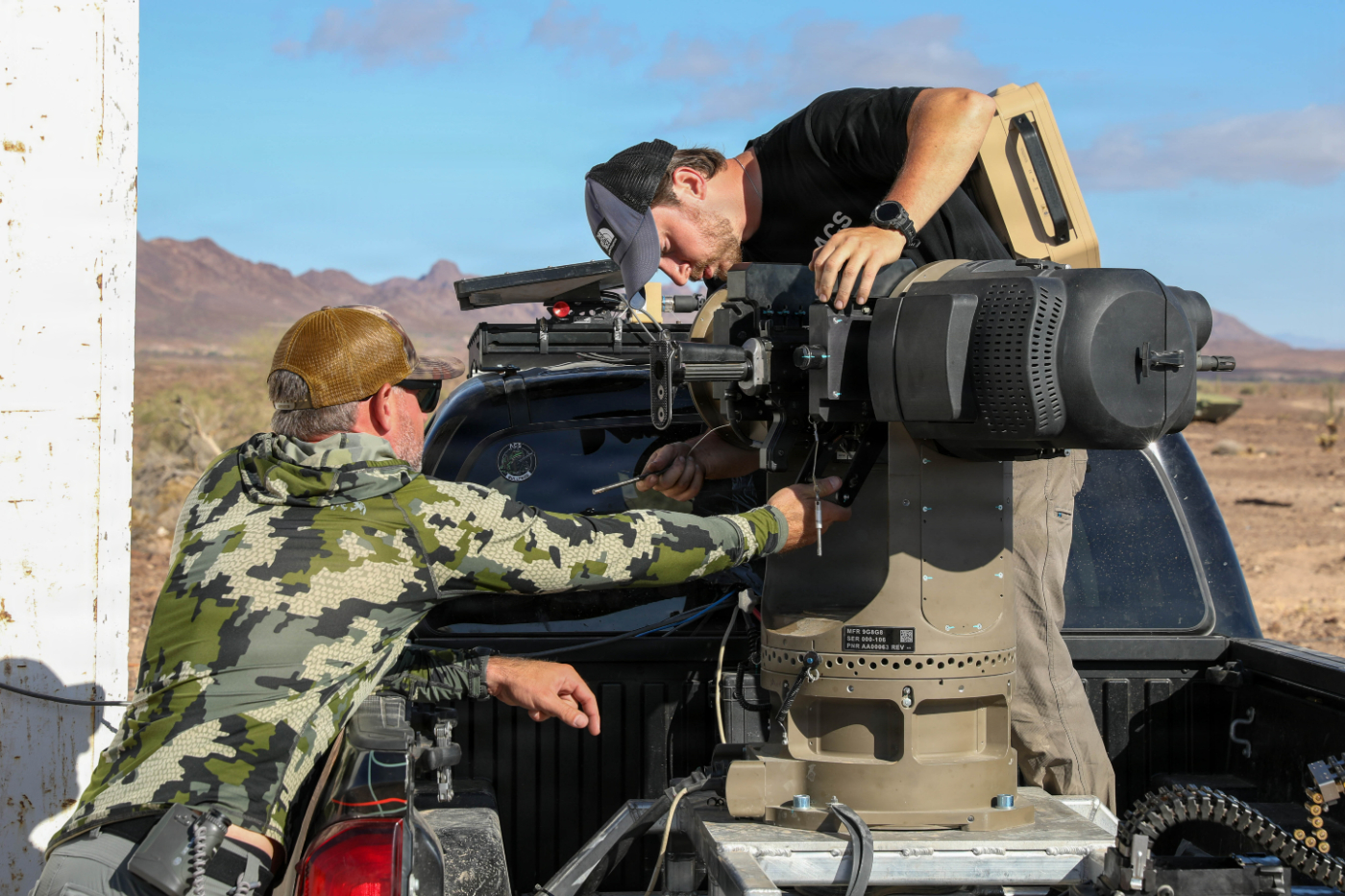
Allen Control Systems, the Texas startup behind the Bullfrog robotic anti-drone gun, is starting a laser weapons business and has hired two senior U.S. Army directed energy officials to run it, the company said Tuesday.
The Austin-based firm, which now brands itself simply as ACS, said in a press release that its new Directed Energy division will develop “new high-energy laser capabilities for U.S. and allied governments.” Amanda Clark becomes vice president for directed energy, and John Mason becomes program director for high-energy lasers. Both come from U.S. Army Space and Missile Defense Command, or SMDC, in Huntsville, Alabama.
Axios first reported the move Tuesday morning. It noted that ACS’s website already lists two Bullfrog versions in development, a dual-band laser dazzler and a 3-kilowatt laser, alongside the M240 and M2 machine gun models the company already sells.
The release gives no laser power level, customer, contract, budget or delivery date. It also doesn’t say whether ACS will build its own laser source or buy one from an established supplier. Breaking Defense noted that the company didn’t specify what kind of laser technology the division will develop.
“The defense industry has invested heavily in directed energy, but generating a powerful beam is only part of the challenge. You still have to find a fast-moving threat, stay on target, and engage it with precision,” said Joe Bingold, ACS president and chief executive. “ACS has already demonstrated those capabilities with our Bullfrog autonomous weapon station, and applying that expertise to directed energy is a powerful combination.”
Bingold’s name at the top of the company is new. As recently as September, co-founder Mike Wior was quoted as chief executive, and Tuesday’s release didn’t address the change.
The tracking problem Bingold describes is real, and it’s different with a laser. A machine gun only needs to put rounds in the right place for a moment. A laser kills by heating one spot on the target until the structure or electronics fail, so the beam director has to keep the aim point steady on a moving, maneuvering drone for seconds at a time. The U.S. Army’s requirements for its 30-kilowatt Enduring High Energy Laser, or E-HEL, spell that out in dwell times: 30 one-second shots per minute against dense target sets, six nine-second shots against sparse ones, and three 17-second shots against hardened targets, according to a draft solicitation reported by Laser Wars.
Bullfrog handles the find-and-track part today with bullets. The turret uses AI-driven computer vision and passive cameras, without radar, to detect a drone, follow it and aim a standard machine gun, and a soldier still has to approve each engagement. The M240 version has a maximum effective range of 800 meters (about 875 yards) against small and midsize drones, the company says, while the heavier M2 version is rated out to 1,500 meters (about 1,640 yards).
During the U.S. Army’s Project Convergence Capstone 5 at Fort Irwin, California, in early 2025, Bullfrog hit all seven drones within range in a swarm engagement, according to the company. The U.S. Army has since evaluated it on M1A2 Abrams tanks and M2A4 Bradley fighting vehicles.
The U.S. Marine Corps picked Bullfrog for its Light Marine Air Defense Integrated System through a prototype contract worth about $6.2 million. In September, ACS was one of seven firms that each received a $500 million ceiling on a U.S. Army counter-drone contract vehicle. The company raised a $200 million Series B in June at a $2.2 billion valuation.
ACS has also signed deals to supply Bullfrog to South Korea and the United Arab Emirates.
Clark spent “17 years of engineering and leadership experience at SMDC,” per the release, most recently as chief of the command’s Directed Energy Division. Before that, she was acting director of the Joint Directed Energy Transition Office, which sits under the Under Secretary of War for Research and Engineering. She holds a master’s degree in electrical engineering, focused on optics and photonics, from the University of Alabama in Huntsville.
Mason was SMDC’s Directed Energy Technologies Branch Chief, where he “led technical development across the command’s directed energy portfolio,” the company said. He holds a physics doctorate from Texas A&M University and earlier held industry jobs developing high-energy laser weapons. The release didn’t name those companies.
The 3-kilowatt figure listed on ACS’s website puts the planned laser Bullfrog at the low end of weapons-class lasers. As a point of comparison, AeroVironment’s LOCUST X3, which the U.S. Army picked for E-HEL under a $464.8 million contract in September, is a 30-kilowatt system. The Army’s AMP-HEL prototypes on Infantry Squad Vehicles and Joint Light Tactical Vehicles use 20-kilowatt LOCUST lasers.
Lasers in the 3-kilowatt class do have a fielded job in the U.S. military. The U.S. Air Force’s Recovery of Airbase Denied by Ordnance system, mounted on a Cougar armored truck, uses a 3-kilowatt Zeus III laser to burn through unexploded bombs on runways, and contractor Parsons is under contract for 29 units. ACS hasn’t said what targets or ranges its 3-kilowatt Bullfrog is meant for.
A dazzler is a different tool. It uses lower power to blind or confuse a drone’s camera or an operator’s optics rather than destroying the airframe.
The Army’s own laser portfolio has narrowed over the past two years. The service dropped the 50-kilowatt Directed Energy Maneuver-Short Range Air Defense laser on Stryker vehicles. A Congressional Research Service report in March showed the Army no longer plans to turn the 300-kilowatt Indirect Fire Protection Capability-High Energy Laser into a program of record, Laser Wars reported. E-HEL, the AMP-HEL prototypes and a planned Joint Laser Weapon System for cruise missile defense are what remain.
ACS isn’t part of any of those programs. Tuesday’s release frames the division as a bet on the counter-drone market, saying it reflects the company’s push for “scalable and cost-effective capabilities” against low-cost drones.
Bingold said Clark and Mason’s Army background, combined with the company’s engineers, “will enable us to rapidly build the layered defenses needed to protect U.S. and allied forces and critical infrastructure at scale.”
Content preview only. Full article available at source. View Full Article
Allen Control Systems (ACS) is launching a new Directed Energy division to develop high-energy laser capabilities for U.S. and allied governments, hiring two senior U.S. Army officials to lead the effort. The company, based in Austin, Texas, aims to enhance its existing Bullfrog robotic anti-drone gun with new laser technologies. This initiative reflects ACS's commitment to counter-drone capabilities and aligns with ongoing defense industry investments in directed energy systems.
- Allen Control Systems (ACS) is starting a laser weapons business.
- Two senior U.S. Army officials were hired to lead the new division.
- ACS aims to develop high-energy laser capabilities for U.S. and allied governments.
- The company has existing contracts with the U.S. Army and foreign nations.
- The Bullfrog robotic anti-drone gun is part of ACS's product line.