
ATACMS and PrSM Iran Burn Exposes US Pacific Missile Gap
 Marcus Chen
ATACMS and PrSM Iran Burn Exposes US Pacific Missile Gap
The most important number in the latest missile-stockpile story is not the range of the Precision Strike Missile. It is the word reported. Defense Security Asia reported on Aug. 4 that the United States expended virtually all available Army Tactical Missile Systems and Precision Strike Missiles during five months of operations against Iran. That claim needs official confirmation, but even as a reported inventory warning it points at the right problem: the United States is treating scarce long-range fires as if each theater owns its own private magazine.
It does not. A PrSM round fired from Kuwait or Bahrain is a PrSM round not available for a Marine or Army kill chain in the first island chain. An ATACMS round used to keep American pilots out of Iranian air-defense envelopes is one less round that can be moved to Guam, Japan, the Philippines, or Australia before a Taiwan crisis. The operational logic in the Middle East may have been sound. The global math is still ugly.
The Missile Is Useful Because The Map Is Big
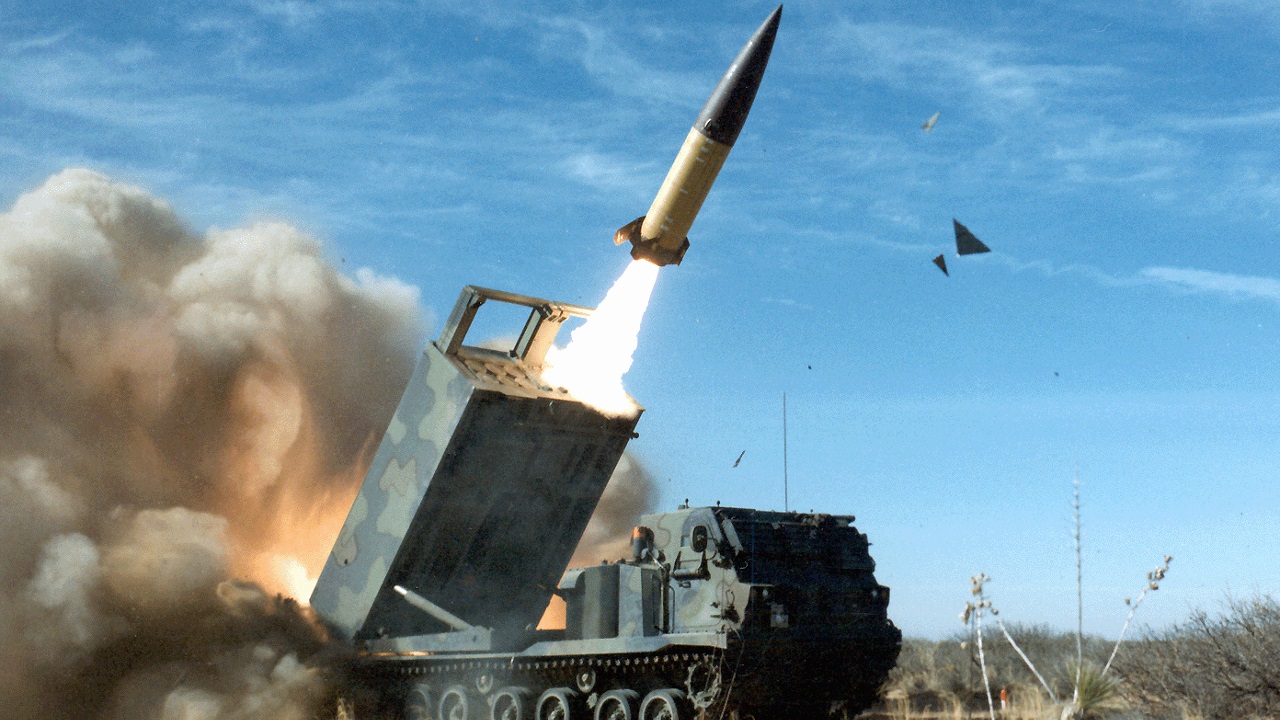
Lockheed Martin describes PrSM as a next-generation surface-to-surface weapon for the U.S. Army with a range of 499-plus kilometers, compatible with M270 Multiple Launch Rocket System and HIMARS launchers, and packed two rounds per launch pod. ATACMS, the older Army Tactical Missile System, reaches roughly 300 kilometers depending on variant. Those numbers matter less in the desert than they do across the Pacific.
Draw a 500-kilometer circle from northern Luzon and it reaches into the northern South China Sea and toward the Bashi Channel. Draw it from the Ryukyus and it begins to complicate Chinese surface movement through the approaches between Taiwan and Japan. Draw it from distributed sites around Guam and the circle is still not enough to solve the tyranny of distance, but it gives commanders a land-based strike option that does not require a carrier to stand inside a dense missile threat.
That is why PrSM is not just an Army modernization program. It is one of the few ways the United States can add mobile, land-based, survivable fires to a theater where fixed airfields are target folders and where every ship inside the first island chain has to assume it is being watched.
Iran Shows The Cost Of Stand-Off Warfare
The reported Iran expenditure shows why stand-off weapons create a dangerous illusion. They reduce aircraft risk, shorten decision cycles, and let commanders hit defended targets without repeatedly building large strike packages. Anyone who has stood watch on a destroyer understands the appeal. If a missile can do the job without putting a crew into a contested air corridor, commanders will reach for the missile.
But every successful stand-off shot is also a logistics transaction. The launcher has to be positioned, the round has to be shipped, the storage site has to be protected, and the replacement has to come from a production line that cannot be surged by memo. The issue is not whether a million-dollar missile is expensive. The issue is whether the next one exists when the next combatant command asks for it.
PrSM is especially exposed because it is replacing ATACMS before enough operational depth has accumulated. A mature weapon family can absorb bursts of expenditure. A transitional inventory cannot. If the United States burned down a large share of available PrSM in the Middle East, the Pacific did not lose a concept. It lost time.
China Does Not Need To Match The Missile
Beijing does not have to copy PrSM round for round to exploit this problem. The People Liberation Army Rocket Force already plans around saturation, base attack, runway disruption, port paralysis, and command-node suppression. Its goal in a first island chain fight would not be to win a precision-missile duel on American terms. It would be to force the United States and allies to spend interceptors and long-range fires faster than they can move or replace them.
That makes the Iran lesson uncomfortable. A regional adversary can impose global opportunity costs by absorbing strikes, dispersing targets, forcing defensive interceptor launches, and stretching a campaign past the point that prewar stockpile assumptions still hold. If Iran can do that from a single theater, China can plan to do it while also threatening Guam, Kadena, Yokosuka, Philippine access points, and the logistics routes that tie them together.
The United States has spent years talking about distributed operations. Distributed operations without distributed magazines are just dispersed targets waiting for resupply.
The Industrial Answer Is Too Slow For The Crisis
The Army request for roughly 1,134 PrSM rounds in fiscal 2027, cited in the Aug. 4 report, is the right kind of signal. It is also not an immediate wartime inventory. A funded missile is not the same as a delivered missile, and a delivered missile is not the same as one positioned at the right port, with trained crews, tested launchers, protected fuel, compatible communications, and authority to fire.
Lockheed Martin says PrSM is designed for accelerated production and future growth. That helps, but missile production is a supplier-network problem. Rocket motors, guidance components, explosives, electronics, test equipment, quality assurance, and skilled labor all move at industrial speed. The Pacific planning problem moves at crisis speed.
This is where Washington tends to cheat the spreadsheet. It counts program money as combat power. It counts alliance access as basing. It counts prototype demonstrations as operational capacity. In a Taiwan contingency, none of those substitutions survive first contact with missile consumption.
What The Pacific Needs Now
The fix is not to stop using ATACMS or PrSM where they are militarily necessary. The fix is to stop pretending one theater can consume long-range fires without consequence elsewhere. INDOPACOM needs ring-fenced inventories, forward storage that is actually hardened, more allied-compatible launch options, and cheaper weapons that can handle targets that do not deserve a scarce premium round.
Japan, Australia, and the Philippines also need a clearer role in the magazine problem. Access agreements help only if they are paired with munition storage, reload concepts, air and missile defense, deception, and political decisions made before the shooting starts. A launcher that cannot be reloaded under attack is a single-use signal.
The reported Iran missile burn is not proof that the United States cannot deter China. It is proof that deterrence depends on inventory depth as much as platform quality.
The Pacific does not need another slogan about integrated deterrence. It needs enough missiles in enough places to make Chinese planners doubt their first week of war. If ATACMS and PrSM stocks are already being drained by another theater, that doubt gets thinner. The range works. The magazine does not.
The United States has reportedly expended nearly all Army Tactical Missile Systems and Precision Strike Missiles during operations against Iran, impacting missile availability in the Pacific. This depletion raises concerns about the U.S. military's readiness to respond to potential conflicts in the region, particularly with China. The report emphasizes the need for improved logistics and inventory management to ensure sufficient missile stocks are available across theaters.
- The U.S. has reportedly used nearly all ATACMS and PrSM in operations against Iran.
- The operational logic in the Middle East affects missile availability in the Pacific.
- PrSM is designed for accelerated production but faces supply chain issues.
- China can exploit U.S. missile shortages without matching them round for round.
- The U.S. needs to improve missile inventory management in the Pacific.