
Australia’s First Collins Extension Shows AUKUS Still Has a Six-Boat Gap
 Marcus Chen
Australia’s First Collins Extension Shows AUKUS Still Has a Six-Boat Gap
Six submarines have to cover roughly fourteen years. That is the uncomfortable arithmetic behind Australia’s decision to begin the first Collins-class life-extension upgrade on HMAS Farncomb later this month.
According to Zona Militar, citing Australia’s Department of Defence, Farncomb will enter an initial technical assessment phase led by ASC, with Thales and BAE Systems supporting the broader sustainment effort. Canberra is putting about US$11 billion into submarine sustainment and life-extension work over the next decade, with Henderson in Western Australia and Osborne in South Australia remaining the two industrial anchors of the program.
The official language is careful. The Collins life-of-type extension is described as a way to preserve capability while Australia transitions toward nuclear-powered submarines under AUKUS. That is true. It is also incomplete. The program is not just a bridge. It is the bridge, because there is no other Australian undersea force available if the AUKUS schedule slips.
The First Boat Matters More Than the Press Release
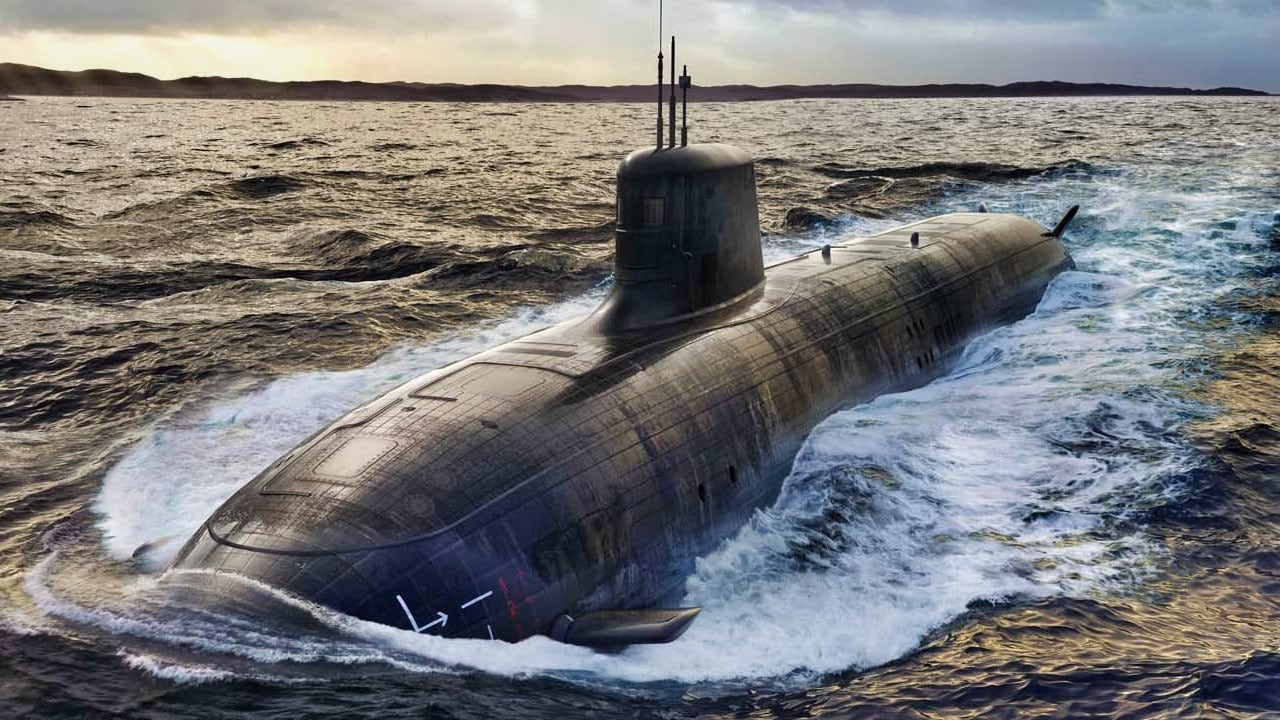
Illustrative submarine image used for analysis of Australia’s Collins-class sustainment and AUKUS transition.
Farncomb is not simply receiving a midlife refresh. The first boat will generate the engineering and maintenance data needed to guide work on the rest of the six-boat fleet. That matters because submarine maintenance is not a spreadsheet exercise. Once the hull is opened, the schedule becomes a negotiation with corrosion, obsolete components, workforce availability, and systems integration.
ASC says full-cycle docking for a Collins-class submarine takes about two years. During that period, the submarine is stripped, the hull is cut open, and major machinery, including diesel engines and the main motor, can be removed. ASC also notes that Collins boats receive updates to sonar, decoys, radar, combat systems, and support for special operations during deep maintenance.
Anyone who has served around naval maintenance knows what that means. The planned job is rarely the whole job. The first life-extension boat will tell Canberra whether the rest of the fleet can be modernized at the tempo AUKUS assumes.
AUKUS Depends on an Old Conventional Fleet
The basic AUKUS pathway still leaves Australia dependent on Collins-class submarines well into the 2030s. The first Virginia-class nuclear-powered submarines are expected only in the early 2030s, and Australia’s future SSN-AUKUS boats arrive later. Zona Militar notes the Collins fleet is intended to remain available until at least 2040.
That creates a simple force-availability problem. Australia operates six Collins-class submarines. If one boat is in a two-year full-cycle docking, another is in shorter maintenance, and a third is in training or work-up, the number of boats available for sustained operational tasking can fall quickly. A six-boat force does not behave like six submarines on station. It behaves like a small rotation base where every long maintenance period has operational consequences.
This is why the US$11 billion sustainment figure should be read as an operational investment, not an accounting line. It is buying time, availability, and industrial learning. It is also buying insurance against delays in the American submarine industrial base, where the Virginia-class program has already struggled to meet the tempo Washington wants for its own Navy, let alone for exports to Australia.
The Industrial Base Is the Real Deterrent
ASA’s AUKUS Submarine Industry Strategy makes the point indirectly. Australia’s nuclear-powered submarine program requires a sovereign industrial base able to build, operate, and sustain a multi-class submarine force, while keeping the existing Collins fleet sustained and upgraded until withdrawal. That is a hard dual task. It means the same national workforce ecosystem has to support today’s conventional boats and tomorrow’s nuclear-powered force.
There is a useful temptation in Washington and Canberra to talk about AUKUS as a future fleet of quiet nuclear submarines operating across the Indo-Pacific. The harder question is what Australia can put to sea in 2027, 2029, and 2031. China does not have to wait for SSN-AUKUS to arrive before changing the undersea balance. The People’s Liberation Army Navy is already expanding its submarine, surface, and anti-submarine warfare capacity across the western Pacific.
For Australia, Collins availability is therefore not a legacy issue. It is the live deterrent. A Collins boat on patrol can complicate Chinese planning around sea lines of communication, approaches to northern Australia, and routes through the Indonesian archipelago. A Collins boat in deep maintenance does none of that.
The Gap Is Manageable Only If Canberra Is Honest About It
The Farncomb upgrade is the right move. Letting the Collins fleet age out before nuclear-powered replacements arrive would be indefensible. But the decision also confirms that AUKUS rests on a narrow operational base for longer than politicians like to admit.
If the first life-extension cycle runs smoothly, Canberra gains a credible path to keeping six conventional submarines relevant into the 2040 window. If the work exposes deeper hull, systems, or workforce problems, Australia will face the worst version of the transition: old boats taking longer to sustain, new boats arriving later than advertised, and a regional competitor that keeps adding capacity while allies explain schedules.
The uncomfortable truth is that Australia’s undersea deterrent for the next decade is not the future SSN-AUKUS design. It is Farncomb, her five sisters, and the industrial system that keeps them deployable.
AUKUS may be the destination. Collins is still the fleet.
Australia is commencing the life-extension upgrade of HMAS Farncomb, the first Collins-class submarine, to sustain its undersea capabilities. This upgrade is part of a US$11 billion investment in submarine sustainment over the next decade, ensuring the Collins fleet remains operational until at least 2040. The program is critical as Australia transitions to nuclear-powered submarines under AUKUS, with the first Virginia-class submarines expected in the early 2030s.
- Australia is investing US$11 billion into submarine sustainment and life-extension work over the next decade.
- The first Collins-class submarine undergoing life-extension is HMAS Farncomb.
- The Collins fleet is expected to remain operational until at least 2040.
- Australia's nuclear-powered submarines under AUKUS are not expected until the early 2030s.
- The upgrade is crucial for maintaining operational capability against regional threats.