
Blue wave presages a defense-spending showdown

The Democrats' impending takeover of the House and the Senate will have sweeping effects on the Pentagon, from budgets to leadership to defense policy. The biggest near-term issue is the fate of the proposed reconciliation bill, which the Trump administration is counting on for $350 billion of its plans to spend $1.5 trillion on defense spending in fiscal 2027.
Even before the election, some Republican lawmakers doubted their ability to pass a bill through the reconciliation process, which is rarely used for defense funding. A lame-duck effort is unlikely to succeed, and January's seating of the new Democrat-controlled Congress is expected to kill the bill for good.
Defense spending
The administration pushed many top priorities into the unusual reconciliation bill, including:
• Munitions funding. The bill is a major conduit for money that would nearly double munitions spending to $76.3 billion to help rebuild stockpiles following several years of equipment transfers to Ukraine and a depletion of inventories during the war with Iran. It was meant to underwrite a production surge for air and missile defense munitions such as Patriot, THAAD, SM-3, and SM-6; plus strike weapons such as hypersonic missiles. Munitions funding is also included in a proposed Iran supplemental that faces resistance from Democrats who oppose the war.
• Golden Dome homeland missile defense system. The proposal includes $17 billion for a new Golden Dome for America Fund plus investment for related programs such as a Space-Based Air Moving Target Indicator capability and a revamped Space Data Network that would serve as the communications layer of the defense system.
• Unmanned systems. The bill includes nearly $54 billion for the Defense Autonomous Warfare Group.
• Aircraft: several F-35s and KC-130Js for the Air Force.
• Warships: The Medium Landing Ship and some investment in the Virginia-class submarine.
If the reconciliation bill is dead, lawmakers will have to decide whether to move any of those items into the defense appropriations bill.
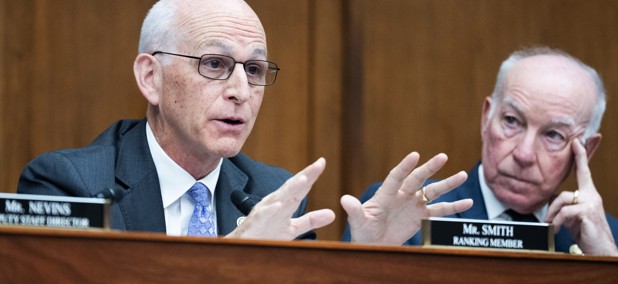
The Pentagon’s $1.1 trillion base budget request—that's $242.4 billion, or 28 percent, over the FY26 defense appropriations bill enacted by Congress—will face more resistance. Rep. Adam Smith, D-Wash., who is expected to once again lead the House Armed Services Committee after two years as its ranking member, said this week that he wants to keep total defense spending to $1 trillion in fiscal 2027.
The administration proposed to offset the Pentagon increase with reductions in domestic non-defense discretionary spending. The guns-versus-butter debate will be reignited, and it is unclear whether base budgets will stay above $1 trillion.
Political headwinds
Several programs are likely to face increased scrutiny in the new Congress.
Golden Dome’s space-based interceptors are a likely target for Democratic opposition. The Pentagon initially selected a dozen companies to work on SBIs, including Anduril, General Dynamics, Lockheed Martin, Northrop Grumman, Raytheon, and SpaceX. SpaceX, which has received $6.5 billion for the Space-Based Air Moving Target Indicator and Space Data Network programs, could face new roadblocks.
Also at risk: the Navy’s Trump-class battleship, the signature component of the proposed Golden Fleet. This author has already raised concerns about the practicality and affordability of the battleship, and Democrats are likely to push back on the program’s rapid development and construction plans. The Navy has chose General Dynamics Bath Iron Works and Huntington Ingalls Industries to build the ships, which would use a distributed construction approach. Leidos’ Gibbs & Cox was tasked with supporting ship design and engineering. If this program falls through, the Navy may revisit plans for the DDG(X) destroyer, which had been shelved in favor of the battleship.
The next Congress will also push the administration to end the war with Iran, which continues to disrupt shipping through the Strait of Hormuz. Democrats have been unwilling to act on the Iran-war supplemental request without establishing guardrails or an exit strategy. At the same time, Democratic majorities in the House and Senate are more likely to push for greater support for Ukraine, which could include more money, faster arms transfers, and pressure on the White House to avoid actions that could harm Kyiv.
Areas of alignment
The new Democratic minority is expected to continue to fund replenishing munitions stockpiles depleted during operations against Iran, despite Democratic opposition to the war itself. Counter-unmanned aircraft systems investment will remain a priority, from low-cost munitions to directed energy. Congress, which has long supported Navy shipbuilding, can be expected to add money for it, even if lawmakers disagree about specific platforms. There will also be continued support for developing autonomous gear and the networks that support them.
More budget delays expected
Congress failed to pass most budget legislation before the 2027 fiscal year began on Oct. 1, and the government is currently operating under a continuing resolution through December 11. That's not enough time to finalize a full spending plan, so the lame-duck Congress will likely pass another CR that extends into the next calendar year. Under the new Congress, passage of a final spending bill could be hindered by negotiations over the status of the Iran war, topline spending levels, the debt ceiling, or other policy issues.
Lawmakers might also pass a long-term CR, covering several months or even the rest of fiscal year. These stopgap spending bills typically restrict new start programs and production rate increases. Although lawmakers can provide workarounds for these limitations, as they did in fiscal 2025, a long-term CR could put a hold on dozens of new programs. The Army could see delays in starting procurement of the MV-75 tiltrotor aircraft and the XM30 Mechanized Infantry Combat Vehicle. Funding would also be limited for its new High Accuracy Detection and Exploitation System surveillance platform, Next-Generation Command and Control, and procurement of new Common Tactical Trucks.
The Navy would face funding gaps for its new FF(X) frigate program and procurement of new submarine tenders. Production of hypersonic Conventional Prompt Strike missiles and planned funding increases for MQ-25 development would also be blocked.
A long-term CR would affect several Air Force missile programs, including procurement of hypersonic AGM-183A Air-Launched Rapid Response Weapons (ARRW), Hypersonic Attack Cruise Missiles (HACM), and the Family of Affordable Mass Missiles (FAMM). The Air Force’s plan to start procurement of new Collaborative Combat Aircraft (CCA) would be delayed without an FY27 spending bill, as would investment in new technologies to defend aerial tankers and a new aircraft to conduct the Looking Glass mission currently performed by the Navy’s E-6B Mercury.
The U.S. Congress faces significant challenges in finalizing defense spending for Fiscal Year 2027 as Democrats prepare to take control. A proposed $350 billion reconciliation bill for defense is expected to fail, impacting various military programs. The Pentagon's base budget request of $1.1 trillion is under scrutiny, with potential delays in procurement and funding for critical military equipment.
- Democrats are expected to take control of the House and Senate, impacting defense budgets.
- A proposed reconciliation bill for $350 billion in defense spending is likely to fail.
- The Pentagon's base budget request is $1.1 trillion, facing resistance from lawmakers.
- Funding for various military programs, including munitions and unmanned systems, is at risk due to political opposition.
- Congress is operating under a continuing resolution, delaying budget finalization.