
Britain to build sub-hunting sensors for AUKUS underwater drones
Britain will lead development of three new sensor and effects packages for underwater drones under the AUKUS security partnership with the United States and Australia, with the systems due to be available across all three nations’ uncrewed underwater fleets from 2027, the UK Ministry of Defence said on Oct. 27.
The three payloads are a synthetic aperture sonar, a deployable anti-submarine warfare sensor and a deployable non-kinetic effector. The Ministry of Defence said they will let uncrewed underwater vehicles map the seabed in detail, place sensors that detect and classify underwater threats, and generate effects underwater, helping the drones watch large areas of ocean and protect undersea cables and pipelines.
A synthetic aperture sonar combines many sonar pings taken as the vehicle moves to build a much sharper image of the seabed than a conventional sonar of the same size, while the anti-submarine sensor is designed to be dropped or laid by the drone to keep listening for submarines and other threats after the vehicle moves on. The third payload, a non-kinetic effector, acts on a target without explosives or physical destruction, though the ministry did not say what form the British system will take.
The announcement closed a week of testing at Maritime Big Play Pacific, an AUKUS exercise in San Diego where the three countries test autonomous maritime systems in realistic conditions before wider adoption. It advances the first signature project under AUKUS Pillar 2, the part of the partnership covering advanced technologies such as autonomy and undersea warfare, which the three governments announced in May to develop payloads for uncrewed underwater vehicles, while Pillar 1 covers Australia’s acquisition of nuclear-powered attack submarines.
“The UK is all in on AUKUS, and this cutting-edge technology shows why. By leading development of these sensor payloads, we’re putting British innovation at the heart of AUKUS and strengthening our collective undersea capability,” said Luke Pollard, Minister for Defence Readiness and Industry.
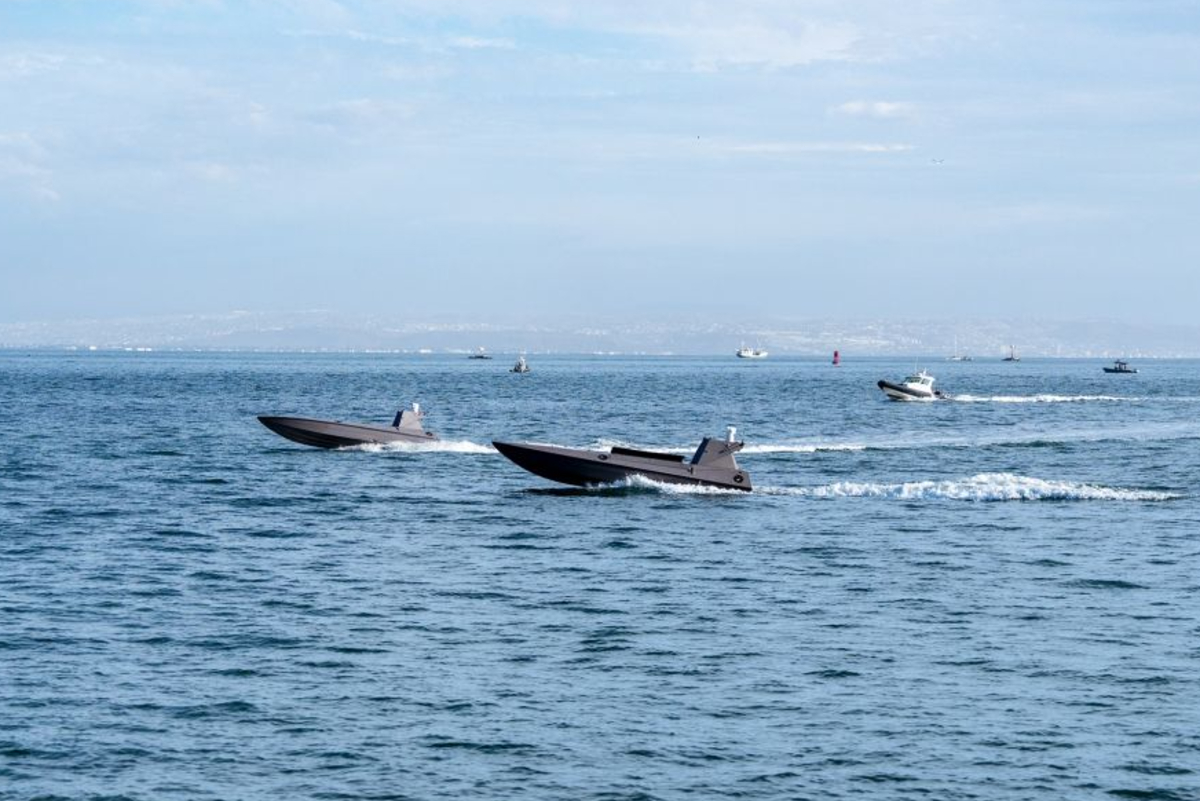
At Maritime Big Play, Australian, British and American crewed and uncrewed systems worked together across four strands: anti-submarine warfare, lethality, contested resupply, and subsea and seabed warfare. The UK led the anti-submarine strand, contributing 13 uncrewed surface vessels, two anti-submarine targets and four underwater gliders from six industry partners. Royal Navy Kraken K3 uncrewed boats also operated during the exercise, and one of them launched three short-range loitering munition quadcopters at Naval Base Point Loma on Oct. 20, showing how a drone boat can carry aircraft closer to an operating area without putting a crew at risk. American companies took part as well, including Saronic Technologies, which fielded three Corsair drone boats with U.S., British and Australian forces for pier resupply runs, some of them carried out with communications denied, and a trilateral sense-decide-effect mission within a mixed uncrewed fleet.
“Maritime Big Play-Pacific gives AUKUS a unique opportunity to turn autonomy into operational advantage,” said Royal Navy Capt. Keith Taylor.
The exercise also featured two of the four winners of the AUKUS Maritime Innovation Challenge, SEA Ltd of Frome and Decision Analysis Services Ltd of Basingstoke. Together with A2i of Dorchester and U.S. company MSI Transducers, they share £3 million (about $4 million) to develop technology for commanding, controlling and coordinating undersea systems.
The payload announcement follows another AUKUS undersea milestone last month. On Sept. 13, the Royal Navy’s extra-large uncrewed underwater vehicle XV Excalibur launched an inert U.S. Mk 48 heavyweight torpedo at the British Underwater Test and Evaluation Centre in Scotland, the first torpedo firing from an uncrewed submarine for either navy. The 12 m (39-foot) Excalibur is an experimental vessel used to test autonomy and new payloads for the Royal Navy’s planned Hybrid Navy, which mixes crewed warships and submarines with uncrewed systems.
Britain is funding the work as part of its Defence Investment Plan, which sets out £298 billion (about $396 billion) in defense spending over the next four years.
Content preview only. Full article available at source. View Full Article
Britain will lead the development of three new sensor packages for underwater drones as part of the AUKUS security partnership, with systems expected to be operational by 2027. The UK Ministry of Defence announced this during the Maritime Big Play exercise in San Diego, where various uncrewed systems were tested. The new technologies aim to enhance anti-submarine warfare capabilities and protect undersea infrastructure.
- Britain will develop three new sensor packages for underwater drones under AUKUS.
- The systems will be available across the uncrewed underwater fleets of the UK, US, and Australia by 2027.
- The payloads include a synthetic aperture sonar and an anti-submarine warfare sensor.
- The announcement follows a week of testing at the Maritime Big Play Pacific exercise in San Diego.
- The UK is investing £298 billion in defense spending over the next four years.