
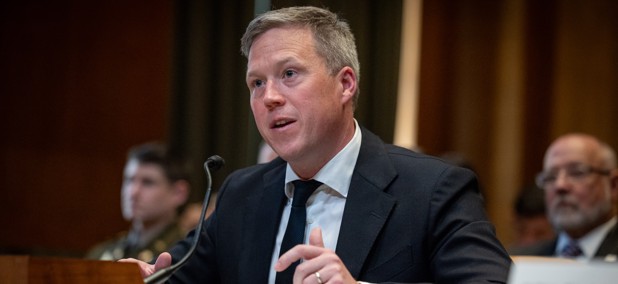
Dan Driscoll, whom President Donald Trump in 2024 hailed as “a disruptor and change agent,” has resigned as secretary of the Army.
The move was first reported by the Wall Street Journal. A source directly familiar with the matter confirmed the news and said Defense Secretary Pete Hegseth’s purging of generals who were tied to Driscoll’s innovation and transformation efforts was a primary cause for the resignation.
“Driscoll brought up concerns with the administration surrounding Army transformation and readiness, and Hegseth's blocking those efforts, specifically by firing the generals who were responsible,” the source said.
A former Army Ranger who led a platoon with the 10th Mountain Division, Driscoll graduated from Yale Law School and worked in investment banking before the White House tapped him as the Army’s top civilian leader.
In the post, he worked closely with a tight set of uniformed military leaders to push a reform agenda across the Army. Those leaders included: Army Chief Gen. Randy George; Gen. David Hodne, commander of Transformation and Training Command; Army Vice Chief of Staff Gen. James Mingus; and Gen. Christopher Donahue, commander of U.S. Army Europe and Africa—all of whom Hegseth has pushed out or removed.
Sen. Jack Reed, D-R.I, in a statement, said that he did not welcome the news. “I am alarmed that Secretary Driscoll’s leadership of the Army stands in stark contrast to Secretary Hegseth’s disastrous tenure atop the Defense Department.”
“We cannot fucking wait.”
Driscoll launched his reform agenda, the Army Transformation Initiative, in May 2025—an agenda informed, at least in part, by Ukraine’s experience rapidly innovating new technologies to resist Russia’s invasion.
“When you look at Ukraine, [they] have not accepted the current version of a thing as sufficient, and they have MacGyvered and come up with whatever they have to do to get to an outcome they need,” he told Pentagon reporters last November.
The key elements of Driscoll’s agenda included integrating artificial intelligence into decision making; pushing more purchasing, equipping, and equipment modification powers down the chain of command, closer to actual warfighters; deploying modernized drone formations; and addressing what he described as a “gap” in counter-drone technology.
“I am publicly on record saying we are learning a lot from them, and we are changing a lot of the lessons that they have taught us,” he said of Ukraine’s military.
In a peppery AUSA address last October, Driscoll described the urgency of transforming the United States Army. “We will win with silicon and software and not our soldiers’ bodies… No one can predict the next war, but we cannot wait, we cannot fucking wait to innovate until Americans are dying on the battlefield.”
Following the ouster of Gen. George, the U.S. Army, under new acting chief Gen. Christopher LaNeve, sent a statement to The Wall Street Journal that a drone battalion that had been working with Ukrainians on integrating lessons learned from drone warfare would be phased out, part of what the statement called a “back-to-basics approach.”
Dan Driscoll resigned as secretary of the Army in 2024, influenced by Defense Secretary Pete Hegseth's removal of generals linked to Driscoll's reform agenda. This agenda, inspired by Ukraine's military innovations, aimed to enhance Army transformation and readiness. Senator Jack Reed criticized the leadership changes, highlighting concerns over the Army's direction under Hegseth's tenure.
- Dan Driscoll resigned as secretary of the Army in 2024.
- His resignation was influenced by Defense Secretary Pete Hegseth's purging of generals.
- Driscoll's reform agenda was inspired by Ukraine's military innovations.
- Sen. Jack Reed expressed alarm over Driscoll's resignation.
- The U.S. Army is shifting towards a 'back-to-basics' approach following leadership changes.