
China Is Studying Trump-Class Battleships for Pacific Weaknesses
 Marcus Chen
China Is Studying Trump-Class Battleships for Pacific Weaknesses
The proposed U.S. Navy Trump-class battleship is not in the water, but Chinese military analysts are already treating it as a targeting problem. That is the important development. Beijing's interest is not evidence that the design works; it is evidence that Washington has offered the People's Liberation Army a large, expensive question to solve.
The Numbers Make the Program a Strategic Bet
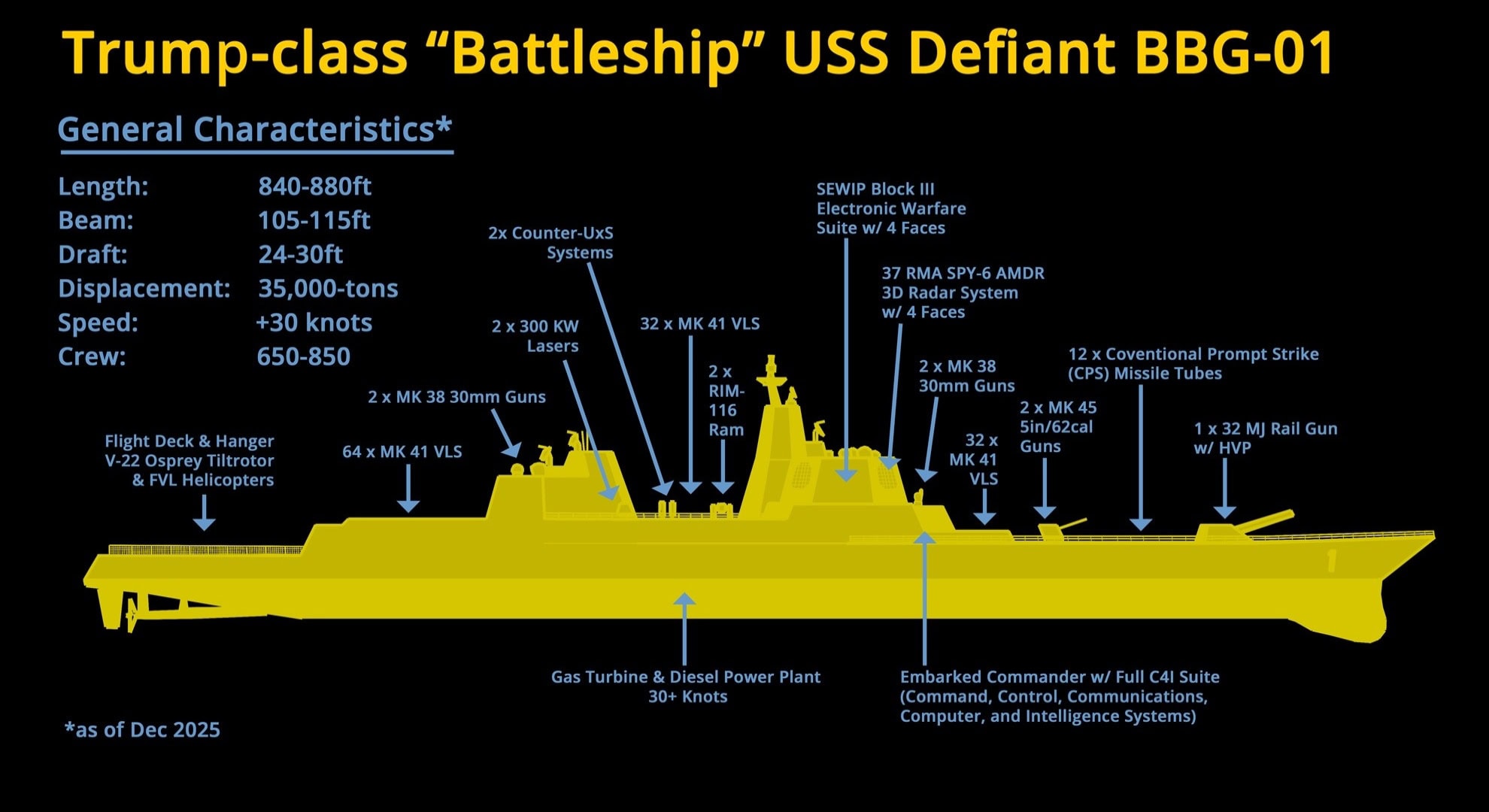
As Defense News reported on September 3, the current concept calls for as many as 15 nuclear-powered battleships built from 2028 through 2056. The estimated program cost is $275 billion, including a $23.4 billion price tag for the lead ship. Spread evenly across 28 years, that is barely more than half a hull per year. The arithmetic is already a warning: a fleet intended to reshape American sea power would arrive at a pace too slow to provide a rapid answer to China's expanding navy.
The proposal is deliberately ambitious. The ships could carry very large missile magazines and may eventually host rail guns, hypersonic weapons, directed-energy systems, and possibly nuclear-armed missiles. Nuclear propulsion would allow long patrols without conventional refueling. A large hull would also have more room for power generation, sensors, damage-control systems, and weapons than a cruiser or destroyer.
But these are proposed capabilities, not an operational specification. The design is not mature, and the most technically demanding systems are not all ready for fleet integration. That distinction matters. A ship designed around future weapons can become a floating schedule slip while its navy waits for the weapons to exist.
Beijing Sees a Concentrated Target
China National Defense News, an official PLA newspaper, assessed the concept on August 21. Its argument was not that a large ship has no value. The paper acknowledged that a heavily protected vessel could continue some missions when communications are jammed and could absorb more damage than smaller combatants. Those are real advantages in a fight where networks fail and repair capacity is scarce.
The PLA assessment nevertheless highlighted the vulnerability created by concentrating combat power in one hull. Quiet submarines, hypersonic missiles, and drone swarms do not need to sink a battleship to make it ineffective. They need to force it away from the threat axis, exhaust its interceptors, damage its sensors, or keep it under continuous surveillance. A ship that survives but loses its radar, communications, flight deck, or missile cells is not providing the same combat power its brochure promises.
That is the Pacific problem. A battleship cannot hide its logistics signature, and a nuclear reactor does not eliminate the need for food, maintenance, escorts, ammunition, and secure ports. Its endurance between fuel stops may be measured in months, but its ability to remain in a contested operating area depends on the entire support architecture around it.
The Concept Conflicts With Distributed Maritime Operations
The U.S. Navy has spent years developing Distributed Maritime Operations, or DMO. The idea is straightforward: spread sensors, command functions, and strike capacity across many nodes so an adversary cannot cripple the force by destroying a few high-value ships. DMO does not mean every platform must be small. It does mean the fleet should avoid making one platform the answer to every tactical problem.
The Trump-class concept pulls in the opposite direction. Fifteen ships would not constitute a broad network; they would be a small number of exceptionally valuable nodes. If the lead ship costs $23.4 billion, the commander who risks it must be willing to accept a level of exposure that is politically and operationally difficult. If the commander keeps it outside the densest missile threat, the ship's large magazine may be irrelevant to the opening fight.
This is not a theoretical concern. The proposed force would enter a Western Pacific battlespace saturated with China's land-based anti-ship missiles, maritime patrol aircraft, submarines, surface combatants, and unmanned systems. The battleship could contribute long-range fires, air defense, and command capacity, but it would still require a screen. Every escort assigned to protect the capital ship is an escort unavailable for another convoy, carrier group, or distributed missile unit.
Shipbuilding Is the Real Contest
The most damaging part of the PLA analysis is its industrial calculation. It notes that leading U.S. shipyards are facing average delays of roughly five years, with the delivery cycle for an individual ship stretching from about five years in the early 2000s to approximately 11 years today. Whether every yard and class fits that average is less important than the direction of travel: American naval ambitions are expanding faster than American production capacity.
Nuclear-powered battleships would compete for reactor components, specialist labor, dry-dock space, and engineering attention with Virginia-class attack submarines, Columbia-class ballistic-missile submarines, and aircraft carriers. Those programs already carry the missions Washington cannot delegate. If a new capital-ship line slows submarine output, the United States would trade the platform best suited to sea denial for a platform that needs a larger protective envelope.
There is also a financial opportunity cost. $275 billion could buy a much larger mix of submarines, unmanned underwater vehicles, long-range anti-ship missiles, air-defense interceptors, and resilient communications nodes. That portfolio would be less impressive in a parade and harder for China to target. It would also fit DMO far better.
What China Wants Washington to Build
Chinese strategists are not neutral observers here. If the United States spends decades building a small fleet of nuclear surface giants, Beijing gains a predictable planning problem and perhaps a delay in less glamorous programs. The PLA paper's skepticism should therefore be read as both analysis and influence: it is describing a vulnerability while encouraging Washington to invest in it.
The right response is not to reject every large surface combatant. A battleship could be useful as one component of a balanced fleet if its design is stable, its weapons are real, and its escorts are available. But the burden of proof is unusually high. Before authorizing 15 hulls, the Navy should demonstrate the mission with a smaller test article, publish a credible weapons schedule, and show that submarine and carrier production will not be displaced.
The current math points in the other direction. Fifteen ships over 28 years is not a wartime surge; it is a long-term industrial experiment. China is already studying how to defeat the concept before the first keel is laid. If Washington builds the battleship before it has solved the network, the magazine, and the shipyard, Beijing will not need to sink the fleet. It will only need to let the program consume it.
Sources and Assessment
- Defense News, “Chinese military analysts can’t wait for the US Navy’s battleship era,” September 3, 2026.
- China National Defense News, PLA assessment of the proposed Trump-class battleship, August 21, 2026, as cited by Defense News.
- U.S. Navy Distributed Maritime Operations concept, referenced for comparison with the proposed concentrated force structure.
China is studying the vulnerabilities of the proposed U.S. Navy Trump-class battleship, which is set to be built from 2028 to 2056. The People's Liberation Army (PLA) assesses that concentrating combat power in a single hull presents significant risks, especially in the Western Pacific, where it would face numerous threats. The report indicates that the U.S. Navy's strategy may conflict with its own Distributed Maritime Operations concept, potentially impacting naval readiness.
- China is analyzing the vulnerabilities of the proposed U.S. Navy Trump-class battleship.
- The U.S. plans to build 15 nuclear-powered battleships from 2028 to 2056 at a cost of $275 billion.
- The PLA highlights the risks of concentrating combat power in a single hull.
- The U.S. Navy's Distributed Maritime Operations concept conflicts with the Trump-class battleship strategy.
- Chinese strategists view the U.S. battleship program as a predictable planning problem.