
China Is Turning a US LCS Patrol Into a South China Sea Test
 Marcus Chen
China Is Turning a US LCS Patrol Into a South China Sea Test
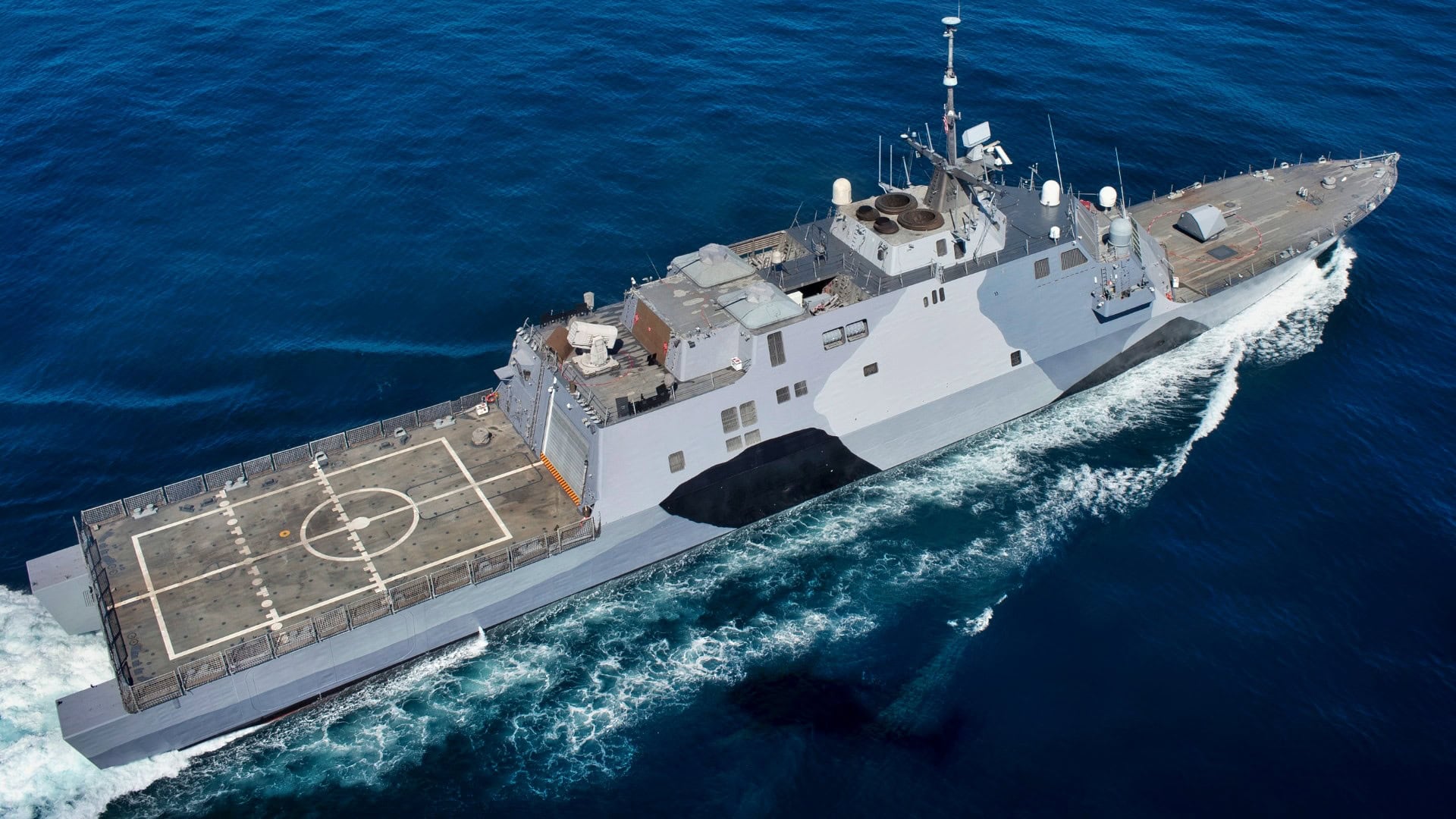
The U.S. Navy sent one Independence-class littoral combat ship near Sabina Shoal on October 20. China responded by dispatching naval forces to track it. No collision occurred, no weapon was fired, and the USS Charleston did not withdraw. That sounds like a non-event. It is not.
The encounter shows how Beijing is using routine American presence operations to rehearse a more demanding question: can China make a U.S. warship operate as if it is already inside a Chinese-controlled maritime zone, without having to fire a shot?
The Contact Was Small but Deliberate
Sabina Shoal, called Escoda Shoal by the Philippines and Xianbin Jiao by China, sits roughly 76 to 78 nautical miles northwest of Palawan. That places it well inside the Philippines' 200-nautical-mile exclusive economic zone and close to the routes used for Philippine patrols and resupply operations toward the Spratlys.
According to Reuters reporting cited in the incident coverage, a Chinese Southern Theater Command Navy spokesperson accused the Charleston of entering Chinese-claimed waters without authorization. The U.S. Seventh Fleet said the ship was conducting routine operations in international waters. Philippine Rear Admiral Roy Vincent Trinidad rejected Beijing's description of the area as Chinese territory.
The important detail is what Beijing did not disclose. China did not identify the tracking vessels, state how close they came, or say how long the surveillance lasted. There was no reported attempt to force the Charleston out. That is consistent with calibrated pressure: create a record of interception, establish a public claim, and keep the encounter below the threshold that would trigger a military response.
The Charleston Is Fast, Present, and Limited
The Charleston is a 127.4-meter trimaran with a full-load displacement of about 3,100 tons. Its combined diesel and gas-turbine propulsion can push the ship beyond 40 knots, and its nominal range is about 4,300 nautical miles at 18 knots. Those characteristics make it useful for presence missions around reefs, chokepoints, and contested fishing grounds.
Its shallow draft and aviation facilities also matter. Depending on its configuration, the ship can support MH-60 helicopters or MQ-8 unmanned aircraft, giving a commander additional eyes over a busy surface picture. The ship carries a Mk 110 57-mm gun, 30-mm cannons, SeaRAM point defense, and, on appropriately equipped ships, Naval Strike Missiles.
But the Charleston is not an Arleigh Burke-class destroyer. It does not carry the Aegis combat system or the destroyer's long-range area-air-defense battery. A Burke brings roughly 90 or 96 vertical-launch cells; the LCS brings none of that magazine depth. If the mission is presence, the Charleston is a credible tool. If the mission becomes sea control under missile threat, the arithmetic changes quickly.
That distinction is exactly why the encounter matters. China did not need to confront a carrier strike group. It tested the political and operational space around a lightly armed U.S. surface combatant operating near a Philippine flashpoint.
Beijing Is Building Pressure by Layers
Philippine monitoring recorded 31 Chinese naval and coast guard vessels near four contested areas during October 13–19, up from 27 the previous week. The count included 23 China Coast Guard cutters and eight PLAN warships. Scarborough Shoal accounted for 16 vessels, while Sabina Shoal had two PLAN ships. Coast guard vessels therefore made up nearly three quarters of the observed force.
That distribution is more revealing than the headline encounter. Beijing can put military ships behind a large coast guard presence, while presenting each individual operation as law enforcement. The result is a layered force that complicates any U.S. or Philippine response. A coast guard cutter can crowd a patrol vessel; a naval ship can remain over the horizon; maritime militia can add mass without carrying the same escalation signal as a frigate.
Taiwan saw a similar pattern on October 18, when its coast guard said it confronted 16 Chinese coast guard, research, and fishing vessels operating around Taiwan and Pratas Island. Al Jazeera reported that Taipei described the activity as coordinated maritime harassment and noted that Taiwan counted 244 Chinese coast guard, research, and other ships around its main island in July, compared with 58 in the same month a year earlier.
These are not identical operations, and the numbers should not be treated as a single order of battle. They do point to a common method: use civilian or quasi-civilian vessels to normalize presence, then use naval forces to backstop the claim when an American or allied warship appears.
The US Has a Presence Problem
Washington is right to keep operating. Avoiding Sabina Shoal would reward a maritime claim that the Philippines rejects and that the 2016 arbitral ruling did not recognize. A U.S. ship also gives Manila evidence that alliance commitments have operational content.
But presence is not the same as leverage. One LCS can document a challenge and complicate Chinese planning. It cannot defend a resupply convoy against a coordinated missile, aircraft, submarine, and coast guard campaign. Nor can it remain indefinitely without nearby logistics, intelligence support, air cover, and a second ship ready to take over.
The practical answer is not to send only larger warships everywhere. It is to make the patrol part of a network: Philippine maritime domain awareness, U.S. long-range aircraft, unmanned surveillance, allied surface ships, and a clear plan for what happens if a Chinese vessel crosses from shadowing into obstruction. Without that network, freedom-of-navigation operations risk becoming scheduled appearances that China can monitor and narrate.
The Test Is Already Underway
The Charleston encounter did not change control of Sabina Shoal. It did show that China can combine legal language, coast guard mass, and naval shadowing around a U.S. patrol while keeping the temperature below open confrontation.
That is the test Washington now has to answer. Can the United States turn a single patrol into persistent, distributed access—or will every future operation be another isolated ship entering a Chinese-managed tactical picture? The Charleston was present. The next question is whether presence can survive contact.
Sources
The USS Charleston conducted a patrol near Sabina Shoal on October 20, 2026, while being tracked by Chinese naval forces. China did not attempt to force the U.S. ship out, indicating a strategy of calibrated pressure. The incident highlights ongoing tensions in the South China Sea, with China employing a layered maritime presence to assert its claims without direct confrontation.
- The USS Charleston conducted a patrol near Sabina Shoal on October 20, 2026.
- China dispatched naval forces to track the USS Charleston without firing weapons.
- Philippine Rear Admiral Roy Vincent Trinidad rejected China's claims over the area.
- China monitored the USS Charleston with 31 naval and coast guard vessels in the region.
- The encounter illustrates China's strategy of using coast guard presence to assert territorial claims.