
China Sends Guilin Back as 368 Missile Cells Signal Overmatch
 S.W
S.WChina Sends Guilin Back as 368 Missile Cells Signal Overmatch
Five Chinese destroyers operating together in the South China Sea put roughly 368 vertical launch system cells into one drill package. That number matters more than the video itself.
USNI News reported on September 3 that the Type 052D guided-missile destroyer Guilin (164) has returned to frontline service with the People's Liberation Army Navy after last year's fatal collision near Scarborough Shoal. Guilin appeared in a Southern Theater Command combined flotilla alongside Type 052D sister ships Weinan (166), Changsha (173), Guiyang (119), and the Type 055 cruiser-sized destroyer Zunyi (107). Chinese Military Online footage showed live firing from main guns, close-in weapon systems, long-range cruise missiles, and surface-to-air missiles.
The immediate story is that one damaged destroyer came back. The larger story is that Beijing can put a repaired Type 052D back into a destroyer-heavy surface action group and use it to send a message to Manila, Washington, Tokyo, and Canberra: the South China Sea is no longer a coast guard theater with navy ships in reserve. The navy is already inside the daily coercion cycle.
The Ship Returned Faster Than the Politics Moved
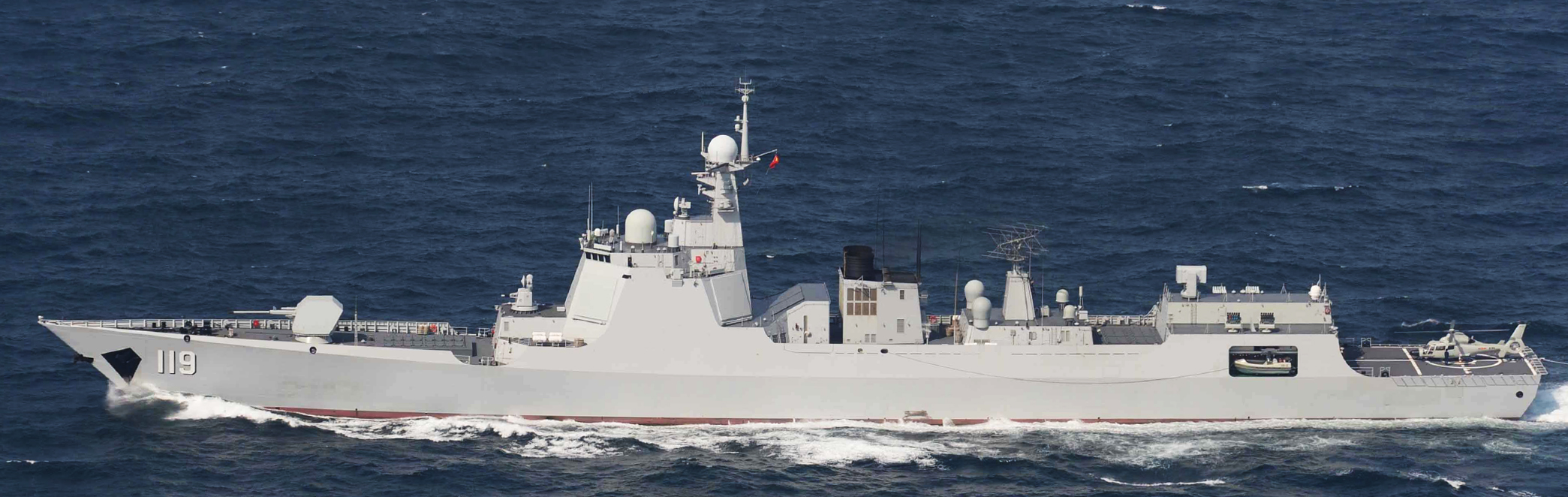
Guilin is not an old frigate brought out for propaganda footage. The Type 052D is one of the PLAN's core modern air-defense destroyers, usually credited with 64 vertical launch cells, an active electronically scanned array radar, HHQ-9 series long-range surface-to-air missiles, YJ-18 anti-ship missiles, land-attack cruise missile options, a 130 mm main gun, and layered close-in defense. At roughly 7,500 tons full load, it is large enough to matter in blue-water escort work and still numerous enough to appear routinely in the South China Sea.
Last August, according to USNI News reporting at the time, Guilin collided with China Coast Guard cutter 3104 during a failed chase of the Philippine Coast Guard vessel BRP Suluan near Scarborough Shoal. The coast guard cutter took the worst of it, with its bow effectively sheared off. Reuters later reported that two Chinese coast guard personnel were publicly marked as martyrs after the incident, confirming the fatal character of a collision Beijing initially handled carefully.
A year later, the destroyer is back in a live-fire formation. That is a repair story, but it is also a readiness story. Navies do not advertise a damaged ship's return unless they are confident enough in the hull, crew, sensors, and weapons chain to put the ship in front of cameras. Anyone who has stood watch on a destroyer knows a ship can be technically repaired long before it is trusted for demanding operations. The PLAN clearly wants observers to see Guilin as trusted again.
The Math Is the Message
Start with the launch cells. Four Type 052Ds at 64 cells each produce 256 cells. Add Zunyi, a Type 055 with 112 cells, and the visible formation carries about 368 cells before counting deck guns, helicopters, electronic warfare, or shore-based aircraft that may be cued into the same operating picture.
That is not a one-for-one missile inventory count. Cells can be loaded with different weapons, and a peacetime drill load is not the same as wartime expenditure. But VLS capacity gives a rough measure of how much air-defense, anti-ship, and strike volume China can concentrate near contested reefs without deploying an aircraft carrier.
Compare that with the Philippine Navy units that usually face Chinese pressure around Scarborough Shoal and Second Thomas Shoal. Manila has capable new ships, including Jose Rizal-class frigates from South Korea and ex-U.S. Coast Guard cutters, but it does not have a destroyer force, area air-defense depth, or comparable missile magazines at sea. A Philippine patrol can show presence. A PLAN destroyer group can threaten escalation across the air, surface, and land-attack domains.
That is the gap.
For the United States and its allies, the uncomfortable part is that this is not the PLAN's high-end war plan. This is what China can do as a routine theater-command signal. The South China Sea is close to Chinese bases, covered by shore-based aviation, backed by coast guard and maritime militia hulls, and fed by a shipbuilding base that keeps adding modern combatants. If China can normalize destroyer formations around Philippine flashpoints in peacetime, wartime access becomes a harder problem before the first shot.
Scarborough Is Becoming a Naval Problem
Scarborough Shoal used to be discussed mostly as a law-enforcement standoff: coast guard cutters, water cannons, blocking maneuvers, fishing access, and diplomatic protests. That frame is now too small. The 2025 collision showed the danger of mixing coast guard pursuit tactics with a navy destroyer in crowded waters. Guilin returning in 2026 shows that the navy side of that mix was not chastened out of the area.
China's public line is that these drills counter what it calls rights-violation and provocative acts. The operational pattern is more important than the slogan. Manila conducts patrols with partners such as the United States, Japan, and Australia. Beijing replies with larger formations, more sensors, and heavier weapons. Each cycle makes the next Philippine patrol more dependent on allied backing, and each allied patrol gives China an excuse to rehearse higher-end responses.
The Type 055 in the formation is especially telling. A 112-cell ship such as Zunyi is not needed to shadow a Philippine coast guard cutter. It is useful if China wants to practice local sea control under the assumption that U.S., Japanese, or Australian aircraft and ships might enter the picture. In that case, the problem is not one shoal. The problem is the air and missile umbrella around the shoal.
Washington Should Stop Counting Presence as Deterrence
The U.S. answer to South China Sea coercion has often been presence: freedom of navigation operations, joint patrols, rotational access in the Philippines, and exercises with allies. Presence is necessary. It is not sufficient.
A destroyer formation like the one USNI described forces a harder question. If a Philippine resupply mission or patrol gets boxed in again, how much allied firepower is actually nearby, how fast can it arrive, and how long can it stay? A U.S. destroyer passing through the area sends a legal and diplomatic signal. It does not by itself solve the magazine depth problem when China can mass multiple modern surface combatants under land-based cover.
This is where the arithmetic turns against Washington. U.S. Seventh Fleet has excellent ships, crews, submarines, and aircraft. It also has too many missions: Taiwan, Korea, Japan, the Philippine Sea, the South China Sea, Guam defense, and Indian Ocean connective tissue. China can choose one flashpoint and surge local weight. The United States has to decide whether it is willing to keep enough combat power close enough to make the surge unattractive.
The answer is not panic. It is logistics and posture. The Philippines needs coastal anti-ship missiles, air-defense coverage, hardened sensors, and repairable bases more than symbolic patrol photos. The United States needs munitions stocks west of the date line and command arrangements that let allied ships operate as a force, not as separate flags in the same camera frame. Japan and Australia need to treat Scarborough and the Luzon Strait as connected problems, because Chinese pressure in one area shapes the other.
The Repair Timeline Has Its Own Warning
Guilin returning after a fatal collision does not prove the PLAN can absorb wartime battle damage at scale. A navigational collision and missile damage are different engineering problems. But it does show a service that can take a politically embarrassing accident, keep the ship out of sight, repair it, and reinsert it into a high-visibility drill with other first-line combatants.
That is not trivial. Battle networks are made from ships, crews, yards, fuel, magazines, and command habits. The South China Sea formation around Guilin suggests those habits are becoming more aggressive and more routine at the same time.
Manila cannot match 368 launch cells. Washington should not pretend that it can be everywhere with one or two passing ships. The operational reality is harsher: China is turning Scarborough into a place where coast guard coercion is backed by destroyer firepower. Unless allied planning starts from that fact, presence will keep arriving after the overmatch is already on station.
Five Chinese destroyers, including the Type 052D guided-missile destroyer Guilin, conducted live-fire drills in the South China Sea in September 2023. The formation showcased approximately 368 vertical launch system cells, highlighting China's naval capabilities. The Guilin returned to frontline service after repairs following a collision in 2025, indicating a shift towards a more aggressive naval posture in the region.
- Five Chinese destroyers, including the Guilin, conducted live-fire drills in the South China Sea.
- The Guilin returned to service after a collision in 2025.
- The formation included 368 vertical launch system cells, indicating significant firepower.
- China's naval presence in the South China Sea is increasing, signaling a shift from coast guard operations to naval dominance.
- The operational pattern suggests a more aggressive stance by the PLAN in the region.