
China Sends Type 054B to Scarborough Shoal and Raises the 2026 Sea Control Bar
 Marcus Chen
China Sends Type 054B to Scarborough Shoal and Raises the 2026 Sea Control Bar
A Type 054B frigate showed up around Scarborough Shoal on July 30. That is the useful fact. The rest of Beijing's messaging about routine patrols and sovereignty can be left to diplomats.
China's Southern Theater Command released footage of a combat readiness patrol around Huangyan Island, the Chinese name for Scarborough Shoal, showing a Type 054B frigate, JL-10 advanced trainer aircraft, and drone footage of a Philippine aircraft. The same operating picture was reinforced by South China Morning Post reporting that a Type 054B guided-missile frigate with bow number 555 and three Chinese coast guard ships shadowed a US-Philippine maritime cooperation activity roughly 50 nautical miles from the shoal.
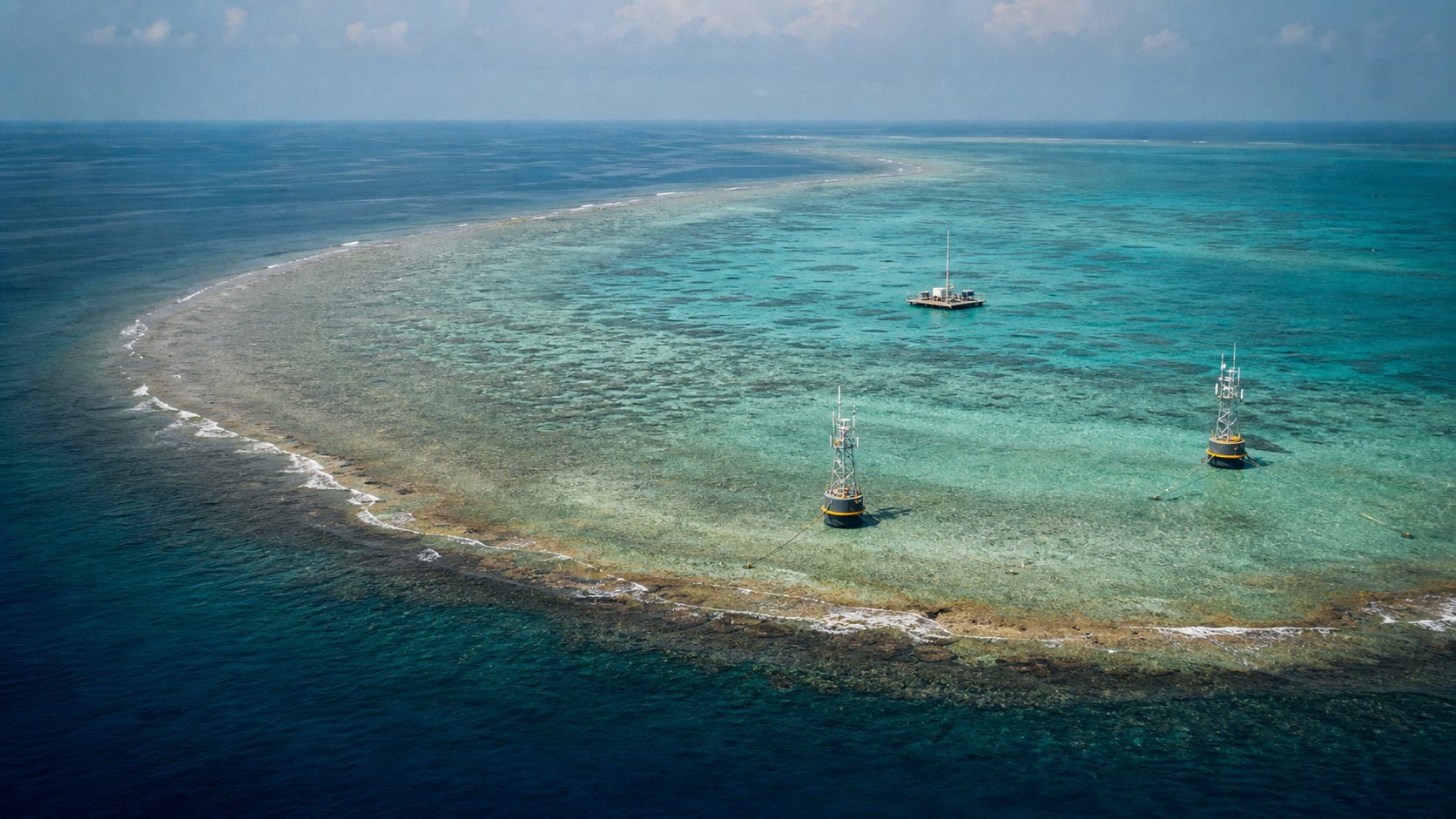
That mix matters more than the press release. A new-generation frigate, coast guard cutters, aircraft overhead, and drones watching the Philippine side is not just a patrol package. It is a layered sea-control demonstration around a feature about 120 nautical miles west of Luzon and effectively controlled by China since 2012.
The 054B Changes the Escort Math
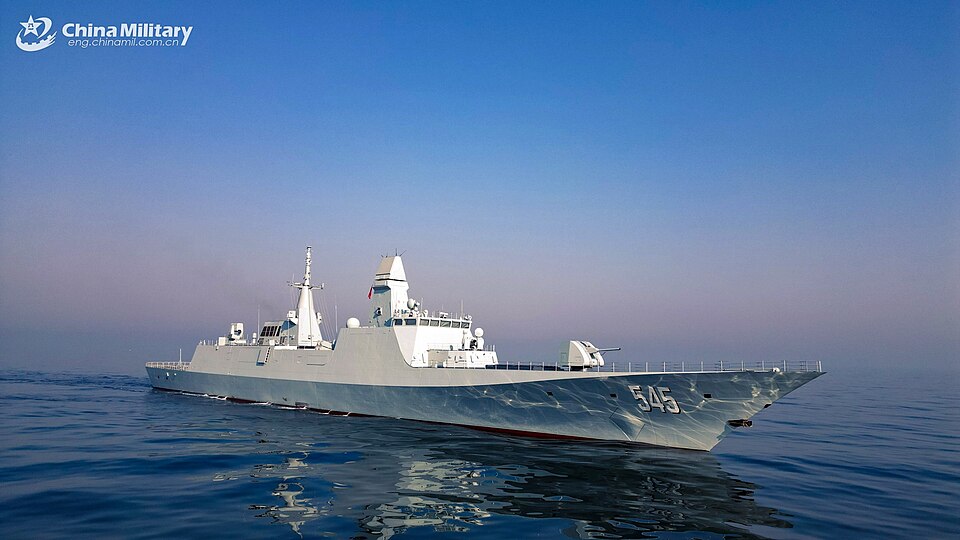
The Type 054B is not a destroyer and should not be treated like one. It is closer to a modern frigate built to do the unglamorous work that keeps a surface force alive: local air defense, anti-submarine screening, command-and-control support, and presence operations that do not require a 10,000-ton Type 055.
Open-source estimates put the Type 054B at roughly 5,000 to 6,000 tons, larger than the older Type 054A. The design is reported to carry a 32-cell vertical launch system, a 100 mm main gun, close-in weapons, improved sensors, and facilities for the larger Z-20 helicopter. The exact combat system fit remains partly opaque, but the direction is clear. The People's Liberation Army Navy is building a frigate with better endurance, sensors, aviation capacity, and fleet utility than the workhorse 054A.
For Scarborough Shoal, that is enough. Beijing does not need to park a carrier or a Type 055 next to the atoll every time Manila conducts a drill. It needs ships that can stay on station, coordinate with coast guard cutters, keep sensors up, and complicate any Philippine or allied attempt to operate near the shoal without being watched.
That is where the 054B becomes operationally interesting. A frigate like this can sit between the coast guard layer and the destroyer layer. It gives the Southern Theater Command a naval asset with more combat credibility than a white-hull cutter but less escalatory weight than a major surface combatant.
Scarborough Is Close Enough to Be Dangerous
Scarborough Shoal is not a distant Spratly feature. It sits roughly 120 nautical miles from Luzon, inside the area Manila treats as part of its exclusive economic zone, and close enough to Subic Bay that every patrol there has immediate alliance meaning. Anyone who has stood watch on a destroyer knows the geography is not abstract. At 15 knots, a ship covers 120 nautical miles in eight hours. At aircraft speed, it is a short hop.
That is why the July 30 package deserves attention. The Chinese coast guard presence handles the law-enforcement narrative. The frigate provides the implied escalation ladder. Aircraft add vertical reach. Drones provide evidence collection and targeting-quality surveillance, even if Beijing does not describe them that way.
The result is a maritime bubble that can be switched from peacetime messaging to crisis pressure quickly. A Philippine aircraft photographed by a Chinese drone is not being shot at. It is being catalogued, tracked, and folded into a sensor picture that tells Manila it is operating inside a watched space.
The point of the Type 054B at Scarborough is not to win a battle by itself. The point is to make every Philippine or US-Philippine move near the shoal happen under Chinese observation and inside a Chinese escalation ladder.
The US-Philippine Drill Trigger Is the Pattern
SCMP reported that the PLA dispatch came after Manila said four Chinese vessels monitored a US-Philippine maritime exercise near Scarborough Shoal. The exercise included Philippine Navy and coast guard vessels alongside US Coast Guard cutters. That is a modest allied package, not a carrier strike group. Beijing still answered with a navy-and-coast-guard shadowing force.
This is the emerging rhythm. Manila and Washington run a maritime activity. Beijing answers with a mixed force. Chinese state media then pushes footage that frames the patrol as normalized defense of Chinese-controlled waters. The tactical event ends, but the new baseline remains.
The 054B matters because baselines are built with repeatable assets. China has enough coast guard hulls to maintain pressure. It has enough older frigates to appear regularly. The newer frigate adds a signal that the PLAN is willing to assign modern combatants to a contested gray-zone location when allied drills approach.
That creates a problem for the Philippines. Manila can win the legal argument and still face a daily operational deficit. The Philippine Navy has a small number of capable frigates, including the Jose Rizal class, and a coast guard that has been stretched by resupply missions, escort tasks, and constant documentation of Chinese actions. Every Scarborough patrol burns fuel, crew time, and maintenance hours. China can make that cost routine.
Washington Has a Presence Problem
The United States can surge impressive capability into the South China Sea. It cannot keep a destroyer or cutter permanently glued to every flashpoint. That is the math Beijing is exploiting.
A US Coast Guard cutter in a bilateral activity helps Manila politically and tactically. It shows the treaty ally is not alone. But if the Chinese answer is a repeatable package of one frigate, several coast guard ships, aircraft, and drones, Washington has to decide whether it wants to match presence day after day or accept that China owns the tempo between exercises.
There is no clean naval answer here. A US Navy destroyer near Scarborough would be more capable than a Type 054B, but also more politically loaded. A coast guard cutter is less escalatory, but it does not change the hard-power balance. Maritime patrol aircraft can document and deter harassment, yet they cannot hold water. The alliance needs persistence, and persistence is always a logistics bill.
That is the uncomfortable part of the Scarborough problem. The shoal is close to Luzon, but China's nearby bases, southern fleet assets, maritime militia, and coast guard mass allow Beijing to turn proximity into pressure. The United States and the Philippines can conduct high-visibility drills. China can answer with low-visibility repetition.
What to Watch Next
The next indicator is not whether the Type 054B appears once. It is whether 054B-class frigates begin cycling through Scarborough, Second Thomas Shoal approaches, or the waters west of Luzon during every US-Philippine maritime activity.
Three signs would point to a real shift. First, repeated deployment of 054B hulls rather than occasional older 054A frigates. Second, more integrated drone footage released by Chinese official channels, especially if it tracks Philippine aircraft or vessels over time. Third, coast guard and navy formations operating with visible air cover, not as separate events but as a standing package.
If those signs appear, the July 30 patrol will look less like propaganda and more like a trial run for a new Scarborough operating model.
The 054B is not a war-winning ship. It does not have to be. At Scarborough Shoal, the side that can keep sensors, cutters, and credible combatants on station owns the daily facts. Right now, Beijing is building those facts faster than Manila and Washington are building the habits to contest them.
Sources: China's Southern Theater Command footage carried by Huanqiu on July 31; South China Morning Post reporting on Chinese vessels shadowing US-Philippine drills near Scarborough Shoal; Naval News reporting on earlier PLA Navy and bomber activity around Scarborough during Balikatan 2026; CSIS Asia Maritime Transparency Initiative geography on Scarborough Shoal.
China deployed a Type 054B frigate to Scarborough Shoal on July 30, 2023, to conduct a combat readiness patrol. This deployment included three Chinese coast guard ships and JL-10 aircraft, which shadowed US-Philippine maritime activities. The presence of the frigate and supporting assets demonstrates China's intent to maintain operational pressure in the region and complicate allied operations.
- A Type 054B frigate was deployed to Scarborough Shoal on July 30, 2023.
- The frigate was part of a layered sea-control demonstration involving coast guard ships and aircraft.
- Chinese forces shadowed US-Philippine maritime cooperation activities near Scarborough Shoal.
- The Type 054B frigate is designed for local air defense and presence operations.
- China aims to maintain operational pressure on Philippine and US forces in the region.