
China Shadows USS Charleston at Sabina Shoal, Testing US Resolve in 2026
 Marcus Chen
China Shadows USS Charleston at Sabina Shoal, Testing US Resolve in 2026
The USS Charleston is not a cruiser, a carrier, or a missile destroyer. It is an Independence-class littoral combat ship with a relatively small crew and a 57mm gun. Yet Beijing sent naval forces to track it near Sabina Shoal on October 20. That choice matters more than the ship's size.
China's Southern Theatre Command said the Charleston had entered waters near the Spratly feature without Chinese approval and had "illegally intruded" on China's sovereignty. The United States does not accept that legal premise. The Philippines, which also contests the feature, said the ship did not enter Chinese territory and had the right to transit international waters without asking permission.
A Small Ship Creates a Large Test
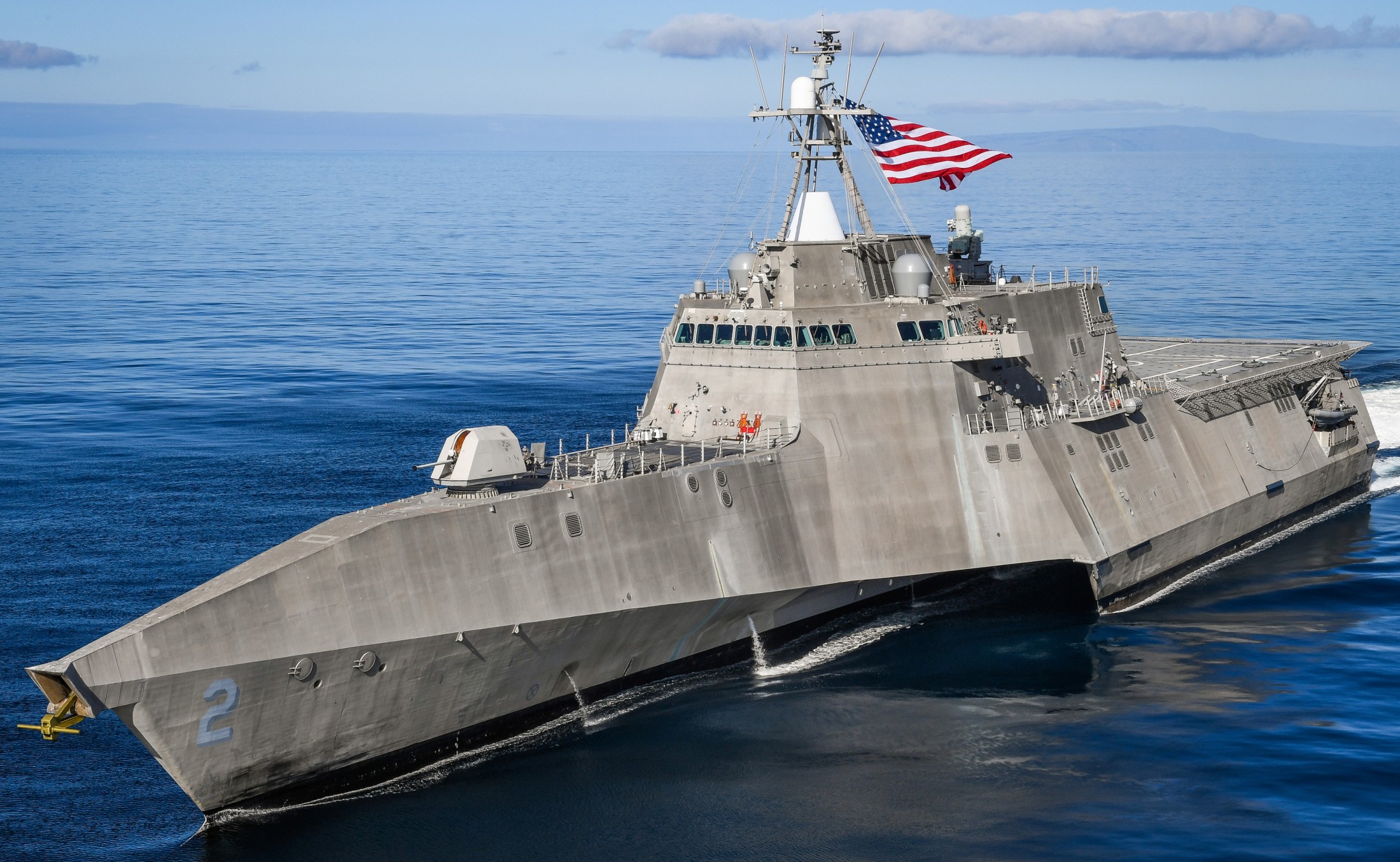
USS Charleston (LCS-18) is about 418 feet long and displaces roughly 3,500 tons full load. Its Independence-class trimaran hull is built for speed, with a top speed above 40 knots, but it carries far less air-defense and strike depth than an Arleigh Burke-class destroyer. Its importance here is therefore operational rather than explosive.
A littoral combat ship can conduct surface warfare, maritime security, and presence missions while operating close to shore. It is a useful platform for testing whether an opponent will challenge the navigation of a US warship without escalating to a level that demands a carrier strike group. The ship's limited magazine is precisely the point: Washington is demonstrating a legal and naval claim with one comparatively exposed hull.
Reuters reported that the US Navy had not immediately commented and that the mission was consistent with the freedom of navigation operations the Navy routinely describes in legal terms. The last known US freedom-of-navigation mission in the South China Sea was more than a year earlier, according to the report. That gap makes this transit easier for Beijing to frame as a political event, even though the underlying principle has not changed.
Sabina Shoal Is a Collision Point
Sabina Shoal, also known as Escoda Shoal, sits in the Spratly Islands and is claimed by both China and the Philippines. It has become one of the most dangerous points in the Manila-Beijing contest because the confrontation is being conducted by coast guard and maritime militia vessels rather than only by warships.
Last month, a China Coast Guard vessel rammed a Philippine boat near the same shoal during a refueling mission, according to the Philippine Coast Guard. Beijing blamed the Philippine side. The physical geography is less important than the pattern: China is using persistent law-enforcement presence to turn a disputed claim into a daily operating reality, while the Philippines is relying on its treaty relationship with the United States to keep access open.
The Charleston transit cuts across that pattern. If China can force a US warship to request permission before entering waters Beijing claims, it has converted a contested assertion into a de facto veto. If the United States sends a ship and then backs away whenever Chinese forces approach, the operation becomes a photograph rather than a policy.
The operational question is not whether the Charleston can defeat the Chinese force shadowing it. It is whether the United States will continue to sail after China says it cannot.
Beijing Is Expanding the Geography of Pressure
The same Reuters report described a separate confrontation near the Pratas Islands, where Taiwan's Coast Guard said a Chinese Coast Guard ship entered restricted waters. Taiwan's vessel Taichung warned the Chinese ship, and both sides broadcast mutually incompatible sovereignty claims. The Pratas incident is hundreds of miles from Sabina Shoal, but the operating method is familiar: a coast guard hull enters, broadcasts a legal narrative, and forces the other side to decide how much risk it will accept.
That is a wider problem than a single freedom-of-navigation patrol. Chinese coast guard activity near Taiwan's east coast has already raised concern in Western capitals because it tests whether Beijing can impose pressure on the less-defended side of the island. At Pratas, the immediate issue was not a fleet battle. It was whether Taiwan could keep control of a remote outpost without creating an incident that China could exploit.
For US planners, the map now contains several simultaneous pressure points: the Spratlys, the Pratas Islands, the Taiwan Strait, and the approaches east of Taiwan. A single ship can signal commitment at one point, but it cannot provide sea control across all of them. The math is unforgiving. Presence is useful; presence everywhere is impossible.
What Washington Should Measure Next
The next US move should not be judged by the number of headlines it produces. It should be judged by four concrete indicators. First, does the Navy publish a clear legal basis for the transit? Second, does the Philippines receive timely operational information rather than discovering the patrol after Chinese statements? Third, can US and Philippine forces maintain lawful activity after a shadowing encounter? Fourth, does Washington repeat the operation on a schedule Beijing cannot predict?
Those questions expose the limits of symbolic patrols. The Charleston is a credible ship for a presence mission, but it cannot independently suppress Chinese coast guard tactics, protect Philippine resupply boats, and deter a larger maritime force. That requires layered coordination among coast guards, aircraft, surface combatants, and allied political decision-makers.
It also requires restraint. China has an incentive to make every transit look like an attack on sovereignty. The United States has an incentive to answer every challenge with a larger platform. Neither reaction improves control of the water. The useful response is repetitive, legally coherent, and backed by allies who are prepared to remain on station after the cameras leave.
The Test Is Persistence
Beijing's decision to track USS Charleston is not proof that China can close the South China Sea. It is proof that China is willing to spend naval and coast guard attention contesting even a small US ship near a contested feature. Washington should treat that as a campaign of pressure, not an isolated encounter.
The Charleston's displacement, speed, and weapons load will not decide the issue. Persistence will. If US ships continue to operate lawfully, if Philippine vessels can resupply without being physically driven away, and if allied forces make the same claim from different directions, China's shadowing tactic remains an assertion. If those activities stop after each protest, Sabina Shoal becomes another place where the strongest statement belongs to the side willing to stay.
Sources: Reuters, "China sends naval forces to monitor US warship near disputed shoal," October 20, 2026; U.S. News, Reuters republish, "China Sends Naval Forces to Monitor US Warship Near Disputed Shoal," October 20, 2026; U.S. Navy, public ship and carrier-strike-group releases, October 2026.
China shadowed the USS Charleston near Sabina Shoal on October 20, 2026, asserting claims over the disputed waters. The USS Charleston, an Independence-class littoral combat ship, was conducting a freedom of navigation operation, which China labeled as an illegal intrusion. The Philippines supported the U.S. position, stating the ship had the right to transit international waters. This incident underscores the ongoing maritime tensions in the South China Sea.
- USS Charleston was tracked by Chinese naval forces near Sabina Shoal.
- China claims the USS Charleston illegally entered its waters.
- The Philippines supports the USS Charleston's right to transit international waters.
- The incident reflects ongoing tensions in the South China Sea.
- China is using coast guard tactics to assert sovereignty over disputed areas.