
China Tests 7,300 Kilometer SLBM and Makes Taiwan Pressure Routine
 Marcus Chen
China Tests 7,300 Kilometer SLBM and Makes Taiwan Pressure Routine
Fifty-four nautical miles is close enough to matter and far enough to be treated as routine. That is the number behind the latest Chinese Coast Guard presence east of Taiwan, according to Defense News reporting from New Taipei City. In June, Chinese white-hulled vessels operated roughly 100 kilometers from Taiwan. On July 6, a Chinese submarine-launched ballistic missile flew about 7,300 kilometers into the Pacific with a simulated warhead.
Those are not the same operation. One is a slow maritime pressure campaign. The other is nuclear signaling. But together they show a cleaner Chinese method for the western Pacific: keep the daily pressure below the threshold of naval combat, then use occasional long-range missile demonstrations to remind every capital from Tokyo to Canberra that escalation space belongs to Beijing too.
That is the uncomfortable part. China is no longer just showing that it can surge aircraft around Taiwan for a few days. It is testing whether it can make presence itself boring.
The Coast Guard Is the Point
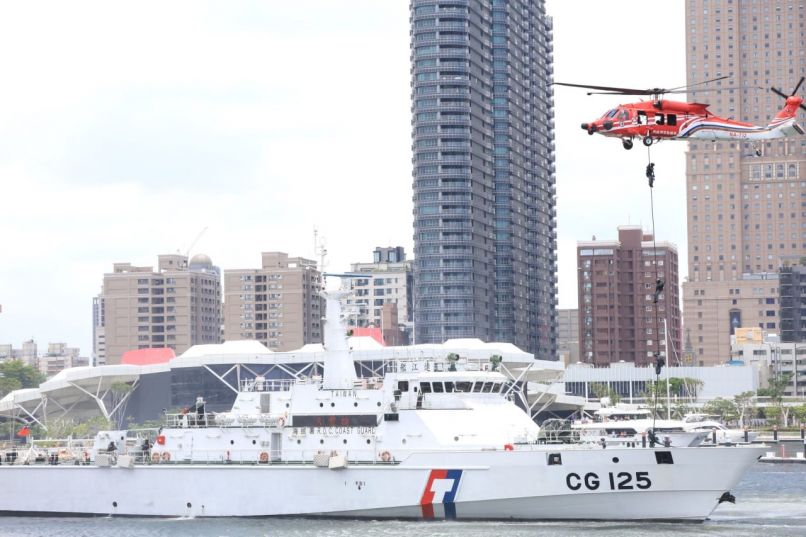
The military significance of the patrol is not that a Chinese cutter can threaten Taiwan by itself. It cannot. The point is endurance, legal ambiguity and response cost. A coast guard vessel can sit, rotate and claim law enforcement language in a way a destroyer cannot. Defense News cited analysts who said Chinese formations had rotated on July 4 and that Beijing described the mission as sustained routine law enforcement patrols.
That word, routine, is doing real work. Once a Chinese patrol east of Taiwan becomes routine, Taiwan and its partners face a bad menu. Ignore it, and the operating picture shifts. Match it with coast guard units, and the daily burden rises. Send naval forces, and Beijing claims Washington or Taipei escalated a police matter into a military one.
Anyone who has stood watch in a crowded operating area understands the practical problem. The first ship is a contact report. The tenth day is a patrol pattern. The thirtieth day becomes a planning assumption. If Chinese cutters can normalize presence east of Taiwan, they begin shaping the backside of the island without firing a shot.
The 7,300 Kilometer Message
The missile test is a different instrument. Defense News reported that the July 6 submarine-launched ballistic missile carried a simulated training warhead and flew roughly 7,300 kilometers, likely over parts of the Philippines, before falling into the Pacific. A July 7 Defense News report separately said the missile traveled about 7,000 kilometers toward waters near Nauru and Tuvalu, raising objections tied to the South Pacific Nuclear Free Zone.
The exact missile type remains unconfirmed in open reporting. Analysts cited by Defense News assessed it was likely a JL-2 or JL-3 class submarine-launched ballistic missile. The JL-2 is generally associated with the Type 094 ballistic missile submarine force, while the newer JL-3 is associated with longer-range sea-based deterrence. For operational planners, the distinction matters. For regional governments, the immediate message is simpler: China wants its sea-based nuclear leg to look usable, not ceremonial.
A 7,300 kilometer trajectory is not just a range number. Draw that arc from the South China Sea and it crosses the mental map of every Indo-Pacific headquarters. It tells Australia that the southern Pacific is no longer a rear area in political terms. It tells Japan that nuclear signaling can appear alongside conventional pressure. It tells the Philippines that its geography may sit under test paths as well as combat routes.
Beijing called the launch part of annual military training and said relevant countries were notified. That matters, but it does not neutralize the signal. Notification reduces accident risk. It does not make a submarine ballistic missile flight a weather report.
The Operational Math
China is pairing two timelines. The coast guard patrol works on a daily clock. It forces Taiwan to spend attention, hull days and political oxygen. The missile test works on a strategic clock. It compresses distance and reminds the region that any crisis around Taiwan or the South China Sea would not remain neatly conventional.
Washington usually answers this problem with presence: carrier strike groups, destroyer transits, bomber task force rotations, Marine littoral regiments and exercises such as Valiant Shield. Presence is necessary. It is also expensive. A Chinese coast guard cutter can impose a surveillance and response requirement at a lower cost than a U.S. Navy destroyer can sustainably answer it.
That asymmetry is the center of the problem. The United States and its allies can win spectacular demonstrations of capability. China is trying to win the calendar. If Beijing can make Taiwan spend every day reacting east of the island while periodically punctuating the theater with long-range missile tests, the burden falls on alliance endurance, not just alliance firepower.
This does not mean China has solved the Taiwan problem. Amphibious lift, undersea vulnerability, joint command friction and economic risk still make an invasion a brutal proposition. But the patrol-and-missile pattern points to another path: constrict the operating environment before a blockade, and make regional intervention planning more politically expensive before a shot is fired.
What Should Change
The answer is not to treat every cutter as a warship. That would help Beijing frame the response as overreaction. The better answer is disciplined matching. Taiwan, Japan and the Philippines need coast guard coordination that is more regular, more public and less ad hoc. The United States should support the maritime picture with intelligence, surveillance and reconnaissance, but avoid making every white-hull encounter look like a U.S.-China naval standoff.
On the missile side, allies need to stop treating Chinese nuclear signaling as a separate file from gray-zone maritime pressure. They are connected in crisis management terms. A routine patrol can become a blockade rehearsal. A rare submarine launch can become the background music to that rehearsal. The same command system has to think about both.
The Pentagon can surge a carrier. It cannot surge routine. That is why this matters.
China is testing whether the first island chain can be worn down by presence before it is challenged by force. The 7,300 kilometer missile got the headlines, but the harder problem may be the cutter that comes back tomorrow, and the day after that, until everyone starts calling it normal.
China conducted a submarine-launched ballistic missile test on July 6, 2023, demonstrating a range of 7,300 kilometers, likely over the Philippines, before landing in the Pacific. Concurrently, Chinese Coast Guard vessels maintained a routine presence near Taiwan, indicating a strategy to normalize operations and exert pressure on Taiwan and its allies. This dual approach combines military signaling with sustained maritime operations.
- China tested a submarine-launched ballistic missile with a range of 7,300 kilometers on July 6, 2023.
- Chinese Coast Guard vessels operated near Taiwan, maintaining a routine presence.
- The missile test is part of China's military training and nuclear signaling strategy.
- The missile likely flew over parts of the Philippines before landing in the Pacific.
- China aims to normalize its maritime presence near Taiwan to exert pressure without direct conflict.