
China's 2026 Carrier Fleet Has Become the U.S. Navy's Target
 Marcus Chen
China's 2026 Carrier Fleet Has Become the U.S. Navy's Target
China now operates three aircraft carriers, and Washington is finally being forced to ask the uncomfortable question Beijing has asked for years: how do you hunt the other side's flattops? A new Center for Strategic and International Studies (CSIS) study argues that the United States and its Pacific allies should stop treating Chinese carriers only as a threat to be defended against and make them the target of a distributed attack campaign. The concept is sound. The force available to execute it is not.
The New Target Set
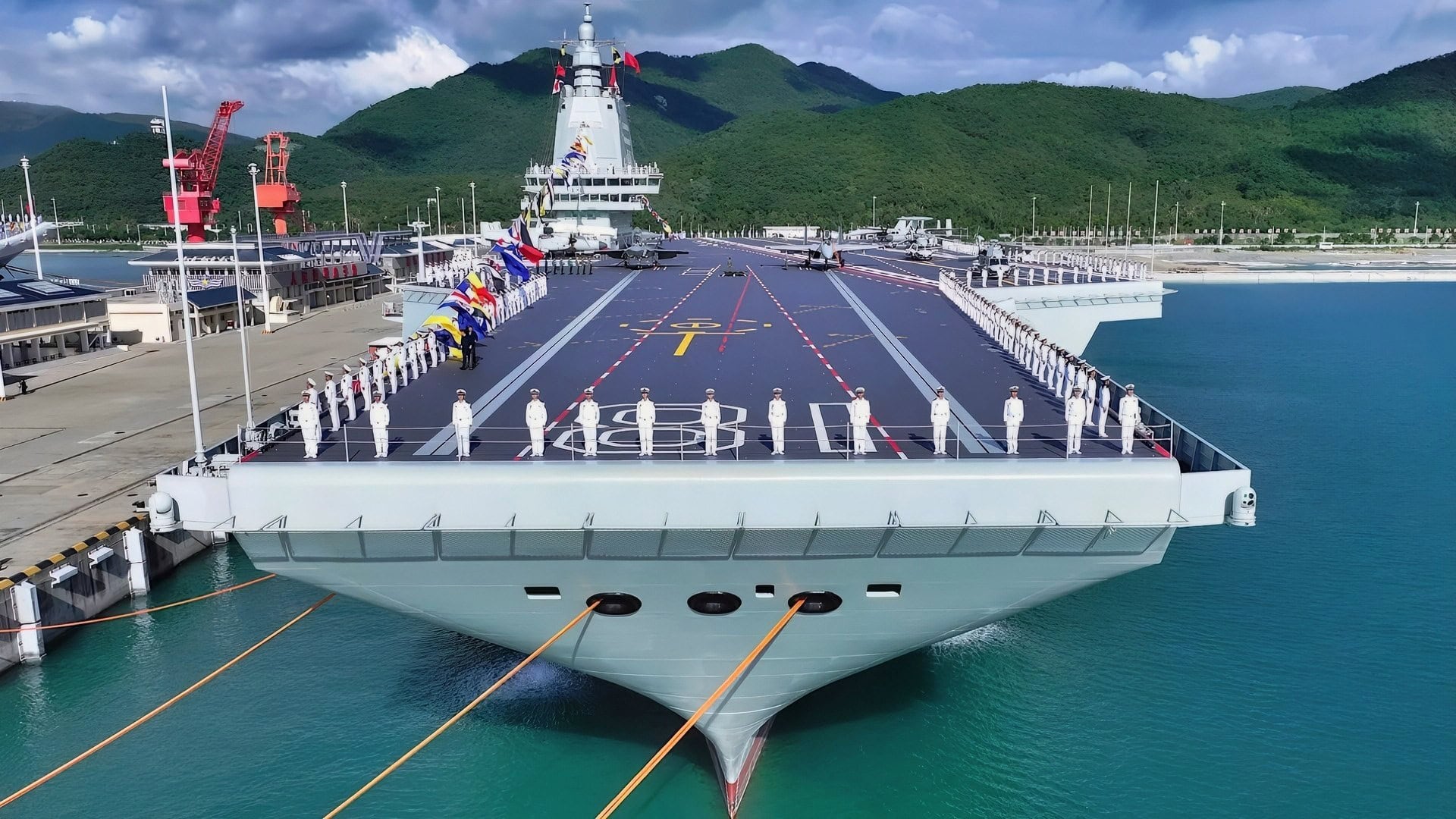
CSIS calls its report “Flip the Script”. Its premise is straightforward: a carrier is not merely a weapon system but a political and operational node. China’s Liaoning, Shandong, and Fujian-class carriers require escorts, air-defense coverage, replenishment, maintenance, and a reliable flow of targeting data. Threaten the whole network and the carrier becomes expensive to use even if it is never sunk.
That matters because China’s carrier program is moving from prestige project to force-generation machine. Defense News, reporting on the CSIS study on September 17, cited a 2025 Pentagon estimate that the People’s Liberation Army Navy could build six additional carriers by 2035. More hulls will give Beijing more options for training, regional presence, and coercive signaling. They will also create more high-value assets that must be protected.
How the Ambush Belt Would Work
The CSIS proposal combines several layers. Nuclear-powered attack submarines would provide the deep-water threat. Allied diesel-electric boats from Australia, Japan, and South Korea could complicate approaches and chokepoints. Land-based anti-ship missiles in Japan and the Philippines would cover predictable routes into the Philippine Sea. Aircraft carrying long-range anti-ship weapons would add another axis, while satellites, maritime patrol aircraft, electronic warfare, and cyber operations would try to turn detection into a firing solution.
Uncrewed systems are the connective tissue. Underwater vehicles could watch ports and approaches for long periods without putting a crewed submarine at risk. Uncrewed surface vessels could force Chinese escorts to spend missiles and attention on cheap targets. The objective is not a cinematic carrier kill. It is to make every sortie a calculation in which the probability of losing a Fujian-class ship is high enough that Chinese commanders keep it behind the first island chain.
“The central idea is to make a carrier’s routine employment around Taiwan, the South China Sea, or beyond the first island chain appear prohibitively risky, day in and day out,” the CSIS report argues.
The Arithmetic Is the Problem
Any former surface officer recognizes the appeal of a distributed ambush belt. It complicates an opponent’s route planning and creates uncertainty before the first missile is launched. But a concept is not a capability. The United States does not currently have enough attack submarines, torpedoes, undersea sensors, or reloadable precision missiles to maintain a dense threat envelope across the Western Pacific during a long war.
CSIS itself identifies the industrial bottleneck. Its proposed fleet would move from the Navy’s current ambition of roughly 350 manned ships and 150 surface and underwater drones toward a force split of about 300 manned and 300 unmanned vessels. That is not a modest procurement adjustment. It requires new designs, new software, new operators, new maintenance chains, and bases able to host systems that may be scattered from Japan to the Philippines.
The munitions problem is more immediate. If every Long-Range Anti-Ship Missile, SM-6, or Naval Strike Missile must be manufactured in North America and shipped across the Pacific after a crisis begins, the campaign has already lost time. The same is true of heavyweight torpedoes. Submarines can be stealthy and still become irrelevant when their magazines are empty.
China's Carriers Are Vulnerable but Not Helpless
The “carrier as vulnerability” argument also needs discipline. A carrier rarely operates alone. China can use shore-based aircraft, long-range missiles, maritime patrol platforms, satellites, and a growing escort fleet to push the threat line outward. Its home waters offer shorter logistics routes than those available to the United States. A U.S. submarine stalking a Chinese carrier near Taiwan may be operating inside a sensor and missile complex designed to find and kill it.
Nor does Beijing need to risk its carriers in the first hours of a Taiwan contingency. The PLA could use land-based aviation and missile forces to establish local superiority, then employ carriers selectively once the American and allied force picture is degraded. A carrier that stays in port still contributes aircraft, command capacity, and political leverage. “Sunk” and “neutralized” are different operational outcomes.
The Real Test Is Sustained Denial
The CSIS report is right that the United States should exploit Chinese carrier vulnerability. It is wrong only if Washington interprets the idea as a license to substitute a report for a magazine depth. The practical requirement is a persistent sea-denial campaign: enough submarines to rotate on station, enough unmanned vehicles to accept losses, enough missiles to fire repeatedly, and enough allied access to reload and repair without creating a single point of failure.
That also changes the alliance conversation. Japan and the Philippines are not simply launch pads, and Australia is not a spare submarine supplier. Their political consent, base resilience, targeting networks, and stockpiles are part of the firing system. If those pieces are missing, the “ambush belt” exists only on a briefing slide.
China’s carriers are valuable targets precisely because they are difficult to replace and politically expensive to lose. But the United States cannot build a credible hunt around a handful of exquisite platforms and optimistic delivery schedules. The math is clear: a carrier-killing strategy requires a much larger force of submarines, drones, sensors, and munitions than the United States can field today. Until that changes, Washington has identified Beijing’s pressure point without yet acquiring the knife.
Sources
The U.S. Navy is evaluating a strategy to target China's aircraft carriers, including Liaoning, Shandong, and Fujian, as part of a broader military campaign. This strategy aims to complicate Chinese operations in the Philippine Sea and surrounding areas. The Center for Strategic and International Studies (CSIS) highlights the need for a persistent sea-denial campaign, but notes that the U.S. currently lacks the necessary resources to implement this effectively.
- China operates three aircraft carriers: Liaoning, Shandong, and Fujian.
- The U.S. Navy is considering a distributed attack campaign against Chinese carriers.
- CSIS estimates that China could build six additional carriers by 2035.
- The U.S. lacks sufficient submarines and munitions for a sustained campaign against Chinese carriers.
- China's carriers are politically valuable and difficult to replace.