
China's 2026 Scarborough Buoys Put Luzon Inside the Sensor Fight
 Marcus Chen
China's 2026 Scarborough Buoys Put Luzon Inside the Sensor Fight
A six-by-six-meter platform is not a base. Two large buoys with antennas are not a radar regiment. But at Scarborough Shoal, 124 nautical miles from the Philippine coast, small hardware can do work that looks minor in peacetime and matters immediately in a crisis.
The Hardware Is Small Because the Position Is Not
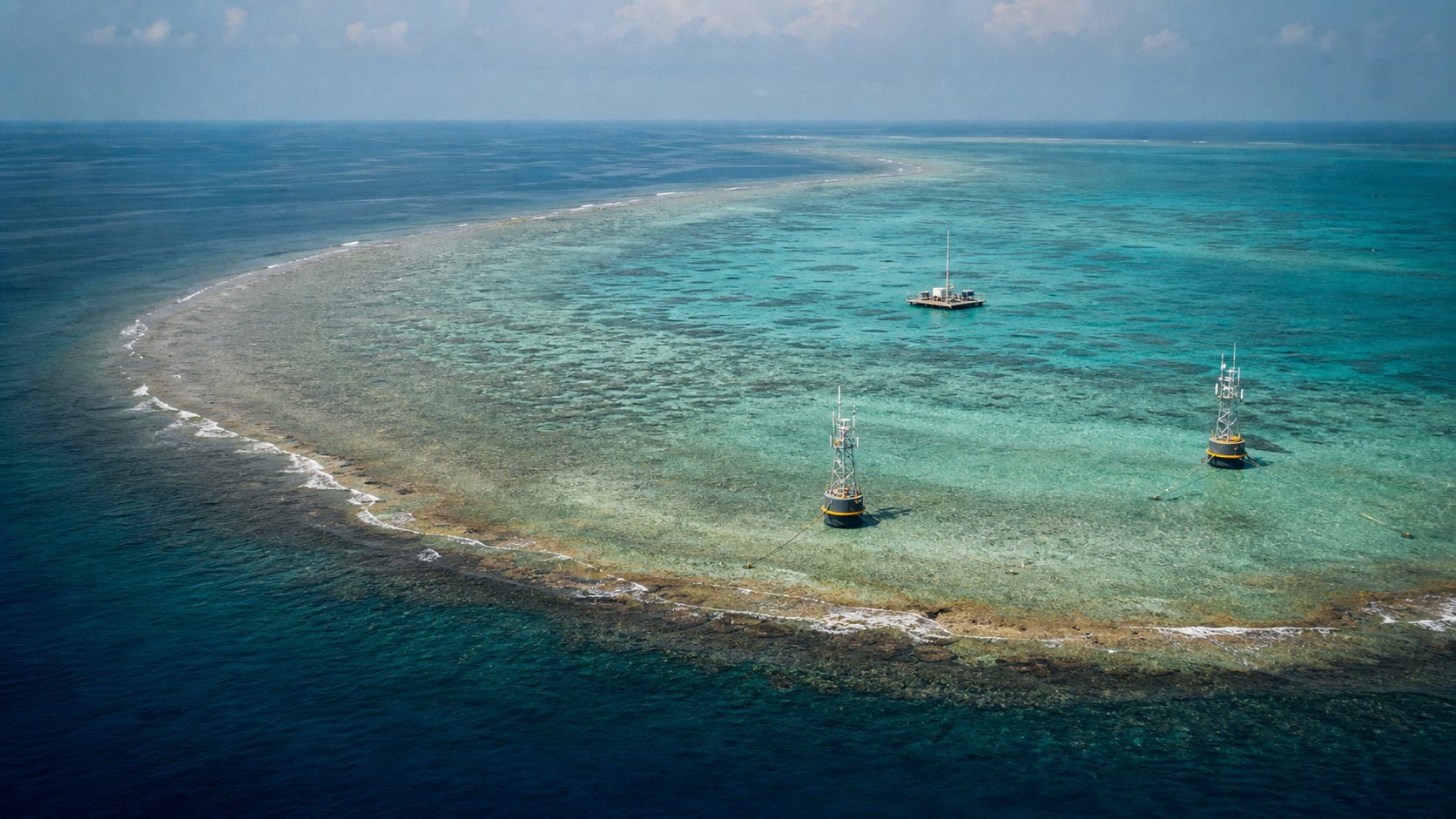
Manila says its aerial monitoring found a floating platform inside Scarborough Shoal with what appeared to be an antenna and personnel aboard. Reuters reported that Philippine officials also released photos of buoys and another antenna inside the shoal, while the Philippine Navy said it would not allow Bajo de Masinloc to become another man-made island. The Associated Press separately reported that Manila filed a diplomatic protest after the structure was detected by the Philippine military and coast guard.
Beijing's line is predictable. China's foreign ministry called activities at Huangyan Island, including scientific research, a legitimate sovereign right. The Chinese Academy of Sciences' South China Sea Institute of Oceanology later described a May 20 expedition for environmental monitoring, sampling, coral reef evolution and related research. None of that proves a military installation. It also does not make the installation irrelevant.
The operational question is not whether a 19.7-foot square platform can fight. It cannot. The question is what it can sense, relay, normalize and justify. A buoy or platform that starts as environmental monitoring can support persistent presence, chart small-craft movement, test communications paths, mark safe approaches through a reef, and give China a reason to keep more coast guard, maritime militia and research vessels nearby.
Scarborough Is a Sensor Problem Before It Is a Base Problem
Scarborough sits close enough to Luzon that anyone who has served on a destroyer in the western Pacific understands the geometry without a map. It is roughly 124 nautical miles from the Philippine coast, near approaches to Subic Bay and within the western air and maritime approaches to Luzon. It is not Mischief Reef, Subi Reef or Fiery Cross Reef, where China built runways, radars, hangars and missile positions after years of dredging. Scarborough is more valuable because it sits in the gap.
China already has a strong southern triangle in the Spratlys. It has Hainan to the northwest. Scarborough would extend the observation line toward Luzon. A permanent base would be the most visible version of that move, but a sensor and presence network is the lower-risk version. It creates enough activity to shape daily behavior without forcing a clear shooting decision from Manila or Washington.
That is the part Americans tend to miss. The United States and the Philippines have clarified that the 1951 Mutual Defense Treaty applies to armed attacks on Philippine armed forces, aircraft and public vessels in the South China Sea. That matters. But an antenna on a platform is not an armed attack. A buoy is not a missile battery. A research vessel loitering inside the shoal does not automatically trigger Article IV. China can therefore work below the treaty threshold while still improving its ability to monitor the same waters that Philippine and American forces would need in a contingency.
The Philippine Red Line Is About Sequence
Philippine officials are right to talk about Mischief Reef, not because Scarborough has become Mischief Reef, but because the sequence is familiar. First comes presence. Then comes an explanation. Then comes repeated activity. Then the activity becomes routine enough that removal starts to look escalatory. In the 1990s, small structures at Mischief Reef were easy to dismiss. Today the reef hosts military infrastructure that changes the map of the South China Sea.
Scarborough does not need a 3,000-meter runway to create military value. In a Taiwan or Luzon crisis, China would need to do three things near the Philippine approaches: identify which ships and aircraft are moving, complicate allied patrol patterns, and force Manila to spend attention and hull days on a reef rather than on wider sea control. A few sensors, if tied to coast guard cutters, militia vessels, over-the-horizon surveillance and aircraft from the mainland or Hainan, can help with the first two tasks. The third happens automatically once Manila has to patrol the site every day.
That is the cost calculation. A buoy is cheap. A Philippine patrol flight, coast guard sortie or allied freedom-of-navigation operation is not. The asymmetry favors the side that can make small objects consume large amounts of political and operational attention.
Washington Cannot Treat This as a Legal Footnote
The U.S. response should not be to dramatize every object at Scarborough as an imminent island-building campaign. That would make American messaging brittle. If the platform is removed or repositioned, Beijing can claim Manila and Washington overreacted. If more objects appear, the United States looks late.
A better response is operational bookkeeping. The U.S. and Philippine militaries should treat Scarborough as a persistent maritime domain awareness problem, not as a periodic diplomatic crisis. That means regular public patrol data, allied aircraft tracks where appropriate, satellite imagery releases, and a standing explanation of why each new object changes the operating picture. If China is doing research, then the public record should show where, when, with which vessels, and under what escort.
It also means hardening the Luzon side of the equation. EDCA sites, coastal radar, mobile anti-ship fires, unmanned surface and air surveillance, and Philippine Coast Guard endurance matter more than another statement of concern. The U.S. cannot defend the first island chain through communiques. It has to help Manila keep enough eyes and hulls in the water that China's small-object strategy stops being cheap.
The Shoal Is Still Unbuilt but the Math Has Changed
The platform at Scarborough may turn out to be exactly what China says it is: an environmental research tool. That still leaves the central problem. Beijing has discovered that scientific language, small equipment and constant gray-zone escort can produce real military effects without crossing the line that alliance lawyers prefer to draw.
Scarborough is not yet another artificial island. That is the wrong standard. The correct standard is whether China is improving its ability to see, mark, normalize and defend a position on Luzon's western approaches. On that measure, even two antenna buoys and a platform are enough to matter.
The United States and the Philippines do not have to fire a shot to lose ground at Scarborough. They only have to accept each new object as too small to count.
China has deployed two large buoys with antennas at Scarborough Shoal, 124 nautical miles from the Philippine coast, to establish a sensor network. The Philippine Navy has raised concerns, and the U.S. is advised to monitor the situation as it could complicate allied patrol patterns. China claims the activities are for scientific research, but the implications for military monitoring are significant.
- China has deployed two large buoys with antennas at Scarborough Shoal.
- The Philippine Navy has expressed concerns about the presence of these structures.
- China claims the activities are for scientific research and environmental monitoring.
- The U.S. and Philippines are advised to treat the situation as a persistent maritime domain awareness problem.
- The presence of these buoys could complicate allied patrol patterns in the region.