
China's 2026 Yagong Buildout Makes Antelope Reef a South China Sea Air Base
 Marcus Chen
China's 2026 Yagong Buildout Makes Antelope Reef a South China Sea Air Base
The runway matters, but the runway is not the story anymore. What changes the military equation in the Paracels is that China is no longer building a strip of concrete at Antelope Reef in isolation. The new structures appearing on nearby Yagong Island suggest Beijing is assembling the support architecture that turns reclaimed land into a working outpost: sensing, warning, communications, and eventually layered defense. That is how an airfield becomes a base.
Reuters reported this week that satellite imagery from August 17 showed a three-pronged structure on Yagong Island, about 14 kilometers northeast of Antelope Reef, that analysts said could be part of an early-warning radar facility. On its own, that is still an educated guess. But in military terms, the guess is plausible because the geometry makes sense. A long runway without better sensing is just more tarmac. A runway paired with radar coverage, sheltered lagoon access, fuel and power, and room for missile batteries is a forward operating node.
Antelope Is Already Big Enough
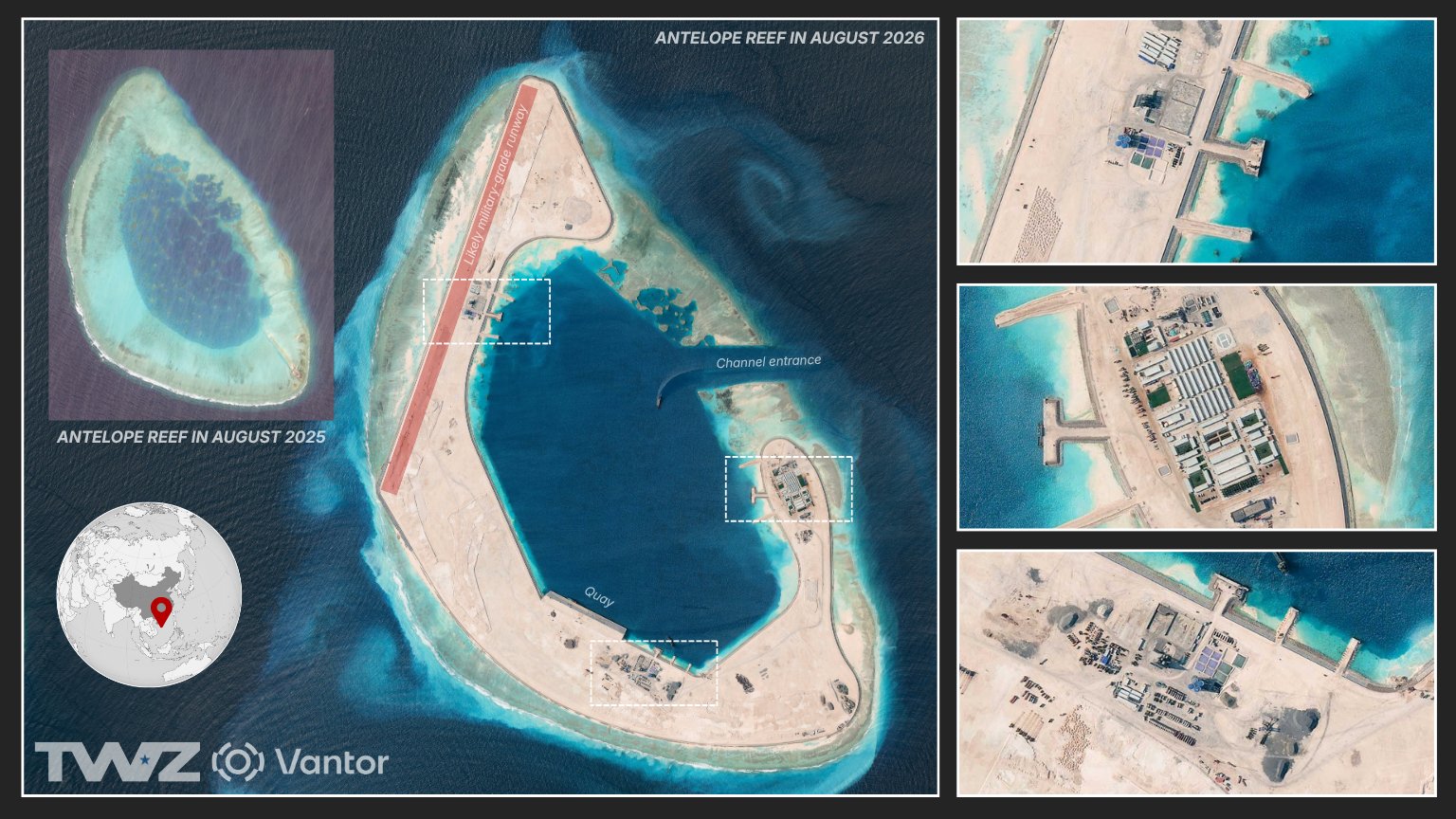
CSIS' Asia Maritime Transparency Initiative estimated earlier this month that reclaimed land at Antelope Reef had reached roughly 1,490 acres. That is almost the size of Mischief Reef at 1,504 acres and far larger than Woody Island's roughly 890 acres. AMTI also noted that Antelope now has enough linear space for a 9,000-foot runway and a lagoon that could support much larger coast guard and maritime militia activity than China's older Paracel outposts.
Those numbers are not abstract. A 9,000-foot runway can handle the aircraft that matter for presence and coercion in the northern South China Sea: fighters, maritime patrol aircraft, transports, and intelligence platforms. The lagoon matters because a base that can berth more hulls can sustain more pressure. Anyone who has served on a destroyer knows the math quickly becomes about sortie generation and dwell time, not about whether a single platform can show up once for a photo.
That is why Yagong matters. If the structures there do evolve into radar or observation facilities, they extend the base's eyes and help reduce single-point failure. In a crisis, redundancy is combat power. One radar can be jammed, damaged, or saturated. A network of sensors spread across nearby features is harder to blind.
What Beijing Is Really Buying
Beijing still says the Antelope facilities serve civilian functions such as weather forecasting, fisheries protection, and research. That is standard dual-use language. The problem for regional planners is that dual-use infrastructure in the South China Sea almost always trends in one direction. First come piers, helipads, prefabricated buildings, and dredging support. Then come hardened storage, bigger communications nodes, and air-defense coverage. After that, the distinction between coast guard support and military basing becomes political theater.
The military value here is not that Antelope suddenly lets China do something impossible. It is that it gives the PLA more capacity, more persistence, and more recovery options in the Paracels. Capacity matters because the South China Sea campaign is about keeping platforms on station. Persistence matters because Beijing's coercive model relies on daily presence. Recovery options matter because distributed facilities complicate any attempt to suppress Chinese operations in the opening phase of a conflict.
There is also a Taiwan angle, even if Antelope sits well south of the strait. An expanded Paracel complex frees Chinese assets elsewhere by letting Beijing shoulder more of the northern South China Sea surveillance and coast guard burden from fixed infrastructure. That is how rear-area buildup affects the frontline. The first island chain is one operating system. Pressure relieved in one sector can be shifted to another.
The Regional Balance Gets Harder, Not Dramatically Different
This is not the kind of development that flips the table overnight. Vietnam remains the immediate military audience, and Hanoi has been expanding its own Spratly positions. But the broader signal is that China can still widen the gap between symbolic regional responses and the hard logistics of sea control. Regional states can protest another round of construction. What they cannot do easily is match permanent concrete with intermittent patrols.
That is the uncomfortable arithmetic. A new allied freedom-of-navigation transit generates headlines for a day. A new radar site tied to a 1,490-acre outpost generates coverage every day after that. Once fuel, sensing, berthing, and runway capacity are in place, Beijing does not need to surge to create presence. Presence becomes the default setting.
The likely next indicators to watch are straightforward: more hardened foundations on Yagong, additional jetties and utility work at Antelope, signs of buried fuel or ammunition storage, and eventually prepared positions for surface-to-air or anti-ship systems. If those appear, the argument about whether this is a military base will be over. The only remaining question will be how much risk Beijing is willing to absorb by pushing it even further south and west toward Vietnam's operating space.
The Bottom Line
China is not just enlarging an island in 2026. It is building the enabling network that makes Antelope Reef usable under pressure. That is the difference between reclamation for propaganda and reclamation for warfighting. The runway drew the attention. Yagong is what tells you Beijing intends to keep the base alive when it matters.
China is constructing military infrastructure at Antelope Reef and Yagong Island in 2026, enhancing its operational capabilities in the South China Sea. The developments include a 9,000-foot runway and radar facilities, indicating a shift towards a more permanent military presence. This expansion allows the People's Liberation Army to increase its capacity and persistence in the region, complicating any potential military responses from neighboring countries.
- China is expanding Antelope Reef to support military operations.
- Yagong Island is being developed with radar and communication facilities.
- The reclaimed land at Antelope Reef is approximately 1,490 acres, nearly the size of Mischief Reef.
- A 9,000-foot runway is being constructed to accommodate various military aircraft.
- The developments indicate a shift towards a more permanent military presence in the South China Sea.