
China's Coast Guard Is Rehearsing a Taiwan Blockade From the East
 Marcus Chen
China's Coast Guard Is Rehearsing a Taiwan Blockade From the East
Since June, Chinese coast guard ships have maintained what Beijing calls regular law-enforcement patrols east of Taiwan. On October 12, Taiwan's defense minister said the island was monitoring a series of Chinese live-fire drills along the mainland coast. These are separate activities, but together they expose a more useful measure of a blockade than another aircraft-counting exercise: whether China can make the waters east of Taiwan feel administratively controlled before it ever announces a war.
The eastern flank is the logistical problem
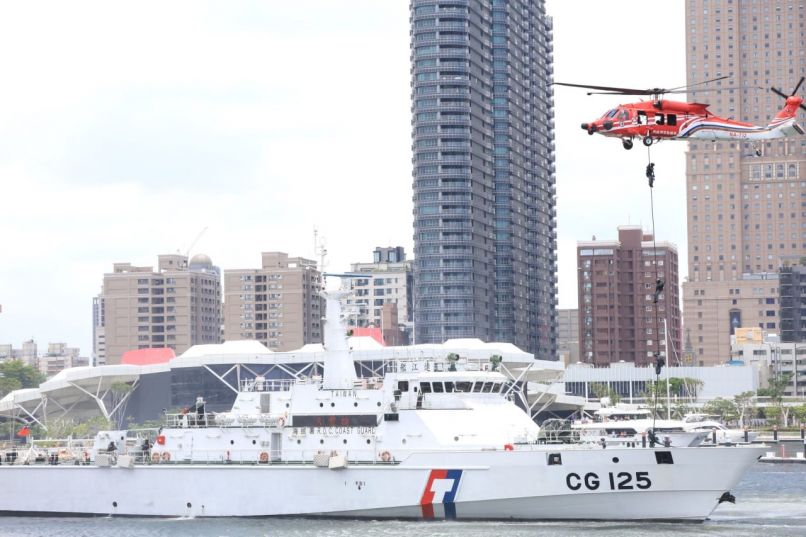
Most public discussion of a Taiwan blockade starts in the Taiwan Strait. That is logical, but incomplete. The strait is narrow, crowded, and watched by every regional navy. Taiwan's east coast faces the Pacific and has traditionally been treated as the island's safer side. In a conflict, however, it is also the route through which fuel, ammunition, replacement parts, and perhaps allied assistance would approach from Japan, Guam, and the wider Pacific.
Reuters reported that a Chinese maritime militia boat was observed off Taiwan's east coast for the first known time in August. Taiwan says Beijing has since used overlapping coast guard, military, and civilian vessels in what may be preparation for a maritime quarantine or blockade. The US State Department described the activity as “deeply destabilising,” while noting that China was asserting authority around waters Taiwan has administered peacefully for more than seven decades.
That matters because a blockade does not begin with a missile strike. It begins with a legal and operational claim that commercial ships need permission, inspection, or escort. If Chinese coast guard cutters can patrol east of Taiwan routinely, supported by fishing vessels and backed by the People's Liberation Army (PLA), Beijing can create a record of presence that it will later describe as enforcement rather than aggression.
Three layers make the patrols dangerous
The first layer is the China Coast Guard (CCG). Its large cutters are not navy frigates, but many are ocean-going ships with the endurance to remain on station for days or weeks. Their white hulls and law-enforcement markings give Beijing escalation control: a Taiwanese or allied commander must decide whether to treat an approaching cutter as a police vessel, a military auxiliary, or the opening move of a campaign.
The second layer is the maritime militia. Fishing boats are cheap, numerous, and difficult to distinguish from legitimate traffic. They can report ship movements, crowd sea lanes, illuminate targets for other forces, and complicate rules of engagement. The point is not that every fishing vessel is a combatant. The point is that a defender cannot safely assume that civilian-looking traffic is irrelevant in a crisis.
The third layer is the PLA. Live-fire activity along China's coast provides training and political cover for the military forces that would enforce a wider exclusion zone. It also forces Taiwan to watch several axes at once. A coast guard patrol east of the island may be presented as routine while missile units, naval aviation, and air-defense batteries exercise on the mainland. Those actions need not be centrally synchronized to impose a combined burden on Taiwan's decision cycle.
What Taiwan would have to solve
Taiwan's problem is not simply finding the patrol ships. It is maintaining a reliable picture of every vessel, deciding which contacts deserve interception, and protecting the sensors that make that picture possible. The island's coast guard can monitor and challenge individual ships, but it is not designed to fight a major navy alone. In wartime, its reports would have to feed the Navy, air force, missile commands, and civilian port authorities without delay.
The geography is unforgiving. A ship approaching from the east can exploit the island's mountainous terrain and weather to complicate radar coverage. A commercial convoy that turns away from the eastern coast may lose days reaching a protected port. A convoy that continues may trigger a confrontation with a CCG cutter and a swarm of ostensibly civilian vessels. That is the kind of friction Beijing wants: not a dramatic naval battle, but enough uncertainty to raise insurance rates, delay deliveries, and make governments question whether resupply is politically worth the risk.
For the United States and Japan, the operational question is equally blunt. Can they establish a protected corridor before China turns a police presence into a fait accompli? The answer requires more than a carrier strike group. It requires persistent maritime surveillance, long-range unmanned aircraft, escorts, electronic warfare, and a clear political decision about when a coast guard inspection becomes an armed attack. A single destroyer can deter one incident; it cannot continuously police an entire eastern approach.
Normalization is the weapon
Recent Chinese activity around Taiwan's east coast should not be mistaken for proof that an invasion is imminent. Nor does every patrol demonstrate a rehearsed blockade plan. The safer conclusion is narrower and more consequential: Beijing is testing whether its presence can become normal in waters that Taipei and its partners once treated as a rear area.
That is a contest of persistence. China can rotate coast guard and militia vessels at a lower political cost than Taiwan or the United States can maintain naval escorts. Each patrol adds experience, charts reactions, and strengthens Beijing's argument that it already exercises jurisdiction. The fleet does not need to sink ships to change the operating environment.
Taiwan's answer should therefore be measured in endurance rather than headlines. It needs redundant sensors, distributed fuel and ammunition sites, hardened ports, rules for escorting commercial traffic, and regular coordination with Japan and the United States. The objective is to make an eastern blockade difficult to sustain, not merely to announce that one is illegal.
The uncomfortable conclusion is that China may be building the first days of a Taiwan blockade in peacetime, one coast guard patrol at a time. If Washington and Taipei wait for the PLA Navy to appear before treating the eastern approach as contested water, they will already be negotiating from behind.
Sources
China's Coast Guard has been conducting regular patrols east of Taiwan since June 2026, indicating preparations for a potential blockade. Taiwan is monitoring these activities alongside Chinese live-fire drills. The U.S. State Department has labeled these actions as destabilizing, as China seeks to establish control over the waters that Taiwan has administered peacefully for decades.
- Chinese coast guard ships have maintained regular patrols east of Taiwan since June 2026.
- Taiwan is monitoring Chinese live-fire drills along the mainland coast.
- China is testing its ability to control waters east of Taiwan.
- The U.S. State Department described China's activities as destabilizing.
- China is using coast guard and militia vessels in preparation for a potential blockade.