
China's DF-17 Video Puts 2,500 Kilometers Between RIMPAC and Taiwan
 Marcus Chen
China's DF-17 Video Puts 2,500 Kilometers Between RIMPAC and Taiwan
The number that matters is 2,500 kilometers. That is the upper range estimate for China's DF-17 medium-range missile, according to the Center for Strategic and International Studies, and it is enough to turn a television clip into a planning problem for every U.S. surface force operating west of Guam.
Defense News reported on July 8 that Chinese state media has shown official DF-17 footage for the first time, presenting the road-mobile hypersonic glide vehicle as a weapon able to conduct precise strikes, operate without fixed launch sites and penetrate advanced defenses. Beijing did not release that imagery in a vacuum. It arrived as the U.S.-led Rim of the Pacific 2026 exercise was underway near Hawaii, after U.S.-Japan drills in late June, and while U.S. naval forces were visibly operating across the Indo-Pacific.
The easy reading is propaganda. The harder reading is operational signaling. The DF-17 is not a magic carrier-killer, and the People's Liberation Army still has to find, track, classify and target moving naval forces at sea. But the video is meant to remind Washington that the geometry around Taiwan, the Philippine Sea and Japan is getting less forgiving.
The Weapon Beijing Chose To Show
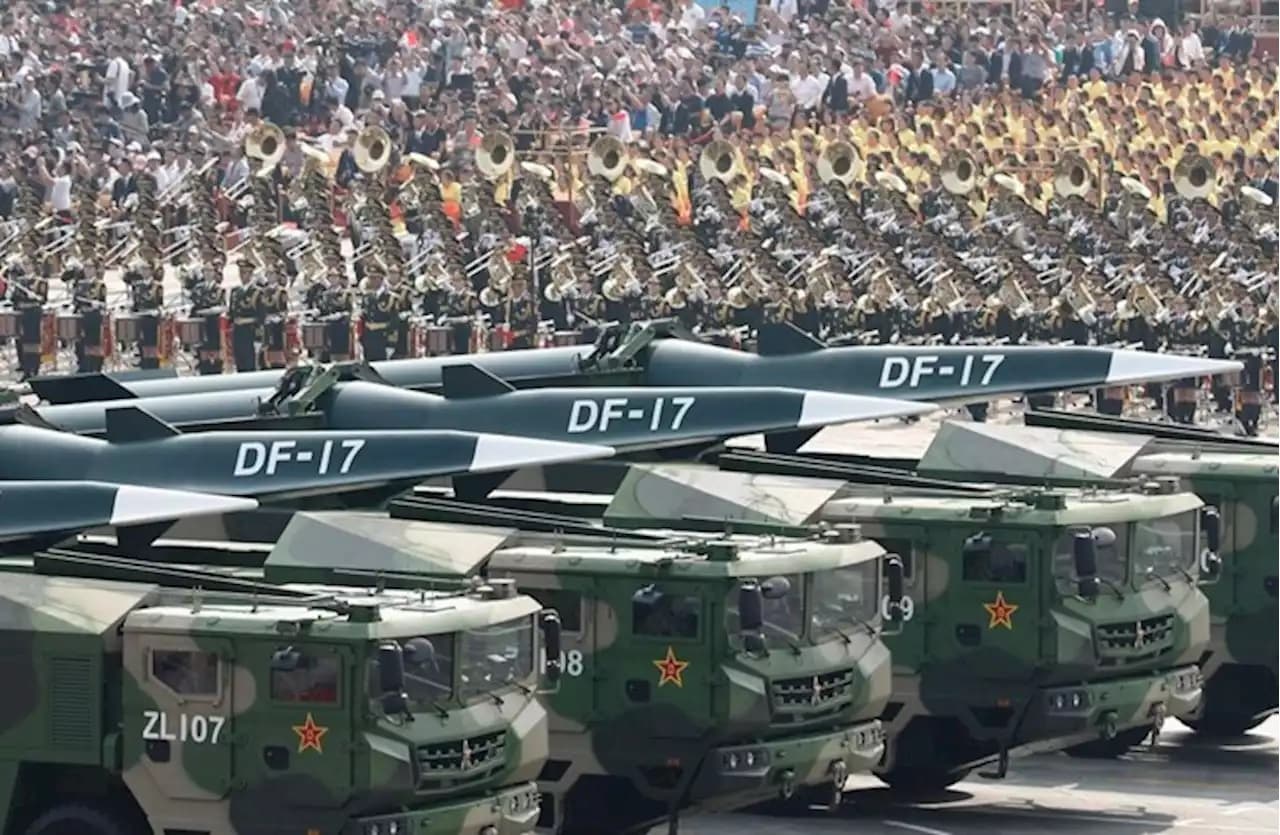
The DF-17 is a road-mobile medium-range ballistic missile carrying a hypersonic glide vehicle. CSIS lists the system at roughly 11 meters long, about 15,000 kilograms at launch, with a conventional or nuclear payload, Mach 5 to Mach 10 glide speed, and a range between 1,800 and 2,500 kilometers. It has been assessed as operational since 2019, after years of Chinese hypersonic testing.
Those specifications matter because the glide vehicle changes the defensive problem. A conventional ballistic missile follows a more predictable arc. A hypersonic glide vehicle flies lower, maneuvers laterally and compresses the time available for detection, tracking and engagement. Anyone who has stood watch in a combat information center knows the difference between a known inbound track and a maneuvering threat that arrives inside a narrowing decision window.
That does not mean U.S. missile defense is useless. It means legacy assumptions about defended bubbles around high-value ships and bases are less comfortable. Aegis ships, Patriot batteries, THAAD and future hypersonic defense programs all still matter. The question is whether they can keep up when the attacker combines mobility, salvo size and unpredictable terminal paths.
RIMPAC Was The Intended Audience
Defense News quoted analysts in Taiwan who argued that the state-media release was timed against major Asia-Pacific exercises, including RIMPAC and U.S.-Japan activity. That is plausible. China did not need to prove the DF-17 exists. It needed to put the weapon back in the political bloodstream while U.S. and allied navies were demonstrating scale.
USNI News' July 7 fleet tracker placed USS George Washington in the Philippine Sea on its first patrol of 2026, with Carrier Air Wing 5 embarked and escorts including USS Robert Smalls, USS Benfold and USS Shoup. USS Theodore Roosevelt was operating near Pearl Harbor during RIMPAC 2026. Those deployments show presence, but presence also creates targetable patterns. Carriers have to launch aircraft, refuel escorts, manage logistics and remain connected to bases and ports.
From China's coast, a 1,800 to 2,500 kilometer envelope reaches deep across the first island chain and into the approaches that matter in a Taiwan contingency. It threatens Kadena, parts of Japan's southwestern island chain, northern Luzon operating areas and naval forces moving through the Philippine Sea depending on launch location. The point is not that every location is always within a clean firing solution. The point is that U.S. commanders have to assume many more places are contested from hour one.
The DF-17 is less useful as a parade object than as a forcing function. It pushes U.S. forces to disperse, hide, move faster and spend more interceptors before the first carrier aircraft reaches a launch point.
The Carrier Problem Is Really A Kill Chain Problem
Calling the DF-17 a carrier-killer skips the hardest part. A carrier at sea is not a fixed airfield. To hit it, China needs a live kill chain: satellites, over-the-horizon radar, maritime patrol aircraft, unmanned systems, submarines, data links and command authority that survives U.S. interference. In wartime, the United States would attack that chain as aggressively as it attacks launchers.
That is why the DF-17 video should not be read as proof that American carriers are obsolete. It is proof that their operating model is under pressure. A carrier strike group that once planned around air-wing reach and escort defense now has to plan around emissions control, deception, distributed logistics and the survival of land bases that feed the fight.
There is also a magazine problem. If the PLA can force U.S. destroyers to expend high-end interceptors against ambiguous or layered threats, Beijing does not need every DF-17 to hit. It needs enough missiles, decoys and supporting strikes to make a carrier commander choose between closing the range and preserving the force. That is sea denial by arithmetic.
Washington's Answer Cannot Be Only Hypersonics
The predictable response is to call for more U.S. hypersonic weapons. Some are needed. The Army's Long-Range Hypersonic Weapon and other programs can impose costs on Chinese launchers, command nodes and hardened targets. But matching missile for missile is not a complete answer.
The better answer is a layered one: longer-range carrier aviation, more unmanned scouts, resilient space and airborne sensors, distributed Marine and Army fires, hardened Pacific bases, rapid runway repair, and enough affordable interceptors to avoid trading million-dollar defense rounds against every incoming threat. The U.S. also needs allied geography. Japan, the Philippines and Australia are not diplomatic accessories in this problem. They are the map.
China's DF-17 clip was designed to look clean and inevitable. War at sea is neither. Sensors fail, launchers hide badly, networks break and ships do not cooperate by sailing in straight lines. Still, the math has moved. A 2,500 kilometer road-mobile glide weapon does not have to win the war by itself. It only has to make the first week slower, more expensive and more dangerous for U.S. forces trying to reach Taiwan.
That is the message Beijing wanted RIMPAC to hear. The U.S. Navy can still operate inside that envelope, but it can no longer treat the envelope as background noise.
China showcased the DF-17 medium-range missile in a video, emphasizing its operational capabilities during U.S.-led military exercises in the Philippine Sea and Taiwan. The DF-17, capable of precise strikes and maneuvering, poses a significant challenge to U.S. naval forces. This demonstration serves as a reminder of the evolving military dynamics in the region, particularly concerning Taiwan and Japan.
- The DF-17 has a range of 1,800 to 2,500 kilometers.
- The missile is operational since 2019 and is designed for precise strikes.
- The video release coincided with U.S.-led military exercises in the Pacific, indicating strategic signaling.