
China's J-20S and J-35A Make Stealth a Numbers Game in 2026
 Marcus Chen
China's J-20S and J-35A Make Stealth a Numbers Game in 2026
China does not need to make every fighter a technological surprise. It needs enough stealth aircraft to make the first 1,000 miles of a Western Pacific air campaign expensive to enter. The latest public imagery of the J-20 family alongside the J-35A points to that problem: Beijing is building a force in which a few high-end aircraft can be reinforced by a larger, more specialized fleet.
The Aircraft Are Different, and That Is the Point
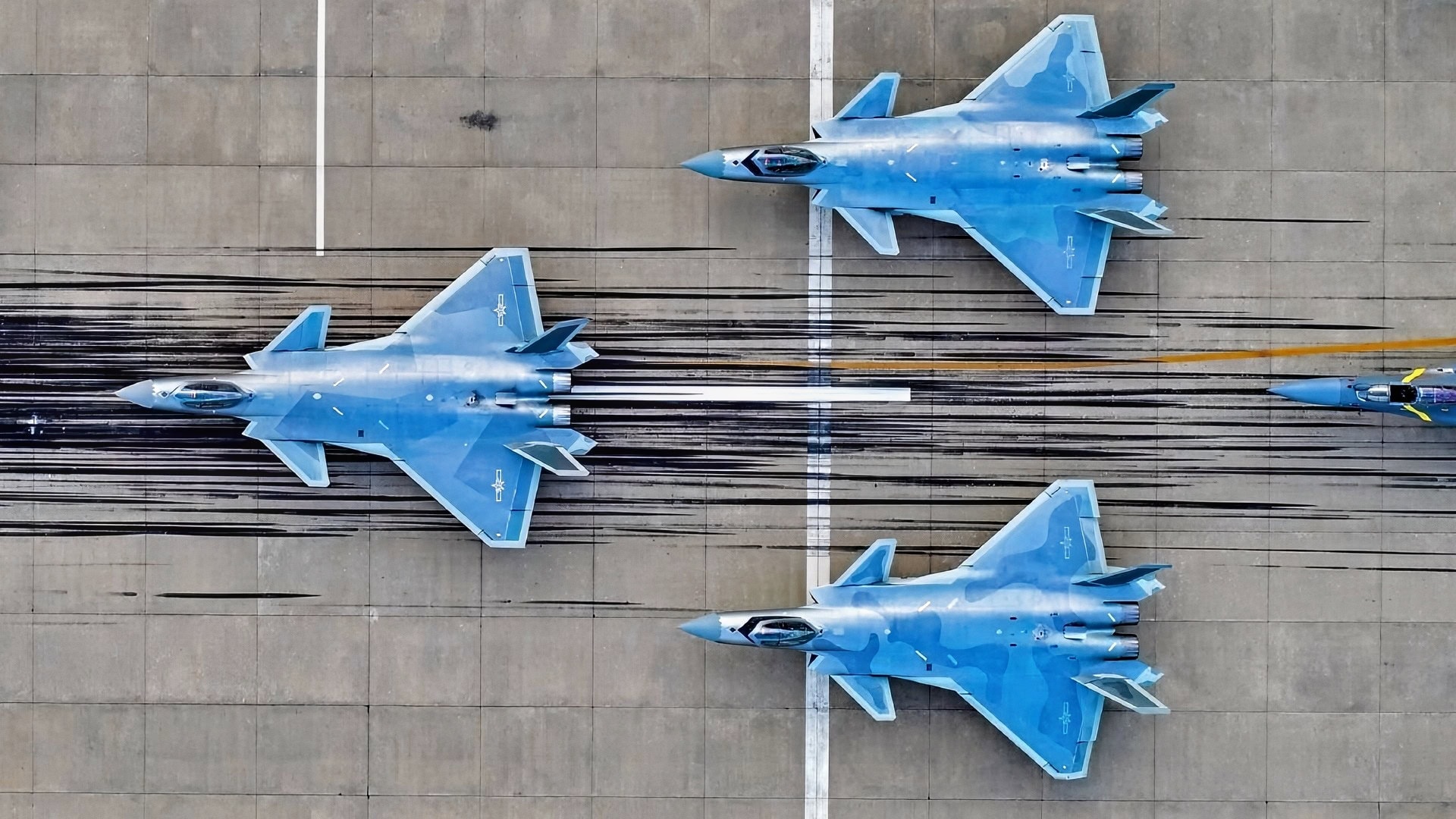
The J-20 is China's long-range stealth air-superiority platform. Its internal weapon bays, twin-engine layout and large airframe are designed to carry fuel and missiles deep into contested airspace. The two-seat J-20S adds a second operator, potentially useful for managing sensors, electronic warfare and unmanned teammates. China has not published a reliable combat-radius or sortie-generation figure, so claims that it matches the F-22 or F-35 in every category should be treated as speculation.
The J-35A fills a different slot. It is a smaller, single-engine stealth fighter derived from the FC-31 design family and closely related to the carrier-capable J-35. Its value is not that it replaces the J-20. Its value is that a medium fighter should be cheaper and easier to distribute across more bases, while still presenting a low-observable target to long-range sensors. The exact radar cross-section, engine performance and weapons load remain classified or disputed.
Numbers Change the Air-Denial Equation
In a Taiwan contingency, aircraft do not fight as isolated icons. They fight through a chain of airfields, tankers, airborne early-warning aircraft, datalinks and missile reloads. A stealth fighter that flies one sortie per day is less useful than a less glamorous aircraft that can be turned around and armed repeatedly. That is why production scale matters.
The J-20 gives the People's Liberation Army Air Force a long-range counter-air tool. It can threaten tankers, airborne warning aircraft and supporting nodes that make a U.S. or allied air campaign possible. The J-35A can add mass to the same problem from more locations. Even a force of several hundred medium stealth fighters would not guarantee Chinese air superiority, but it would force the United States and Japan to spend scarce fighter sorties on defensive counter-air missions rather than strikes.
The arithmetic is brutal. If an opposing air force must protect tankers, bases and command aircraft across Japan, Guam and the Philippine approaches, every additional Chinese stealth track consumes patrol time, sensor capacity and weapons. The aircraft does not need to penetrate every defended zone. It only needs to make the defender keep looking in too many places.
Production Is More Important Than the Brochure
Open-source reporting cannot yet establish how quickly China is producing combat-ready J-20S or J-35A squadrons. Nor can satellite imagery alone show pilot proficiency, engine reliability or the availability of modern air-to-air missiles. Those are the gaps between a production headline and a warfighting capability.
Still, the direction is clear. CSIS tracking has documented a wider and more active Chinese military presence across the Indo-Pacific, while recent reporting on China's bomber patrols, coast guard operations east of Taiwan and long-range missile activity shows a force increasingly comfortable operating beyond its near seas. Stealth aircraft fit that operating concept: they extend the threat envelope while complicating the surveillance picture around the First Island Chain.
China also benefits from geography. Fighter production and maintenance can be supported from the mainland, while Taiwan, Japan and U.S. forces must protect a dispersed network of air bases and logistics hubs. The PLA's advantage is not simply aircraft performance. It is the ability to combine aircraft with land-based sensors, ballistic missiles, cruise missiles and maritime pressure.
What Washington and Tokyo Should Measure
Counting airframes is necessary but insufficient. The decisive indicators are operational. How many J-20 and J-35A aircraft are assigned to deployable units? How many can generate two sorties in a day? Are they receiving modern long-range missiles in meaningful quantities? Can Chinese pilots exchange targeting data under jamming? And can damaged bases be repaired faster than the attacking force can suppress them?
The United States should also stop treating stealth as an American monopoly. Distributed basing, passive sensors, runway repair and long-range air-to-air weapons matter more when the opponent has a growing low-observable fleet. Japan's F-35 force and future air-defense architecture will have to cover more approaches, not just the airspace immediately around the Japanese islands.
The Strategic Judgment
The J-20S and J-35A do not prove that China has solved the hard problems of air warfare. They do show that Beijing is building a layered fighter force rather than betting on one prestige aircraft. That is the meaningful development.
For years, debates about Chinese stealth fighters focused on whether one design was better than an American counterpart. That is the wrong comparison. The operational question is whether China can put enough survivable aircraft, missiles and sensors into the battlespace to overload the defender's decision cycle. If the answer becomes yes, the Western Pacific will not be closed to U.S. forces. It will become prohibitively dangerous to enter without a much larger magazine and a much more distributed air network.
The aircraft specifications remain uncertain. The production trend is not. Numbers are becoming China's stealth advantage.
Sources
China is building a layered fighter force with J-20S and J-35A aircraft to enhance its air capabilities in the Western Pacific by 2026. The J-20S serves as a long-range stealth air-superiority platform, while the J-35A is a smaller, more deployable stealth fighter. This production strategy aims to complicate U.S. and allied air operations, forcing them to allocate resources defensively.
- China is producing J-20S and J-35A stealth fighters to enhance air capabilities.
- The J-20S is a long-range stealth air-superiority platform.
- The J-35A is a smaller, single-engine stealth fighter.
- China's stealth aircraft production aims to complicate U.S. and allied air operations in the Western Pacific.
- Operational effectiveness depends on the number of deployable units and sortie generation capabilities.