
Chinese MLRS Type 63 on the Liman Direction Shows Shortage of Russian Light Artillery 2026
 Dmitri Volkov
The Chinese Type-63 MLRS on the Liman Front Shows a Shortage of Russian Light Artillery 2026
The rare Chinese Type-63 MLRS, destroyed by the Ukrainian unit "Phoenix" on the Liman front on May 21, is important not because it is a large weapon. On the contrary, it is significant precisely because of its small size. Twelve launch tubes of 107 mm caliber, a range of about 8 km, a weight of around 600 kg, and a crew of several people — this is not "Tornado," not "Tornado-S," and not even the BM-21 "Grad." This is the weapon of a poor, scattered, and very nervous war, where the commander needs not a breakthrough fire barrage, but the ability to quickly fire from cover and disappear before an FPV drone arrives.
According to ArmyInform, citing the State Border Guard Service of Ukraine, operators of the drone systems from the "Phoenix" unit discovered and destroyed a Chinese Type-63 MLRS on the Liman front. In the same episode, the Ukrainian side reports hitting about a dozen Russian artillery pieces, logistics, and personnel; one Russian soldier, noticing a heavy Vampire-type drone, attempted to shoot at it with his rifle and was immediately hit. Such details should not be turned into a joke. They illustrate the environment in which old light artillery is becoming visible again: everything that fires is now simultaneously a target.
Why the Type-63 Ended Up on the Russian Section of the Front
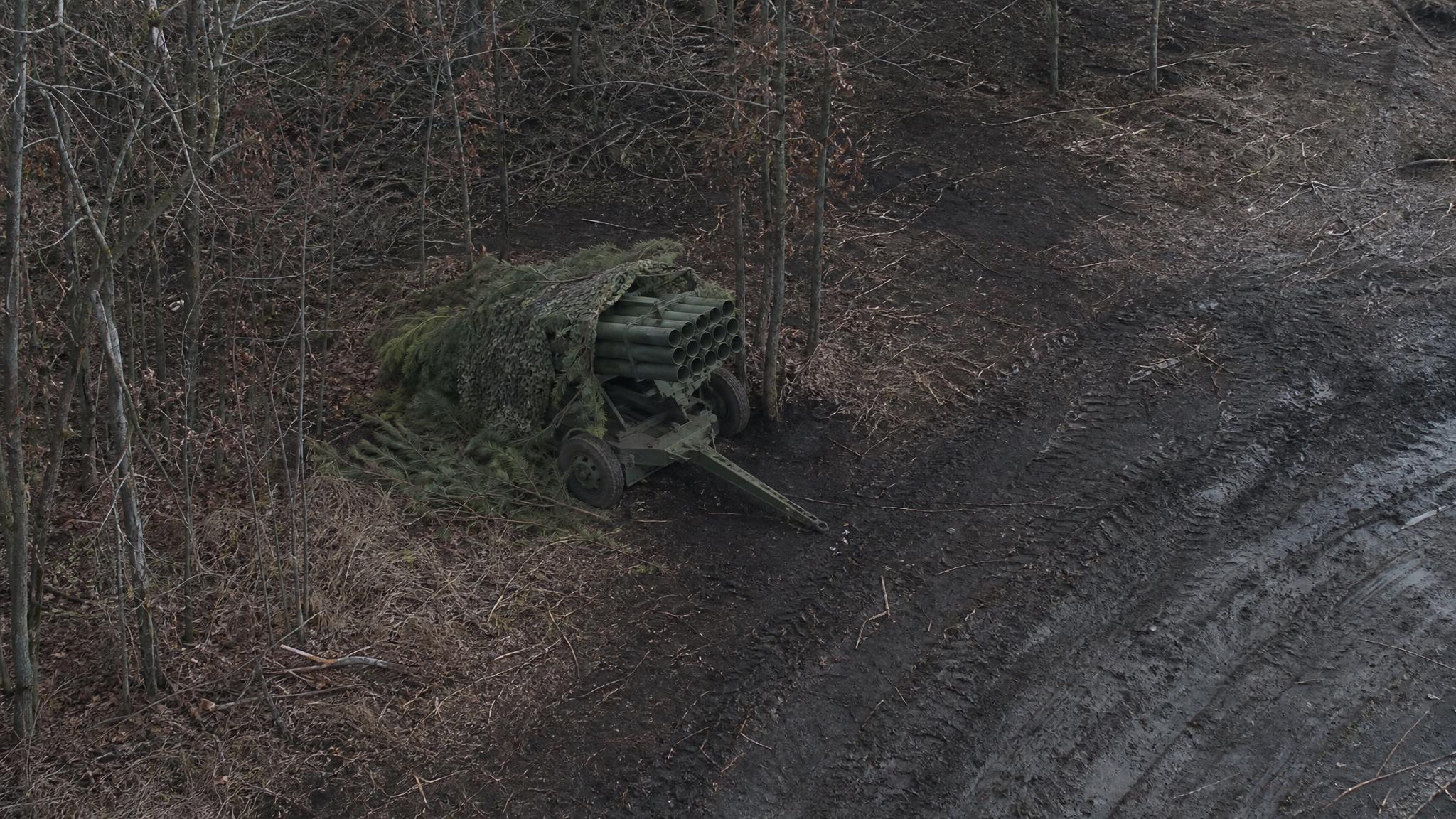
Illustrative image generated for analysis. It is not a frame from the Liman front.
The Type-63 was developed in China in the early 1960s as a simple towed 107-mm multiple launch rocket system. Its technical philosophy is extremely clear: low weight, simple carriage design, twelve tubes in three rows, quick deployment, and a cheap unguided projectile. According to open sources, the standard rocket weighs about 18.8 kg, the warhead approximately 1.3 kg, and the maximum range is about 8.05 km. In Soviet tradition, such a system would not be a central element of an artillery regiment. It is closer to the weapon of mountain, airborne, special, or irregular units.
That is why its appearance among Russian forces on the Liman front cannot be automatically interpreted as "new Chinese assistance." The Type-63 and its copies have been distributed for decades across Afghanistan, the Middle East, Africa, the Balkans, and post-Soviet shadow warehouses. It is more logical to see here not a direct line from Beijing to the front, but a dirtier and more prosaic picture: the Russian army is increasingly engaging everything that can be transported, loaded, and hidden. In 2022, Russian commanders still spoke the language of battalion tactical groups and massed artillery. By 2026, in certain areas, they are already speaking the language of small launchers, electric bikes, ground robots in the rear, and people sent to fetch water under drones.
Light MLRS as a Symptom of Fire Density Depletion
The Russian army has not lost artillery as a class. That would be too convenient and incorrect a statement. But it is losing the previous freedom of artillery application. Large batteries are easier to detect, barrels and launchers are more quickly caught in the "reconnaissance — drone — strike" chain, and logistics for ammunition are becoming just as vulnerable as the weapon itself. Therefore, commanders are looking for intermediate solutions: small groups, short fire raids, dispersed positions, one-time supply routes, weak but cheap means of destruction.
The Type-63 fits well into such tactics. It can be hidden in cover, rolled out for a limited time, and used against the front line or Ukrainian logistics at shallow depth. But here lies the main drawback. A range of about 8 km in the conditions of a modern front means that the crew is forced to operate in the saturation zone of Ukrainian FPVs, heavy drones, and reconnaissance UAVs. In Soviet textbooks, such a system could exist due to camouflage and surprise. On the front in 2026, camouflage has become temporary, and surprise is measured in minutes.
Hence the institutional conclusion. If a unit is forced to use a rare light MLRS where standard towed artillery, a mortar battery, or "Grad" would have been expected, it is not necessarily a sign of catastrophe. But it is a sign of fragmentation in the fire system. Commanders are addressing local needs with what is available, rather than what is optimal. In the old Russian army culture, this was called "finding means." In reality, it often means that normal resources are already occupied, damaged, too visible, or too expensive for the task at hand.
The Chinese Trace Without a Chinese Strategy
Politically, it is tempting to see the Type-63 as evidence of deepening Chinese-Russian military supply. Such a conclusion would be premature. Unlike modern electronic components, machinery, or dual-use technologies, the 107-mm systems of the Type-63 family are too widely distributed and too old for a single destroyed unit to serve as proof of a fresh state channel. Its origin is Chinese; its path to the front can be anything — from old stocks of third countries to long-standing gray procurements.
But the lack of direct evidence of a Chinese supply does not make the episode insignificant. It shows something else: the Russian army is gradually normalizing the use of foreign, old, and imperfect material bases. This has already happened with Iranian drones, North Korean munitions, civilian Chinese components, and commercial communication means. The Type-63 in this lineup is not a central element, but a small cog. However, it is precisely the small cogs that reveal the true state of the machine. Empires usually look impressive on parade; in war, they are revealed by what they use to fill the gaps in their ranks.
What This Changes on the Liman Front
Tactically, the destruction of one Type-63 does not change the entire Liman sector. The Russian side can replace it with mortars, FPVs, towed artillery, or another improvised launcher. But the very fact of discovering and hitting a rare MLRS speaks to the density of Ukrainian aerial reconnaissance. If the border "Phoenix" is capable of not only finding but also hitting a concealed small system in a forested area, then the Russian bet on miniaturizing firepower offers only partial protection.
For Moscow, this is an unpleasant dilemma. Large artillery has an effect but attracts counter-battery fire and long-range strikes. Small artillery is cheaper and more mobile but must get closer and is more quickly caught in the drone zone. There is no elegant solution between these two options. There is only the accounting of losses: how many launchers, crews, supply vehicles, and operators can be lost for a few salvos against the Ukrainian front line.
My forecast is cautious. We will see more such episodes — not necessarily with the Type-63, but with light, old, export, and improvised fire means. The Russian army will maintain the ability to press the front, but increasingly at the cost of technological and organizational patchiness. In the short term, this makes it dangerous and unpredictable. In the long term, it worsens manageability, supply, and the quality of fire planning. The Type-63 under Liman is not a sensation. It is a small snapshot of the great fatigue of the Russian artillery system.
Ukrainian forces destroyed a Chinese Type-63 multiple launch rocket system (MLRS) operated by Russian troops in Lyman on May 21, 2026. This incident reflects a shortage of Russian light artillery and highlights the effectiveness of Ukrainian aerial reconnaissance. The engagement resulted in the reported destruction of multiple Russian artillery pieces and personnel.
- A Chinese Type-63 MLRS was destroyed by the Ukrainian Phoenix unit on May 21, 2026.
- The Type-63 MLRS has a range of approximately 8 km and is considered light artillery.
- The incident highlights a shortage of Russian light artillery on the Lyman front.
- Ukrainian forces reported hitting around ten Russian artillery pieces and logistics personnel during the same episode.
- The use of the Type-63 MLRS indicates a shift in Russian military tactics towards smaller, more mobile artillery systems.