
Chinese Navy's 4 Type 071 Landing Ships Conduct Live Fire Drills, Amphibious Operations Shift from Single Ship Assault to Fleet Coordination
 Li Minghui
Four Type 071 Landing Ships of the PLA Navy Conduct Live Fire Exercises, Amphibious Operations Shift from Single Ship Assault to Coordinated Formation
On October 18, multiple media outlets cited reports from the Chinese military stating that four Type 071 amphibious transport docks of the PLA Navy conducted a rare concentrated live fire exercise. The publicly released footage and reports did not disclose the complete exercise subjects, maritime areas, or ship names, so it is not appropriate to interpret it directly as a rehearsal for actions in a specific direction. However, the simultaneous appearance of four ships of the same class is already more significant than single-ship training.
What Four Type 071 Ships Mean
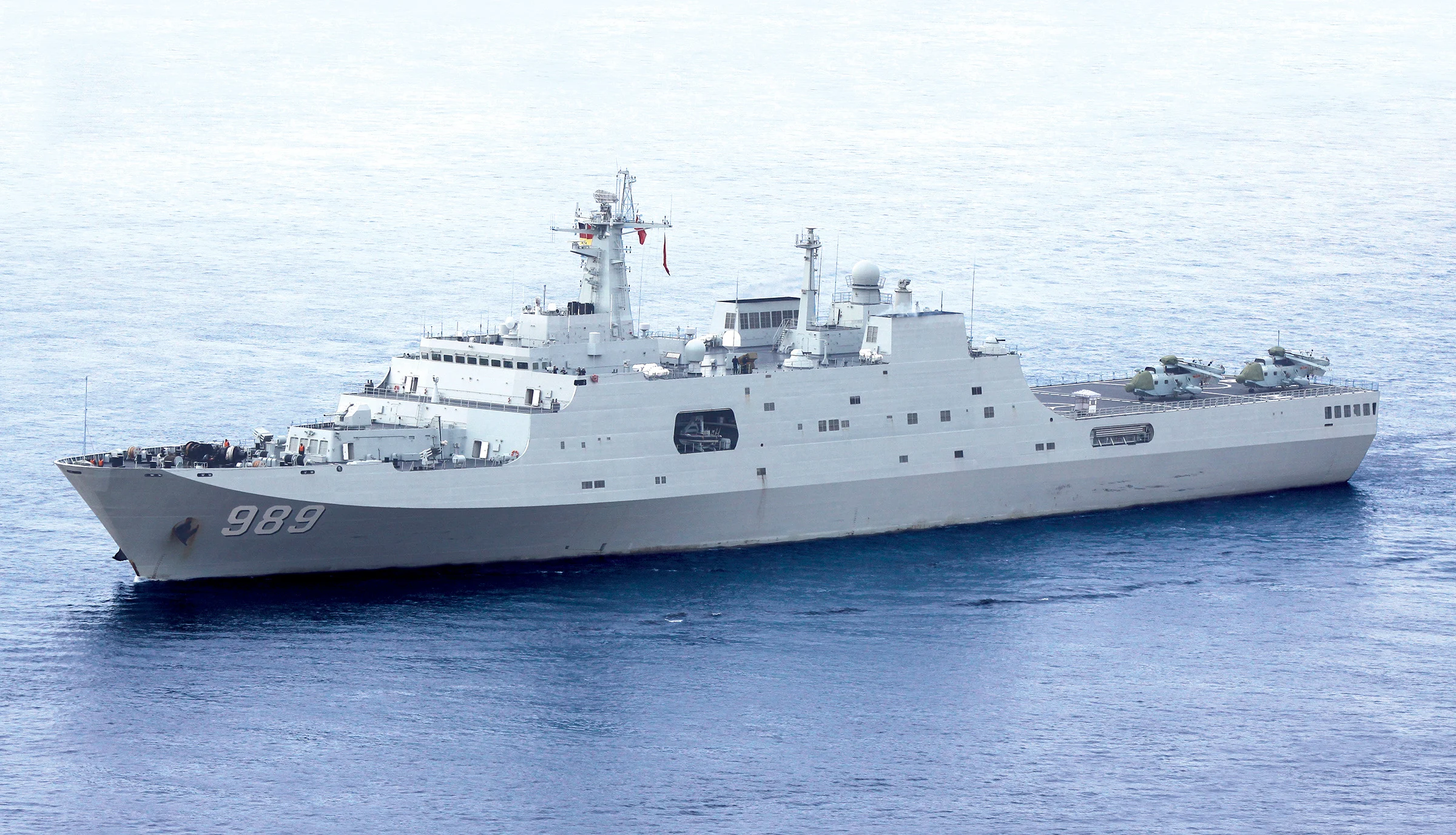
The Type 071 amphibious transport dock is one of the earlier large-scale amphibious deployment platforms formed by the PLA Navy, with a length of about 210 meters and a full-load displacement typically estimated at around 20,000 tons in publicly available data. It can carry landing troops, vehicles, and air-cushion landing craft, while the stern dock allows for loading and unloading operations while offshore. There may be differences in equipment and carrying capacity among different batches, and the so-called "number of personnel and vehicles it can carry" should not be simply regarded as the actual grouping for each mission.
Its key value does not lie in the firepower of a single ship. The Type 071 is essentially a maritime transport and command node, and the real determinant of operational efficiency is whether escort vessels, mine-sweeping forces, aviation, drones, and coastal firepower can integrate it into a complete system. The concentrated live fire training of the four ships indicates that the training focus may be shifting from "delivering troops to the shore" to "maintaining the rhythm of the landing formation under complex threats." In simple terms, the most challenging aspect of amphibious operations is not getting the first ship close to the coast, but whether the subsequent waves can continue to arrive.
Training Shift Observed from Live Fire Exercises
The Global Times reported on October 18 that the four Type 071 ships participated in a rare live fire exercise; the Chinese military network also recently released footage of PHL-191 modular rocket launcher training. While these two pieces of news may not belong to the same operation, viewed together, they indicate that the PLA is emphasizing the connection between long-range firepower, maritime delivery, and coastal operations. The U.S. Naval Institute News released a summary of the situation in the Western Pacific on October 16, continuing to regard amphibious delivery, long-range firepower, and joint operations around the first island chain as key observation points.
There is a technical issue that is easily overlooked: simultaneous training of four landing ships imposes far higher demands on communication, formation navigation, air situation distribution, and logistical support than single-ship operations. Live fire exercises are not just about "accuracy," but also include whether target designation is stable, whether firing windows are unified, and whether ships can quickly relocate after firing. If the training includes these elements, it tests system coordination rather than the promotional effectiveness of a specific weapon.
Actual Impact on the Taiwan Strait Direction
The Taiwan Strait is short, with dense beaches and strong maritime and aerial surveillance, making it impossible for any large-scale amphibious operation to rely solely on Type 071 landing ships. Their more realistic tasks are to undertake second-wave delivery, equipment replenishment, casualty evacuation, and sustained supply. The first wave of operations may be completed by air-cushion boats, helicopters, and small high-speed platforms, while the Type 071 is responsible for continuously delivering heavier vehicles and personnel into the combat zone. Therefore, the coordinated exercise of the four ships is more about enhancing "sustained combat capability" rather than simply increasing the number of one-time assaults.
However, the public reports did not specify whether this exercise included cross-service coordination, nor was there evidence to indicate it targeted a specific objective. Equating a live fire training exercise directly with a combat readiness signal is an over-interpretation. I am more inclined to believe that this is the PLA Navy testing the mature platform's large-scale application, with particular attention to the survival capabilities of multi-ship formations under enemy reconnaissance, long-range firepower, and adverse sea conditions.
The Real Shortcomings Still Lie After the Landing
The increase in the number of Type 071 ships can improve delivery capacity but does not automatically solve the core challenges of amphibious operations. After the landing site is opened, troops require stable ports, beach roads, fuel supplies, and air defense cover; if the logistics chain is cut off, the more landing ships there are, the more concentrated the targets become. The construction speed of large vessels is easy to quantify, but whether training can combine maritime and aerial cover, mine-sweeping, firepower, and logistics into a repeatable process is difficult to assess from a set of images.
Therefore, the most noteworthy aspect of this live fire exercise involving four Type 071 ships is not the number of vessels themselves, but whether there will be larger-scale escort formations, unmanned systems, and joint firepower in the follow-up. The PLA has already proven its ability to build and concentrate the use of large landing platforms; the next question is how long these platforms can operate continuously in a high-intensity reconnaissance and long-range strike environment.
On October 18, the People's Liberation Army Navy conducted live-fire exercises with four 071-class amphibious assault ships in the Taiwan Strait. This exercise marks a shift towards coordinated amphibious operations, emphasizing sustained operational capability rather than just initial landings. The 071-class ships are crucial for transporting troops and equipment during such operations.
- Four 071-class amphibious assault ships participated in live-fire exercises.
- The exercises indicate a shift towards coordinated amphibious operations.
- The 071-class ships are designed for transporting troops and equipment.
- The exercises took place in the Taiwan Strait.