
Conflict Enters Day 37, Iran Rejects Trump's Note, U.S. "Black Hawk" Helicopter Hit
The military strikes by the United States and Israel against Iran entered their 37th day on April 5. The Iranian military rejected Trump's "48-hour" ultimatum. Israeli airstrikes on Iranian petrochemical facilities have resulted in 5 deaths and 170 injuries. Two U.S. Black Hawk helicopters were hit by Iranian mountain dwellers. The Iranian foreign minister warned that if the U.S. bombed Iran's Bushehr nuclear power plant, neighboring countries would suffer if a nuclear leak occurred.
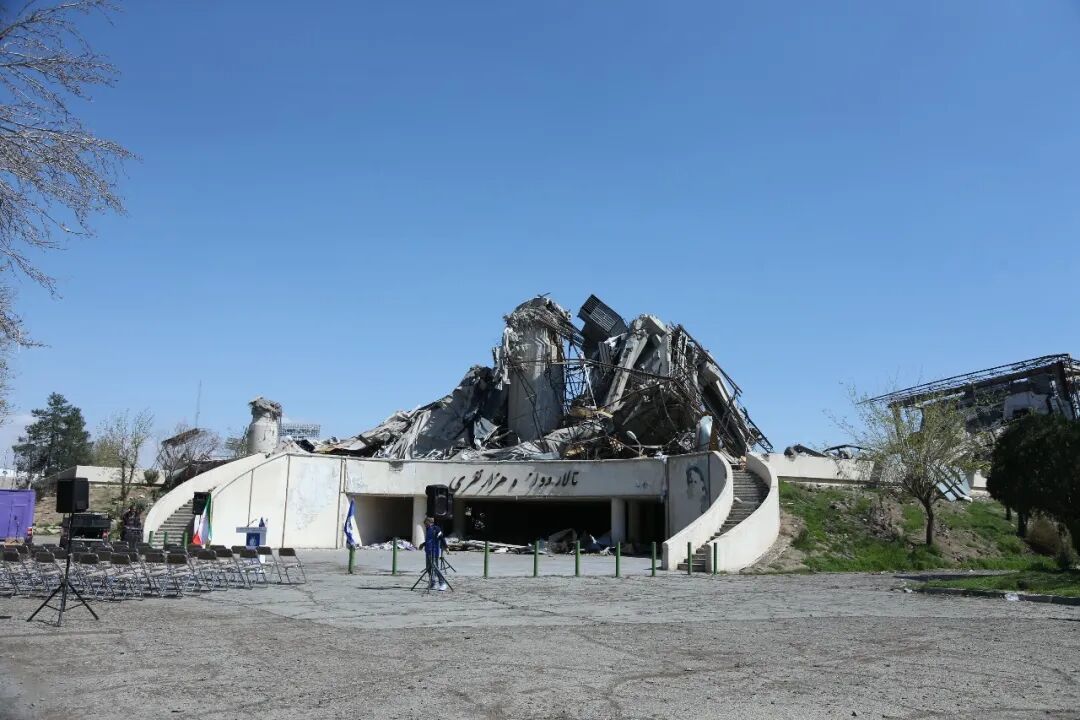
This is a damaged sports hall photographed on April 3 at the Azadi Stadium in Tehran, the capital of Iran. Photo by Xinhua reporter Shadati
The Iranian military rejects Trump's "48-hour" ultimatum
On April 4, Abdollahi, commander of the Central Headquarters of the Iranian Armed Forces' Khatam al-Anbiya, responded to U.S. President Trump's "48-hour" ultimatum, emphasizing that the Iranian military would firmly defend national rights and protect national assets, making the aggressors pay a price.
The Iranian Islamic Republic Broadcasting and Television reported that Abdollahi stated that after facing continuous failures, Trump exhibited "helpless, panicked, unbalanced, and foolish behavior," attempting to threaten Iran's infrastructure and national assets.
Abdollahi emphasized that if the U.S. and Israel launched such attacks, "we will launch continuous and devastating strikes on all infrastructure used by U.S. forces and Israeli infrastructure without restrictions." He reminded the U.S. and Israel that since the start of this imposed war on Iran, "everything we have said has been put into action."
Earlier that day, Trump posted on social media, demanding that Iran "reach an agreement" within 48 hours or "open the Strait of Hormuz," threatening that "time is running out—only 48 hours remain before disaster strikes them."
On March 26, Trump announced a 10-day delay in the "destruction" of Iran's energy facilities, extending the deadline to 8 PM Eastern Time on April 6.
Israeli media: Israeli military leaders admit underestimating Hezbollah's strength, believe Iranian regime remains stable
On the evening of April 4, a recording aired by Israel's Channel 12 showed an Israeli military leader admitting that the Israeli military underestimated the strength of Hezbollah in Lebanon and believed that the Iranian regime remains stable, possibly requiring some form of "agreement" with Iran in the end.
The television station broadcast several segments of a recording of Israeli Defense Forces Northern Command Commander Rafi Milo meeting with representatives of the residents of the northern collective community of Misgav Am on March 31. The report stated that the atmosphere during the meeting was "tense," and Milo apologized for the death of a local resident who was mistakenly hit by Israeli military fire.
Milo stated that there is a "gap" between the Israeli military's assessment of the losses Hezbollah would suffer in the IDF's "Northern Arrow" operation in the second half of 2024 and Hezbollah's actual demonstrated combat capabilities in the current conflict. Despite suffering "heavy losses," Hezbollah's combat capabilities still "concern the Israeli military." Hezbollah still has the ability to launch a large number of rockets, most of which target the Israeli military.
In another segment of the recording, Milo expressed his belief that the conflict between Israel and the U.S. against Iran would not end with a "regime change." He noted that the Iranian "regime, although experiencing turmoil, seems to remain stable. Perhaps some form of agreement will ultimately be needed."
Channel 12 also cited an Israeli Air Force intelligence officer, reporting that before the conflict began, the Israeli military assessed that Iran had about 2,500 ballistic missiles. After accounting for launch consumption and U.S.-Israeli airstrikes, Iran currently has over 1,000 ballistic missiles capable of reaching Israel.
Iranian media: Soleimani's daughter denies that his relatives were arrested in the U.S.
According to a report by the Iranian Islamic Republic Broadcasting and Television on April 4, the two daughters of Qassem Soleimani, the late commander of the Islamic Revolutionary Guard Corps' Quds Force, denied that Soleimani's relatives were arrested in the U.S.
Soleimani's daughter, Zainab, stated that the U.S. State Department's claims are lies, and the individuals arrested in the U.S. have no relation to Soleimani.
Another daughter, Narges, stated that the U.S. claims are not credible because both of Soleimani's nephews are male, and no relatives of Soleimani have lived in the U.S. to date.
The U.S. State Department issued a statement on April 4, saying that Soleimani's niece, Hamid Soleimani Afshar, and her daughter were arrested by federal agents that day.
U.S. media: U.S. military reallocates stealth cruise missiles to strike Iran
On April 4, Bloomberg reported that the U.S. military has ordered the reallocation of "Joint Air-to-Surface Standoff Missiles-Extended Range" (JASSM-ER) from various global locations for military operations against Iran. Most of these stealth cruise missiles will be deployed to the Middle East battlefield.
Insiders revealed to Bloomberg that the U.S. military ordered the reallocation of this missile type from reserves in the Pacific region for the conflict with Iran at the end of March. Missiles from other regions, including those deployed in the U.S. mainland, will also be transported to bases under the U.S. Central Command or to RAF Fairford in the UK. The U.S. Central Command's area of responsibility includes the Middle East and other regions.
The "Joint Air-to-Surface Standoff Missiles-Extended Range" has a range of over 960 kilometers. The report stated that before the conflict, the total inventory of this missile type was about 2,300, and it is expected that after the reallocation, only 425 will remain available for use in other global regions, with another 75 rendered unusable due to damage or technical failures.
If the shorter-range "Joint Air-to-Surface Standoff Missiles" (JASSM) are included, about two-thirds of the U.S. inventory of such missiles is being used for the conflict with Iran.
Insiders stated that in the first four weeks of military operations against Iran, the U.S. military consumed over 1,000 "Joint Air-to-Surface Standoff Missiles-Extended Range." On January 3, during the U.S. attack on Venezuela, U.S. aircraft launched 47 of this missile type.
Bloomberg noted that since the U.S. and Israel launched large-scale military operations against Iran, concerns have been raised regarding the supply of interceptors and long-range strike weapons for U.S. air defense systems. At the current production level, it will take years to replenish the consumed military stockpiles.
Two U.S. Black Hawks hit by Iranian mountain dwellers
The public relations department of the Iranian Islamic Revolutionary Guard Corps stated on April 4 that tribal members in the Iranian mountains hit two Black Hawk helicopters on April 3. The Iranian Islamic Revolutionary Guard Corps expressed gratitude for this.
The statement said that tribal members from the Kohgiluyeh and Boyer-Ahmad Province and the Bakhtiari region acted separately, effectively striking the two Black Hawk helicopters in remote mountainous areas far from the deployment zones of Iranian armed forces. The helicopters were attempting to rescue the pilot of a previously downed U.S. F-35 fighter jet.
Iranian military claims to strike multiple U.S. targets in the Gulf region with drones
On April 4, the Iranian military announced that it had conducted drone strikes against multiple U.S. targets in Gulf countries, including Kuwait.
According to the announcement, the Iranian military used "Arash-2" drones to strike U.S. missile and drone detection and identification radars, as well as the command posts of U.S. mechanized, armored, and helicopter forces stationed in Kuwait.
The targets also included aluminum industrial facilities in the UAE. The U.S. and Israel have invested heavily in the aluminum industry in the UAE, utilizing it to produce various aircraft, including the F-35 stealth fighter, as well as missiles, tanks, and armored vehicles.
Netanyahu confirms Israeli airstrikes on Iranian petrochemical facilities, says action marks further escalation
On April 4, Israeli Prime Minister Netanyahu confirmed that the Israeli military had conducted airstrikes on Iranian petrochemical facilities that day, stating that this move marks a further escalation of military actions against Iran's industrial infrastructure.
Netanyahu stated in a social media post that the Israeli military had previously destroyed about 70% of Iran's steel production capacity, which was used to produce "raw materials for weapons against Israel," adding, "Today, we attacked their petrochemical plants."
Netanyahu stated that Israel would continue airstrikes on Iranian steel and petrochemical facilities, targeting these "cash cows" of the Iranian government.
Iranian media reported that the petrochemical economic zone in Mahshahr, southwestern Iran, was struck that day, resulting in 5 deaths and 170 injuries.
Iranian military: Iraqi vessels can pass through the Strait of Hormuz
According to a report by the Iranian Islamic Republic News Agency on April 4, a spokesperson for the Central Headquarters of the Iranian Armed Forces announced that "brotherly country" Iraq is not subject to any restrictions imposed by Iran in the Strait of Hormuz.
The spokesperson reiterated that these restrictions are only aimed at "enemy countries."
Iranian media: Trump is mired in the quagmire of war
An article published by Iran's Tasnim News Agency on April 4 stated that U.S. President Trump is mired in a "quagmire of war," with the war against Iran yielding no results and failing to achieve any of his fanciful goals, and now once again issuing hollow threats against Iran.
The article also stated that Trump feels shocked and helpless due to the continuous downing of advanced U.S. aircraft by Iran's air defense systems.
Earlier that day, Trump posted on social media, demanding that Iran "reach an agreement" within 48 hours or "open the Strait of Hormuz," threatening that "time is running out—only 48 hours remain before disaster strikes them."
On March 21, Trump issued a threat to Iran, demanding that it open the Strait of Hormuz within 48 hours, or he would destroy its various power plants. On March 23, he stated that the U.S. and Iran had engaged in "very good and productive" dialogue over the past two days and would delay airstrikes on Iranian power plants by 5 days. On March 26, he announced that "at the request of the Iranian government," the action would be delayed by 10 days, extending the deadline to 8 PM Eastern Time on April 6.
U.S. media reports Iran uses multispectral cameras to identify U.S. and Israeli aircraft
According to a report by the Wall Street Journal on April 4, Iran is using a complex network of multispectral cameras to track and identify U.S. and Israeli aircraft.
The report cited Amir Avivi, chairman of the Israeli Defense and Security Forum, stating that Iran has deployed these cameras along routes commonly used or critical for enemy aircraft, capable of capturing data beyond visible light wavelengths. Once enemy aircraft are detected, the Iranian military attempts to shoot them down. Unlike radar systems, these cameras do not emit signals that Israel can use to locate them.
Earlier that day, a spokesperson for the Central Headquarters of the Iranian Armed Forces stated that the Iranian Islamic Revolutionary Guard Corps Aerospace Force's new air defense system successfully shot down a U.S. F-35 fighter jet, three drones including the MQ-9 and "Hermes" models, and two cruise missiles, declaring, "This Friday (April 3) should be called the black shame Friday for the U.S. and Israel."
The spokesperson stated, "We have a new air defense system, developed independently by our knowledgeable youth, which will gradually be revealed in actual combat."
Iranian foreign minister: neighboring countries will suffer if a nuclear leak occurs
On April 4, Iranian Foreign Minister Amir-Abdollahian warned on social media that if Israel and the U.S. bombed Iran's Bushehr nuclear power plant, neighboring countries closer to the nuclear power plant would suffer loss of life if a nuclear leak occurred.
Amir-Abdollahian wrote, "Israel and the U.S. have bombed Iran's Bushehr nuclear power plant four times. Radioactive dust will cause the capitals of the Gulf Cooperation Council member states to lose lives, while it will not affect Tehran."
In another post, Amir-Abdollahian expressed gratitude to Pakistan for its efforts on related issues, stating that Iran has never refused to communicate with Islamabad regarding the situation. Iran is focused on "a plan to permanently end this illegal war imposed on Iran."
The Bushehr nuclear power plant is located outside the city of Bushehr in southern Iran and is the only operational nuclear power plant in the country.
Fragments of Iranian missiles fall near Israeli military headquarters
Israeli media reported on April 4, citing military sources, that Iran launched multiple rounds of multi-warhead missiles toward central Israel that day, with missile fragments landing near the Kirya military base in Tel Aviv, the location of the Israel Defense Forces headquarters.
Reports indicated that missile fragments fell in a parking lot near the Kirya base. Some missiles carried multiple warheads, causing explosions at over a dozen locations in central Israel, damaging buildings and injuring at least 6 people.
A warning system installed on the mobile phones of Xinhua reporters indicated that air defense alarms sounded in multiple areas of central Israel, including Tel Aviv, that day. The Israeli military issued a statement confirming that Iran launched multiple rounds of missiles toward Israel that day.
Comprehensive report by Xinhua News Agency
Israeli airstrikes targeted Iranian petrochemical facilities, causing 5 deaths and 170 injuries. Two U.S. Black Hawk helicopters were shot down by Iranian tribesmen while attempting to rescue a downed pilot. Iran also launched drone strikes against U.S. military targets in the Gulf region on April 3-4, 2023.
- Israeli airstrikes on Iranian petrochemical facilities resulted in 5 deaths and 170 injuries.
- Two U.S. Black Hawk helicopters were shot down by Iranian tribesmen.
- Iran conducted drone strikes against U.S. military targets in the Gulf region.