
Crane Aerospace brakes help Northrop’s combat drone pass key test
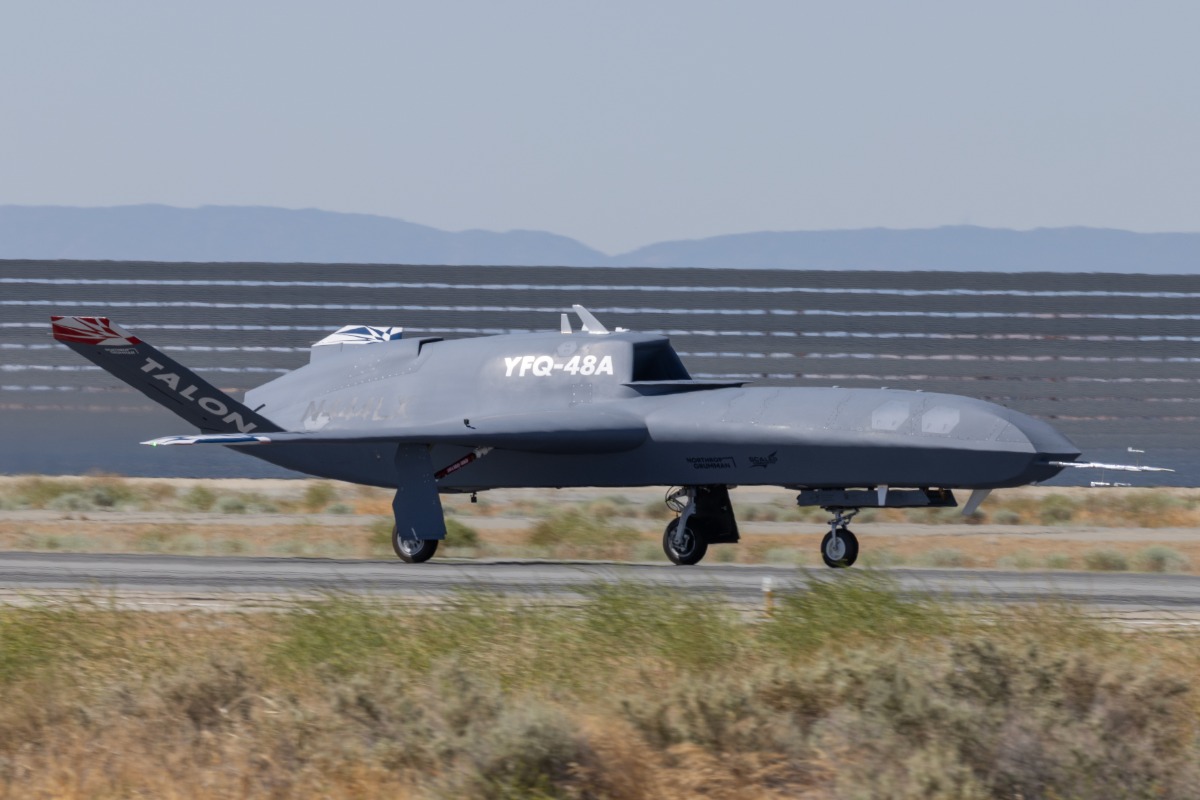
Northrop Grumman’s YFQ-48A Talon Blue autonomous combat aircraft completed its first taxi test on May 14 at Mojave, California, moving under its own power for the first time and bringing the Air Force’s third designated drone wingman prototype within striking distance of its first flight. Crane Aerospace and Electronics, part of Connecticut-based Crane Company, supplied the brake control system that made that taxi run possible, and the company’s announcement on May 18 provides the clearest confirmation yet of where the program stands in its ground test campaign.
A taxi test is deceptively simple to describe and genuinely demanding to execute. The aircraft rolls down the runway, accelerates, steers, and stops — nothing that sounds dramatic on paper, but the test validates the integration of the propulsion system, landing gear, flight control surfaces, and braking architecture under real loads and speeds before the aircraft ever leaves the ground. Getting all of those systems to work together reliably on a new prototype, particularly one designed with heavy emphasis on novel manufacturing methods and reduced part counts, is where programs can expose problems that are far easier to fix on the ground than after a first flight reveals them at altitude. Talon Blue getting through taxi testing without incident is a meaningful technical milestone.
Crane A&E’s contribution is the brake control system, a component that manages anti-skid braking performance during landing and ground operations, modulating brake pressure to prevent wheel lockup and allow the aircraft to stop in the shortest possible distance without losing directional control. Ryan Sands, Crane A&E’s Vice President and General Manager of Landing Systems, described the work in the company’s announcement: “Leveraging decades of brake control system expertise, we utilized our Standard System Architecture and worked closely with Northrop Grumman to rapidly provide a best-in-class, mission-critical brake control solution for this aircraft.” The Standard Systems Architecture Crane references is the company’s modular design framework, which allows it to adapt proven brake control technology to new platforms quickly rather than engineering a custom solution from scratch for each customer, a critical capability in programs where speed is as important as performance.
Crane A&E’s heritage in brake control technology stretches back to 1947, when its predecessor brand Hydro-Aire partnered with Boeing to deliver what the company describes as the industry’s first anti-skid braking system, the same fundamental technology that evolved into the systems now flying on thousands of commercial and military aircraft worldwide. The company states that its brake control systems help aircraft stop every 1.2 seconds globally, a figure that reflects just how broadly its technology has been integrated across aviation.
The Talon Blue that rolled down the Mojave runway on May 14 is a genuinely different aircraft from anything Northrop Grumman tried to build before. The company lost the Air Force’s first CCA increment competition, in which the Air Force selected General Atomics’ YFQ-42A and Anduril’s YFQ-44A for engineering and manufacturing development, with Northrop’s earlier design reportedly passed over partly because of cost concerns, according to Air and Space Forces Magazine. Northrop responded by going back to the drawing board with its subsidiary Scaled Composites, initially under the internal codename Project Lotus before renaming the effort Project Talon.
The redesigned aircraft features 50 percent fewer parts than Northrop’s previous submission, weighs approximately 1,000 pounds less, and requires a construction time that is 30 percent faster, according to Northrop officials who spoke with reporters in California, as reported by Defense News. The Air Force assigned the YFQ-48A designation to the prototype in December 2025, and Brig. Gen. Jason Voorheis, the Air Force’s program executive officer for fighters and advanced aircraft, said at the time that “their approach aligns with our strategy to foster competition, drive industry innovation, and deliver cutting-edge technology at speed and scale.”
The propulsion system powering Talon Blue is a member of Pratt and Whitney’s PW500 engine family, a commercial turbofan originally developed for business jets that the RTX subsidiary adapted for combat drone operations through an extensive test program simulating CCA-specific flight conditions. Pratt and Whitney ran the PW500 through simulated flight and operational conditions unique to CCA missions and reported favorable thrust, range, and operability results, according to the company’s April 2026 announcement, which confirmed the engine was integrated and ready to support flight testing.
The PW500 family has accumulated more than 24.5 million flight hours across its commercial applications, according to Pratt and Whitney, giving the design a maturity baseline that a purpose-built military engine would not have at this stage of development. Using a commercial derivative rather than a clean-sheet military turbofan is a deliberate affordability choice that mirrors what the broader CCA program has been doing since its inception.
Content preview only. Full article available at source. View Full Article
Northrop Grumman's YFQ-48A Talon Blue completed its first taxi test in Mojave, California, on May 14, 2026. This marks a significant milestone in the development of the autonomous combat aircraft, which is equipped with a PW500 engine and a brake control system from Crane Aerospace. The Talon Blue is designed to enhance operational capabilities with reduced weight and complexity compared to previous models.
- Northrop Grumman's YFQ-48A Talon Blue completed its first taxi test on May 14, 2026.
- The aircraft is designed as an autonomous combat drone.
- Crane Aerospace supplied the brake control system for the Talon Blue.
- The Talon Blue features 50% fewer parts and is 1,000 pounds lighter than previous designs.
- The PW500 engine family has over 24.5 million flight hours in commercial applications.