
Dark Eagle on Guam Gives China a New 2026 Targeting Problem
 Marcus Chen
Dark Eagle on Guam Gives China a New 2026 Targeting Problem
Guam is roughly 1,640 miles from the Luzon Strait, about 1,805 miles from the middle of the Taiwan Strait, and just under 1,925 miles from Shanghai. That distance math is why one photograph from Valiant Shield 2026 matters more than the usual exercise publicity.
The U.S. Army's Dark Eagle Long-Range Hypersonic Weapon was deployed on Guam during the June exercise, according to a Pacific Command confirmation reported by Stars and Stripes on July 21. The Army and Pacific Command had already released images showing Adm. Samuel Paparo observing soldiers from 7th Infantry Division, Multi-Domain Command-Pacific, training with the system during Valiant Shield. DVIDS metadata places one of the Dark Eagle images on June 6 and describes the weapon as assigned to 7th Infantry Division during the exercise.
The official caption is careful. It says training, integration, multi-axis effects, and the usual free-and-open language. The operational message is less careful. The Army has now shown that its premier ground-launched hypersonic system can appear on Guam during a major joint exercise. For Beijing, that turns Guam from a rear-area logistics hub into a potential launch point for conventional prompt strike.
The Range Is the Point
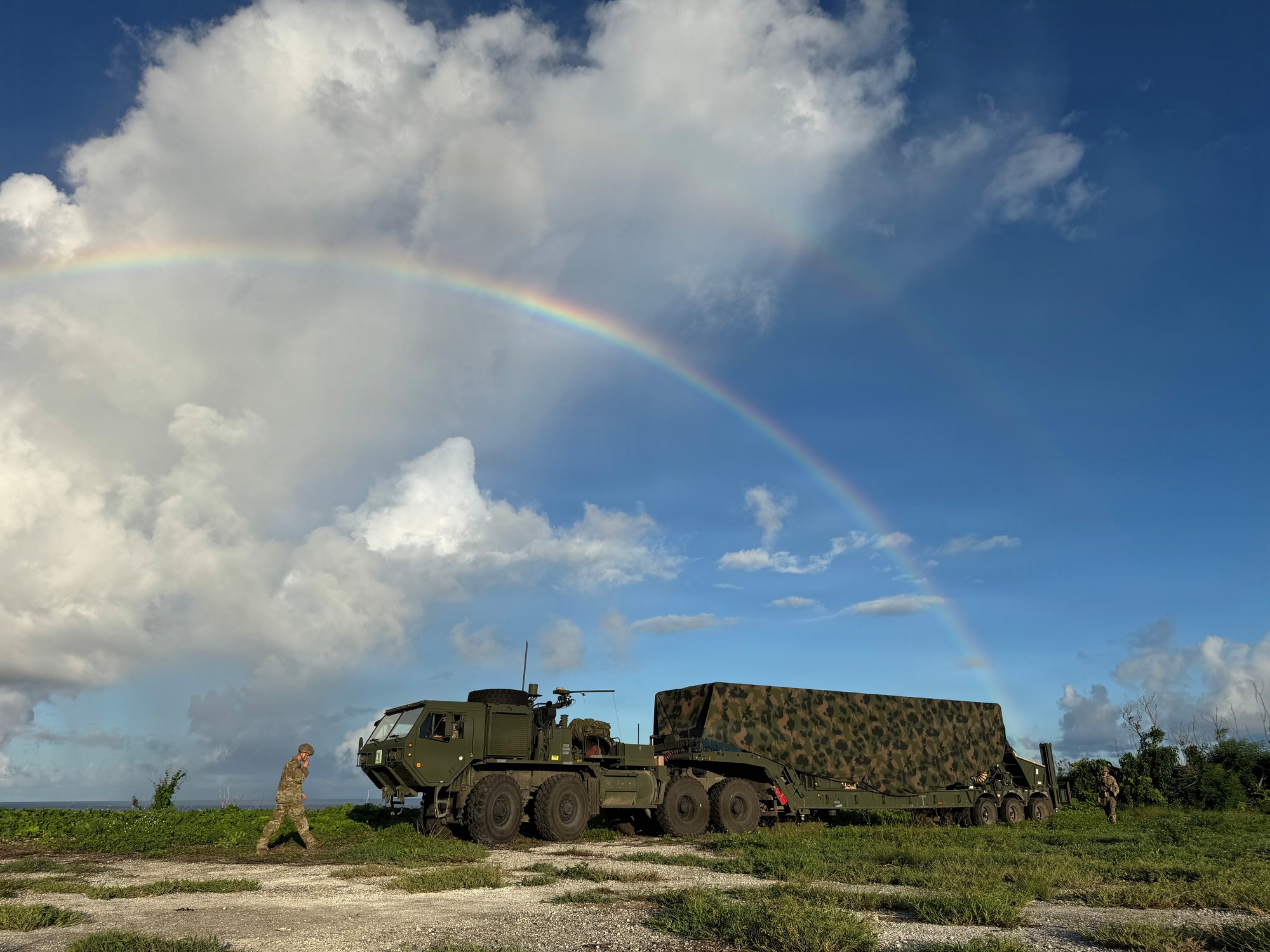
The Congressional Research Service describes the Long-Range Hypersonic Weapon, also known as Dark Eagle, as a ground-launched missile equipped with a hypersonic glide body, transport vehicles, support equipment, and fire-control systems. CRS cites a reported range of 1,725 miles. Stars and Stripes, referencing earlier reporting on Defense Secretary Pete Hegseth's Redstone Arsenal briefing, used a higher figure of about 2,175 miles.
Those two numbers lead to different maps. At 1,725 miles, Guam can threaten approaches around the Luzon Strait and parts of the Philippine Sea, but the Taiwan Strait itself sits near the edge or just beyond the envelope depending on the target point. At 2,175 miles, the geometry changes. Fujian, Shanghai approaches, and key sections of China's eastern seaboard begin to sit inside the outer ring.
Either way, the signal is not subtle. Guam gives the United States a fixed, sovereign, heavily built-up position west of Hawaii and east of the first island chain. It is not as close as Okinawa or the Philippines, but it is politically easier to use and logistically deeper. Anyone who has served on a destroyer knows what that means: a missile sitting ashore does not need underway replenishment, does not need a carrier screen, and does not burn steaming days just to remain present.
A Hypersonic Battery Is Not a War Plan
Dark Eagle is built around a boost-glide profile. A rocket booster accelerates the weapon to hypersonic speed, then a maneuvering glide body flies through the atmosphere toward the target. The practical purpose is to hold time-sensitive, heavily defended targets at risk without asking aircraft or ships to penetrate the densest part of China's anti-access network.
That sounds clean on a briefing slide. It is messier in the Pacific. A single battery does not solve the targeting problem. It needs space-based and airborne sensing, communications that survive jamming, launch authority that can move faster than the target, and battle damage assessment after impact. The missile is the visible piece. The kill chain is the weapon.
There is also the magazine problem. Hypersonic weapons are expensive and scarce. The Army has spent years getting Dark Eagle through delayed testing and fielding. Even if the system is now mature enough for Guam training, Washington cannot pretend it has a deep inventory. In a Taiwan scenario, the first salvo would be precious. Every round used against a fixed command site is a round not available for a mobile launcher, air-defense node, or naval target.
That scarcity cuts both ways. China does not need to believe the United States has hundreds of Dark Eagles. It only needs to believe a handful could arrive early enough to complicate a campaign plan. If PLA planners have to assign more surveillance, missile defense, cyber effort, and conventional strike capacity to Guam, the battery has already imposed costs before firing.
Guam Is Becoming a Two-Way Missile Base
Paparo has been asking Congress for a much larger Guam defense architecture. Stars and Stripes reported that his request included $909 million for the Guam Defense System, intended to counter ballistic, hypersonic, and cruise missile threats while also providing a basis for future offensive capability. That phrase matters. Guam is no longer just an island that needs defending. It is becoming a node where defense and offense are being fused.
That is a hard shift for U.S. posture in the western Pacific. For two decades, Guam's military value was usually described in terms of runways, submarine access, bombers, prepositioned stores, and repair capacity. Those still matter. But a ground-launched hypersonic system changes the political and military value of the island. It lets the Army contribute to sea denial without owning a ship, and it gives Pacific Command another way to generate pressure when carrier availability is thin.
The drawback is obvious. Guam is a known point on the map. China has built the missile force precisely to attack bases like it. A Dark Eagle launcher may be mobile on the island, but the island is not mobile. Fuel farms, ports, magazines, air defenses, radar sites, and command nodes can all be targeted. Hardening, deception, dispersal, and rapid repair become just as important as the missile itself.
The Message to Beijing and to Congress
The timing is useful for Washington. Valiant Shield took place across Japan, Guam, and the Northern Mariana Islands from June 22 to July 1, while the Army's photo releases appeared in mid-July and the Guam confirmation followed on July 21. That sequencing allowed Pacific Command to make a public point without staging a formal missile crisis.
To Beijing, the message is that the United States is testing how quickly it can move land-based long-range fires into the theater and fold them into joint operations. To Congress, the message is more domestic: fund the Guam shield and the offensive missile inventory, or the concept stops at a photo caption.
Marcus rule of thumb: if a weapon cannot be protected, supplied, targeted, and reloaded, it is not a deterrent. Dark Eagle on Guam clears only the first hurdle. It proves presence. It does not yet prove sustainment.
But presence still counts. China has spent years making U.S. ships and aircraft work harder inside the first island chain. Guam-based Dark Eagle turns part of that problem around. It gives the PLA another launcher to find, another timeline to compress, and another reason to wonder whether the first hours of a crisis would be as controllable as its exercises assume.
The U.S. Army deployed the Dark Eagle Long-Range Hypersonic Weapon on Guam during the Valiant Shield 2026 exercise in June. This deployment enhances Guam's strategic military value, allowing the U.S. to threaten key areas in China with a new hypersonic capability. The Army is also advocating for increased funding to bolster Guam's defense architecture, indicating a shift towards a more offensive posture in the region.
- The Dark Eagle hypersonic weapon was deployed on Guam during the Valiant Shield 2026 exercise.
- The weapon has a reported range of 1,725 to 2,175 miles, affecting strategic targets in China.
- Guam is becoming a dual-use military base for both defense and offensive capabilities.
- The U.S. Army is seeking funding for a larger defense architecture in Guam.
- The presence of Dark Eagle complicates China's military planning regarding U.S. capabilities in the region.