
"Deep Dive: Ammunition Crisis, Signs of the U.S. Entering a 'Strategic Menopause'?"
[Global Times Special Correspondent in the U.S. Wang Kai, Global Times Reporter Li Meng, Global Times Special Correspondent Liu Wen]Editor's Note: Recently, the issue of ammunition shortages in the United States has become a focal point of concern. The consumption from military actions against Iran, combined with previous military aid to Ukraine and Israel, has led to a sharp decline in the stockpiles of key weapons such as the U.S. "Patriot" interceptors. This ammunition crisis not only exposes deep-seated shortcomings in the U.S. defense industry but also reflects a strategic imbalance, being described as a sign that Washington is entering a "strategic menopause." Since the end of World War II, the U.S. has frequently initiated wars globally, disrupting international order, continuously overextending its national power, and ultimately making its own citizens bear the cost.
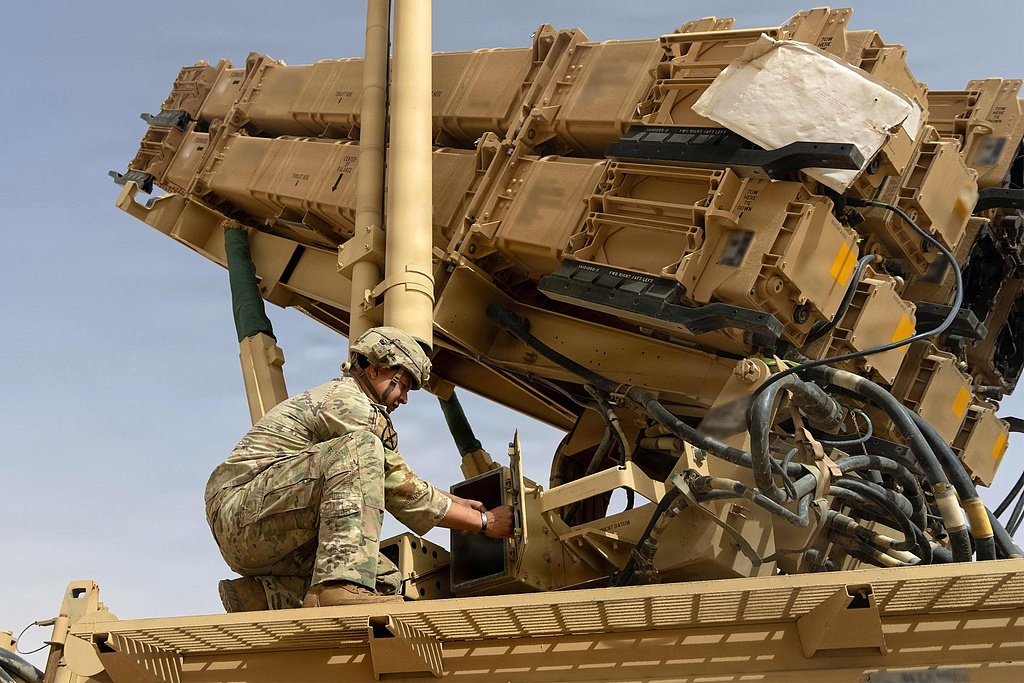
"Equipped but Out of Ammunition" and a Missile "Slips Through"
In a cornfield near the capital of Ukraine, Kyiv, several U.S.-made "Patriot" missile defense systems have been quietly parked for weeks. The chief engineer responsible for the operation of these systems in Ukraine, Dmytro, recently told CNN that he hasn't seen the "Patriot" system in operation for six weeks. "We have the equipment, but we can't intercept any missiles," the engineer said emotionally, explaining that the reason is simple—Ukraine has run out of interceptors.
Shifting focus from Ukraine to the Middle East reveals that the shortage of "Patriot" interceptors is also present here. On July 13, Iran launched a series of drone and missile attacks against U.S. forces stationed at three bases in Jordan. The U.S. military was forced to respond with "Patriot" interceptors at an astonishing rate of consumption. By July 17, the defense line was breached, and an Iranian missile struck a prefabricated housing unit at a U.S. base, resulting in the deaths of three American soldiers and injuries to over 100 others. U.S. Secretary of State Rubio responded by stating, "We shot down almost all the missiles, but one slipped through."
From the battlefield in Ukraine to the U.S. bases in Jordan, the shortage of "Patriot" interceptors is no longer a localized issue but a concentrated exposure of the U.S. ammunition crisis. According to reports from CNN and other media, the current tight ammunition stockpile in the U.S. extends far beyond "Patriot" interceptors. Since the outbreak of hostilities with Iran, the U.S. military has consumed nearly 80% of its "THAAD" missile stockpile and about half of its "Patriot" interceptors. Additionally, informed sources have revealed that the U.S. military has "almost exhausted" its Army Tactical Missile System and precision strike missiles, while the Navy's "Tomahawk" cruise missiles have also seen nearly half of their stock consumed.
A Pentagon internal memo obtained by The Washington Post in early August shows that Deputy Secretary of Defense Vanberg has explicitly requested defense contractors to "accelerate" weapon production and delivery. However, restocking is not easy. The Center for Strategic and International Studies (CSIS) estimates that even with accelerated production, the stockpiles of "Patriot" and "THAAD" interceptors will not return to pre-war levels against Iran until mid-2029. The U.S. think tank, the Foreign Policy Research Institute, points out that the production cycle for U.S. air defense missiles typically spans years. Lockheed Martin can produce only about 600 "Patriot" interceptors per year. This means that just to replenish the consumption from the first month of the Iran conflict would take three years.
Structural Imbalance Between Strategic Ambitions and Defense Industrial Base
The U.S. ammunition crisis has surprised many—after all, the U.S. is the strongest military power in the world. Regarding the "ammunition deficit" in the U.S., the Vice President of the Observer Research Foundation in India, Pante, wrote that this is not merely a result of the current conflict with Iran but reflects a deep-seated structural imbalance between U.S. strategic ambitions and its defense industrial base. In the decades following the Cold War, successive U.S. governments, based on the assumption that "large-scale interstate wars are unlikely to occur," prioritized production efficiency over expanding capacity, ultimately creating an industrial ecosystem that cannot meet the demands of sustained high-intensity warfare.
This structural imbalance has a clear institutional path. After the Cold War, the Pentagon actively promoted the consolidation of the defense industry. In 1993, then-Secretary of Defense Aspin and Deputy Secretary of Defense Perry held a meeting with heads of major defense contractors, which later became known as the "Last Supper." The two candidly stated that military budget cuts were a foregone conclusion, and defense contractors had to either merge or exit the market. Subsequently, dozens of U.S. Department of Defense contractors merged into a few major players.
As the U.S. strategic focus shifted, its military production system began to reorganize. In pursuit of profit, U.S. defense contractors adopted a "lean production" model, significantly reducing redundant capacity and backup production lines. At the same time, the loss of skilled manufacturing labor and the aging of production infrastructure further constrained the speed of U.S. military production.
Within the Pentagon's budgeting system, ammunition faces another inherent disadvantage: within limited budget allocations, each military branch must always make trade-offs between ammunition and large equipment such as aircraft and armored vehicles. Large equipment has a service life of up to 30 years, is large in scale, highly visible, and has a clear deterrent effect; whereas ammunition is mostly stored in warehouses after production and is only activated or replaced when war breaks out or when its service life expires. This difference between "visible deterrence" and "invisible reserves" often puts ammunition at a disadvantage in long-term budget negotiations.
Military expert Zhang Junsha told Global Times reporters that the U.S. ammunition crisis is also directly related to the country's supply chain issues. The hollowing out of the domestic industry in the U.S. is severe, with many small and medium-sized supporting factories shutting down, upstream and downstream supply chains breaking, and the production capacity of key components being limited. Any problem in one link can drag down the overall ammunition delivery schedule. Additionally, the high degree of industry monopoly has weakened the motivation to expand production. The U.S. military-industrial complex is concentrated in a few giants like Boeing, which are more inclined to take on high-profit new weapon development contracts, while showing little willingness to expand production of lower-profit conventional ammunition.
"The Depleted U.S. Ammunition Stockpile and the Myth of 'Extended Deterrence'"
The implications of the U.S. ammunition crisis for Washington, its allies, and the world have become a hot topic of discussion among politicians, scholars, and media in multiple countries. Some believe that the ammunition shortage has become a consideration in the White House's discussions on how quickly and under what conditions the U.S. should reach an agreement with Iran. Bloomberg reports that the most direct impact of the U.S. ammunition crisis is that if negotiations with Iran do not progress, the White House's options for military escalation will be limited.
The U.S. ammunition crisis affects far more than its conflict with Iran. The Atlantic Council, a U.S. think tank, believes that Washington's allies, partners, and adversaries are all paying attention to several important questions: How will the U.S. prepare for potential other conflicts before its ammunition stockpiles are restored? Will the current ammunition shortage affect perceptions of U.S. deterrence and operational credibility?
The South Korean newspaper Hankook Ilbo recently published an article titled "The Depleted U.S. Ammunition Stockpile and the Myth of 'Extended Deterrence'," stating that due to limitations in real material capabilities, the U.S. "Indo-Pacific Strategy" is likely to shrink from its original "multi-theater simultaneous deterrence" to a "limited intervention with trade-offs and concentrated forces." In other words, once multiple regions experience conflicts simultaneously, the U.S. will no longer have the capacity to immediately deploy overwhelming conventional military forces to all fronts.
Professor Zhang Jiadong from Fudan University's Center for American Studies told Global Times reporters that the U.S. ammunition crisis will inevitably affect Washington's strategic deterrence and credibility. CSIS senior researcher Karako referred to the ammunition crisis as a "generational disaster for U.S. conventional deterrence." The Hankook Ilbo stated, "The U.S. ammunition stockpile is gradually running low, which is a sign that this superpower is entering a 'strategic menopause.' The current U.S. military is like an aging giant that is exhausting its long-term operational endurance."
Zhang Junsha told reporters that the U.S. ammunition shortage exposes the deep contradictions between its global military hegemony ambitions and its resource capabilities. This may help curb U.S. military adventures around the world to some extent, which could be a significant blessing for world peace. Furthermore, this will also weaken the security confidence of allies and impact the U.S. alliance system. Once allies see the reality that the U.S. military cannot sustain long-term high-intensity interventions, they will actively adjust their diplomatic and defense strategies, no longer blindly relying on the U.S., and some countries may even seek strategic autonomy, leading to a loosening of the U.S.-led alliance system.
This judgment has already been confirmed. On August 7, Saudi Arabia, Turkey, and Pakistan signed the "Mecca Joint Defense Agreement." The Atlantic Council believes this indicates that Saudi Arabia is seeking to reduce its dependence on the U.S. The New York Times reported that, given the production lag in the U.S., European countries are seeking to increase arms procurement from other countries. Some U.S. officials are also concerned that Asian countries will doubt the U.S.'s ability to protect them with non-nuclear defense systems. The Hankook Ilbo also questioned the reliability of U.S. security: "How long will South Korea uncritically accept the premise of the alliance that 'U.S. extended deterrence can completely fill the security gap'?"
"Overextending National Power Will Ultimately Leave It Unable to Maintain Core Strategic Interests"
In fact, the biggest issue reflected by the U.S. ammunition crisis is not the shortcomings of its defense industrial base, but rather the strategic missteps of the U.S. This country, which continuously initiates wars, disrupts world peace, overextends its national power in conflicts, and makes the people of various countries pay the price.
U.S. magazine Foreign Affairs points out that war seems to have a certain "fatal attraction" for the U.S. Data shows that from the end of World War II in 1945 to 2001, the U.S. initiated 201 armed conflicts, most of which were unauthorized wars of aggression by the United Nations Security Council. According to data from the Costs of War project at Brown University's Watson Institute for International and Public Affairs, wars initiated by the U.S. in countries like Iraq and Afghanistan from 2001 to 2023 have resulted in 940,000 direct deaths.
The U.S. has also suffered significant losses. From 2001 to 2021, the U.S. deployed 832,000 troops to Afghanistan. During these 20 years, 2,461 American soldiers died, and at least 20,000 were injured.
War has brought the U.S. not only personnel casualties and economic losses but also impacts on its core interests. According to a recent report by Foreign Affairs, the wars in the Middle East have long-term strategic costs that have damaged the U.S.'s global standing and competitiveness. Twenty years later, the U.S. will find that wars have weakened its military strength and economic power. History is very clear: if a great power overextends its national power in minor conflicts, it will ultimately be unable to maintain its core strategic interests.
The U.S. military faces a critical ammunition shortage, with nearly 80% of THAAD missiles and half of Patriot interceptors consumed amid ongoing conflicts in Ukraine and the Middle East. This crisis has led to operational challenges, as U.S. forces have not utilized Patriot systems in Ukraine for over six weeks. The Pentagon has urged defense contractors to accelerate production, but recovery of stockpiles may take until 2029. This situation highlights a significant imbalance between U.S. military ambitions and its defense industrial capacity.
- U.S. ammunition stockpiles are critically low, with nearly 80% of THAAD missiles and half of Patriot interceptors consumed.
- Patriot interceptors have been used extensively in response to Iranian drone and missile attacks.
- The U.S. military has not seen operational use of Patriot systems in Ukraine for over six weeks due to ammunition shortages.
- The Pentagon has requested defense contractors to expedite weapon production, but recovery of stockpiles may take years.
- The ammunition crisis reflects a structural imbalance in U.S. defense industrial capacity and strategic ambitions.