
Dongfeng-17 Live Fire Launch Footage Released for the First Time: PLA Rocket Force Displays 1800 Kilometer Strike Chain Front and Center
 Li Minghui
DF-17 Live Fire Launch Footage Released for the First Time, PLA Rocket Force Displays 1800 km Strike Chain
The timing of July 1 is quite interesting. The Chinese strategic missile forces celebrate their 60th anniversary, and CCTV and Global Times have released footage of two live-fire drills by the Rocket Force. The most eye-catching aspect is not another equipment display, but the first public release of live fire footage of the DF-17 hypersonic missile. The DF-17 was already showcased during the 2019 National Day parade, but the gap between the parade formation and the launch site is not just a matter of a single shot; it is a piece of the puzzle for external observers to assess its training maturity.
Details of the Release
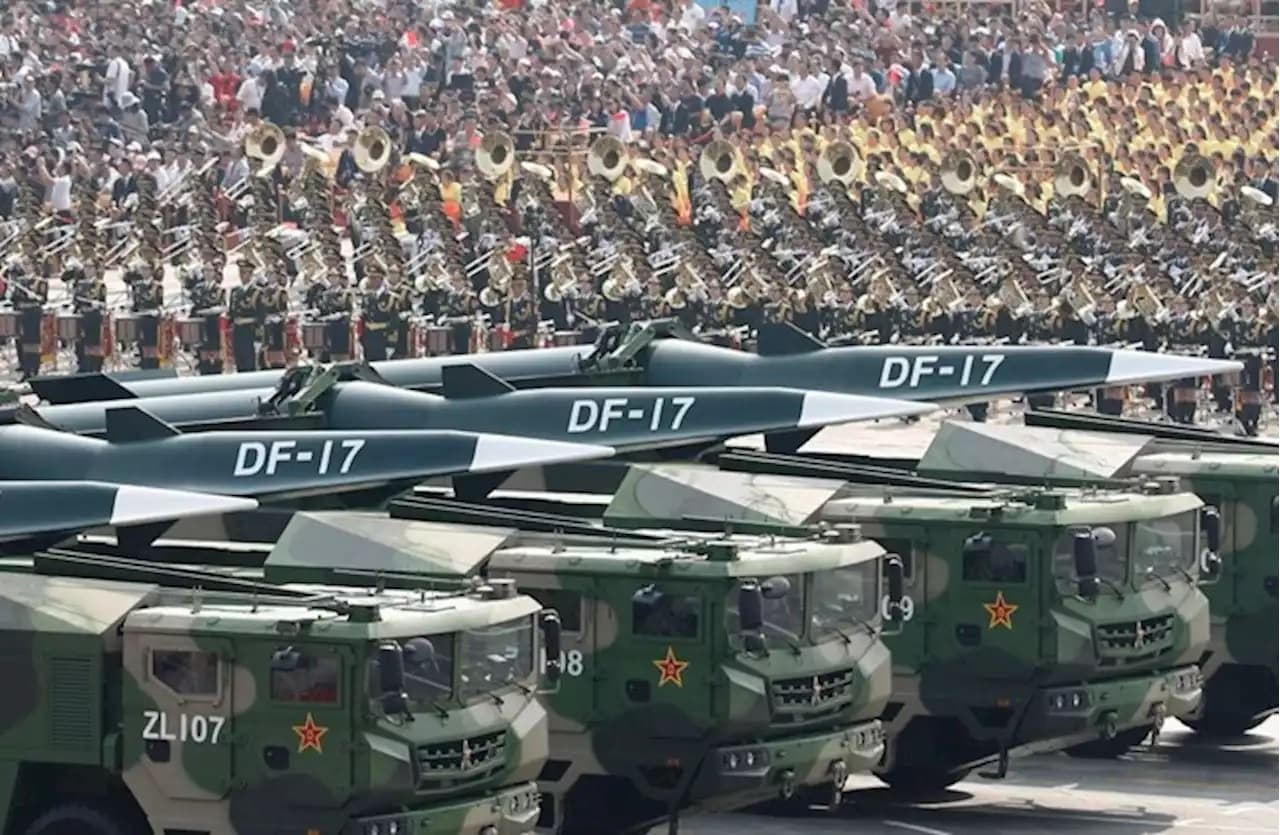
Global Times cited CCTV reports that the Rocket Force publicly conducted two live-fire drills around the anniversary, showcasing multiple strategic missiles, with the DF-17 live fire footage being released for the first time. The South China Morning Post previously noted that CCTV footage showed a DF-17 launch vehicle deploying and launching beside a road, while another segment featured multi-service coordinated training at a training ground in the Gobi Desert.
I believe the key point is not merely the "first time seeing a launch," but rather that the public content selected three elements: mobile launch, field positioning, and system training. The DF-17 is not a silo-launched intercontinental missile; its value comes from road mobility, rapid positioning, and post-launch relocation. In simple terms, whether the launch vehicle can find its position in a complex electromagnetic environment, complete geolocation, receive fire control data, and withdraw before an adversary can retaliate is a better indicator of combat capability than how fast a single missile can fly.
What Does 1800 to 2500 Kilometers Mean?
Public information estimates the range of the DF-17 to be mostly between 1800 and 2500 kilometers. The CSIS Missile Threat defines it as a medium-range missile system carrying a hypersonic glide vehicle; the South China Morning Post also adopted a similar estimate, believing this range is sufficient to cover the first island chain and reach parts of the second island chain.
This number may not seem as exaggerated as that of the DF-26, but it fits right into the sensitive distance for operations in the Western Pacific. Launched from the coastal or inland areas of the mainland, it could theoretically cover support nodes around Taiwan, Okinawa, the Luzon Strait, and some maritime maneuvering targets. It cannot simply be labeled as an "aircraft carrier killer," as mobile naval targets require reconnaissance, tracking, data links, and terminal identification to form a closed loop; however, if the targets are airports, ammunition depots, radar stations, or port fuel areas, the strike logic of the DF-17 becomes much clearer.
The Real Challenge of Hypersonics
Many discussions simplify hypersonic weapons to "above Mach 5." This is akin to only looking at a sports car's top speed without considering brakes, tires, and the road. The challenge of the DF-17 lies in the booster delivering the glide vehicle to the appropriate altitude, after which the warhead glides on a lower trajectory and can maneuver to change its path, compressing the detection, calculation, and interception windows of air defense and missile defense systems. Existing systems like Patriot, Aegis, and THAAD each have their roles, but when facing low-trajectory maneuvering targets, early warning radars and fire control links will experience higher pressure.
CCTV also mentioned that the troops train under strong electromagnetic interference and precise counterattack threats, a statement worth a closer look. On the real battlefield, the DF-17 units face not just target range conditions but also satellite overhead, drone searches, electronic suppression, cyber attacks, and long-range fire countermeasures. The Rocket Force's willingness to publicly release such training footage at least indicates they want the outside world to believe that this system is no longer just "parade equipment."
Don't Overlook Production Capacity and Usage Boundaries
However, I do not agree with the idea of deifying the DF-17. Hypersonic glide vehicles involve heat-resistant materials, inertial navigation corrections, terminal control, and batch consistency, and the costs will not be low. It is more like a precision tool used to strike key nodes rather than a cheap rocket. What truly influences the rhythm of operations is the division of labor among the DF-17, DF-15/16, long-range rocket artillery, air-launched cruise missiles, and drones.
- The DF-17 is suitable for suppressing high-value fixed or semi-fixed targets, especially air defense, command, and airport support nodes.
- The DF-26 provides longer-range regional deterrence, but the launch preparation and target system requirements are also higher.
- Conventional ballistic missiles and long-range artillery are responsible for quantity suppression, with more controllable costs.
- Drones and reconnaissance satellites determine the speed of target updates; without this link, even the most advanced missiles will be less effective.
This is why I prefer to view this public release as a "mission chain demonstration" by the Rocket Force, rather than simply showcasing a missile. After undergoing anti-corruption and restructuring, the Rocket Force needs to prove both internally and externally that training has not stopped and that key equipment is still forming usable combat capability.
A Signal to the First Island Chain
For the United States, Japan, and Taiwan, the public release of DF-17 launch footage may have a psychological effect greater than the technical increment. Adversaries have long been aware of the existence of this missile and would incorporate it into their war games and base defense plans; however, the official public video transforms an abstract threat into a communicable visual signal. Especially as topics like the Fujian aircraft carrier, Y-20 tanker, and J-35 continue to heat up, the DF-17 fills the gap in long-range precision firepower.
The real unanswered question is: how large a scale, how many waves, and how quickly can the Rocket Force deploy high-value munitions like the DF-17 in a high-intensity campaign? Publicly launching a single missile is not difficult; the challenge lies in having dozens of launch units operate continuously under the pressures of reconnaissance, communication, supply, and reloading. This question is key to assessing the PLA's regional denial capabilities.
The People's Liberation Army Rocket Force publicly showcased the first footage of the Dongfeng-17 hypersonic missile launch during a live-fire exercise on July 1. This event coincided with the 60th anniversary of the strategic missile forces and highlighted the missile's operational capabilities, including its range of 1800 to 2500 kilometers. The exercise demonstrated mobile launch capabilities and training under complex conditions, emphasizing the missile's role in targeting critical military infrastructure.
- The Dongfeng-17 hypersonic missile launch footage was publicly released for the first time.
- The missile has an estimated range of 1800 to 2500 kilometers, capable of reaching targets in the first and parts of the second island chain.
- The launch was part of a series of exercises commemorating the 60th anniversary of the Chinese strategic missile forces.
- The exercise included elements of mobile launch, field positioning, and system training under electromagnetic interference conditions.
- The Dongfeng-17 is designed to target high-value fixed or semi-fixed targets, such as air defense and command nodes.