
Drones and autonomous warfare: ‘One-way attack’ and reshaping ISR
Whether it’s seaborne reconnaissance platforms such as the Global Autonomous Reconnaissance Craft (GARC) – now called LYNX – or semi-submersible logistics such as AEVEX Maritime Systems’ NightTrain or high-flying drones providing ISR, autonomous systems are playing a growing role in multi-domain missions, offering longer time on site, greater coverage in contested areas and carrying out missions without putting crew members in harm’s way.
Breaking Defense spoke with Craig Anders, SVP of Growth at AEVEX, about the need for autonomy, how the company is building multi-domain solutions and lessons learned from the use of uncrewed systems in Ukraine and Iran.
What’s the threat scenario right now that is driving the need for air and maritime autonomy?
 Craig Anders, SVP of Growth, AEVEX
Anders: We’re operating under this environment with persistent surveillance, ships, comms, everything’s exposed to attack. Everybody can see everything everywhere. Adversaries are out there deploying inexpensive systems at volume, at scale, and it disrupts the navigation and communications that we depend on to fight. GPS is a mess, comms are a mess, everything’s being jammed.
By creating the distributed capability to help grow reach and reduce the exposure of the manned side of things, both air and maritime autonomy can help maintain awareness, mission effects and keep the forces operating across way larger areas and swaths of the area of responsibility (AOR). These systems need to remain useful when navigation and communications are degraded and operating conditions change.
It’s such a dynamic battlefield these days that having autonomy that doesn’t rely on traditional methods of fighting is now this situation that is critical to mission success.
How have the lessons learned from Ukraine and Iran shaped the thinking around air and maritime autonomy?
We’ve learned both what to do and what not to do over the past four to five years. I was in the military and we started off the Phoenix Ghost program on the government side, and I was able to come here and continue that mission. One of the things we learned there is if you can’t cycle fast, if you don’t have people on the ground near the fight, you’re going to get left behind because being able to dynamically flex, have short engineering cycles, short stroke changes to systems outside the normal build process, you’re just going to lose.
Iran reinforces that pressure. They mass inexpensive threats on the battlefield. They levy pressure on our defenses, our inventories and our maritime access at a level we’ve never seen before. Affordability is key. Resilience of the system is key. Being able to adapt to keep it all working together is the only way to succeed in this environment.
We need functional systems in a degraded environment. We need to be able to have close connections between the operators and the engineers, and our production approach needs to be flexible enough to incorporate those changes fast. Otherwise, we’re not going to have what we need to fight. Even if we do deliver it, it’s not going to be very effective. We strive to shorten those engineering cycles, shorten those production cycles and continue to get users the things they need in a short timeline.
That’s because the Research, Development, Test, and Evaluation, RDT&E, cycle has to move at the pace of combat.
Right, and here’s the deal. Over time, airplanes aren’t going to grow extra wings or weird new kinds of propellers. This becomes largely an autonomy and a software fight. You have to have a good solid vehicle by which to implement these capabilities, whether it’s air, sea or subsea.
We’re taking the background we have in airborne intelligence, ISR, one-way attack and what we’ve learned on the battlefield, and producing that in a method that ties up with the way the US wants to fight.
What is evolving rapidly is how the US employs affordable unmanned systems at scale, across domains and as part of a broader force. That requires more than platforms. It requires concepts of operations, force structure, storage, forward support, and sustainment that keep those systems effective as conditions change.
What multi-domain capabilities are needed, and how has AEVEX evolved into a company that can offer them?
A key to this coming fight is understanding what layered defense and offense looks like. You don’t want to just send a couple long-range, one-way assets out there. They’ll probably just get shot down and you won’t know what happened. You don’t want to have a USV just floating out there in the water by itself. You want these things working together autonomously, but also passing information back to be used for the rest of the fight. Ultimately, this whole multi-domain concept is important to ensuring mission success in these AORs because of the uncertainty.
We believe that bringing in this BlackSea piece – there’s one-way attack boats, ISR boats, security, there’s mine sweeping. You have high-flying ISR assets that work with the boats. You have one-way attack that gets tied together by the boats on the water and the planes in the sky.
When you bring systems together to accomplish different parts of a mission, a common autonomy architecture and compatible interfaces can help them share information and coordinate more effectively. That is the opportunity we are pursuing across air, surface, and subsea capabilities. Our CompassX family of navigation and autonomy capabilities supports that approach, with modular hardware and software tailored to the platform and mission.
There are so many different capabilities you can bring to bear using these types of systems, whether it’s ISR, non-kinetic effects, EW/EA, mine sweeping, mine neutralization, critical infrastructure protection, long-range logistics. There’s so much you can bring to bear that helps take people out of harm’s way, but still accomplish the mission set. When you start to tie all these together across our divisions, it tells a story and sets a new standard on the battlefield.
How does having all of these systems working in conjunction give a more comprehensive picture of the battlefield to decision makers?
You’re going to see things you couldn’t see before. You’re going to see patterns develop. Every platform the military owns, operates or uses generates data, and that data, a lot of times, largely goes unused. As you start to pull together these systems of systems and these whole concepts of operations, you start to see different points where you can pull and utilize data to help make better decisions, target better, communicate better, share data across multiple common operating pictures, and enable the fighting man to make better decisions across the board.
You mentioned BlackSea Technologies, which you recently acquired and is now AEVEX Maritime Systems. What capabilities do they bring?
AEVEX already had surface capabilities through Mako. Our Maritime Systems division adds substantially greater maritime engineering, vessel manufacturing, and operational depth. That broadens both our portfolio and the expertise we can bring to customers.
When you look at their main system, it used to be called the GARC, now it’s LYNX. That’s a US Navy Program of Record. We’ve delivered 350 vessels, and now we’re revamping them to increase the comm/nav solution on it to make it even more adaptable in the current environment.
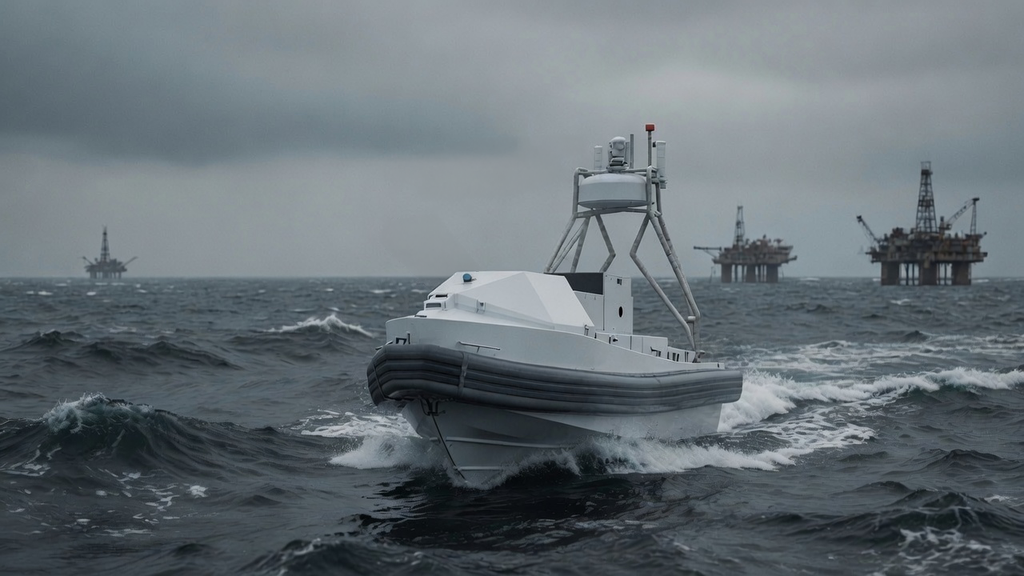 The LYNX – formerly the Global Autonomous Reconnaissance Craft (GARC) – reconnaissance platform is an uncrewed vessel that can stay on site for long periods of time to conduct reconnaissance operations. (Photo courtesy of AEVEX Maritime Systems.)
Those systems are fantastic. They’re all aluminum. We have more than 25,000 operational hours in them. They’re doing mine sweeping in the straits right now. They’re doing countermeasures. They have some unique reconfigurable capabilities that a lot of other people do not. Affordability is also central to our approach.
When you look at that, coupled with some of the other things we’re doing such as the NightTrain, low visibility container transport and delivery; that’s a semi-submersible, large ship, has a couple storage containers on the back. It has a wet bay and it does 2,700 nautical miles.
We have the sea-based petroleum distribution, which is a tanker that holds 185,000 gallons of gas that you can sink down to the sea floor and cache petroleum in place for contingency operations. It creates just a whole other level of how you would operate and fight in that environment.
What else should people know about AEVEX and what you’re doing in the field?
The biggest thing is multi-domain matters, because every mission out there crosses multiple domains. Bringing air, surface, and subsea capabilities together is going to give the warfighter what they need and create opportunities for more coordinated operations. It’s hard to fight in a vacuum. If you’re just focused on air, you’re just focused on sea, you’re missing out. You’re missing out on the CONOPS that help you win effectively and spend less doing it.
Autonomy is changing the way forces see and operate and deliver effects, sustain themselves. Autonomy is bringing capability to bear. Autonomy is also the back side, where you’re using data to analyze and grow your models in an effort to continue to iterate these systems to success. Its value is in real-world performance and real-world operating conditions, but you take that back and you grow your systems based on data and not conjecture. That’s exciting for me.
We bring substantial operational experience delivering and supporting these capabilities. That experience gives us a strong foundation for incorporating lessons from the field and continually improving our systems as requirements evolve. The production process has to keep pace as well, so we can move those improvements into repeatable builds and deliver them at the volume customers need.
That’s what we’re building at AEVEX: the ability to turn evolving mission requirements into capability customers can field and use. We help customers develop concepts of operations, integrate capabilities, and sustain them in the field. That is how we deliver solutions that remain useful as the mission changes.
AEVEX Maritime Systems is enhancing its autonomous systems, including the LYNX reconnaissance platform, to support military operations in the United States. The company emphasizes the importance of affordability and resilience in response to evolving threats, drawing lessons from recent conflicts in Ukraine and Iran. Their focus on multi-domain capabilities aims to improve operational effectiveness and decision-making in dynamic battlefield environments.
- AEVEX Maritime Systems is enhancing autonomous systems for military operations.
- The LYNX platform is a key asset for reconnaissance missions.
- Lessons from Ukraine and Iran are shaping the development of air and maritime autonomy.
- The need for affordable and resilient systems is emphasized due to evolving threats.
- Multi-domain capabilities are crucial for mission success.