
Five Ships in the Ports of Odessa Show How Russia Turns the Black Sea into an Air Blockade of Ukraine in 2026
 Dmitri Volkov
Five ships in the ports of Odesa show how Russia is turning the Black Sea into an air blockade of Ukraine in 2026
The most telling figure in the Black Sea over the past 24 hours is not the number of missiles launched or the tonnage of damaged infrastructure, but the number five. This is the number of ships that, according to the Russian Ministry of Defense, were hit on August 25 in the ports of Pivdenny and Odesa; three cargo ships with military cargo, one tanker, and another cargo vessel were specifically mentioned, while Reuters emphasized that it was not possible to independently confirm these claims. However, in this case, the degree of reliability of each individual hit is less important than the logic behind the choice of targets. Moscow no longer hides that it views the port, commercial vessel, and fuel tank as elements of a single military system. In other words, Russia is trying to achieve at sea what the Black Sea Fleet could not achieve through naval presence: an actual blockade of Ukraine from the air.
This fundamentally distinguishes the current stage of the war from many previous episodes around Odesa. Previously, strikes on ports could be interpreted as pressure on exports, as a response to Ukrainian attacks on Russian logistics, or as an episode of the familiar war of attrition. Now, a more coherent scheme is emerging. When docks, fuel nodes, ships under loading, and approaches to the harbor are simultaneously under attack, it is not about "punishing" one specific operation by Kyiv, but about systematically creating a zone of commercial fear. For insurance companies, shipowners, and traders, this is often enough: they do not need to wait for a formal closure of the corridor to leave it.
Air blockade instead of naval dominance
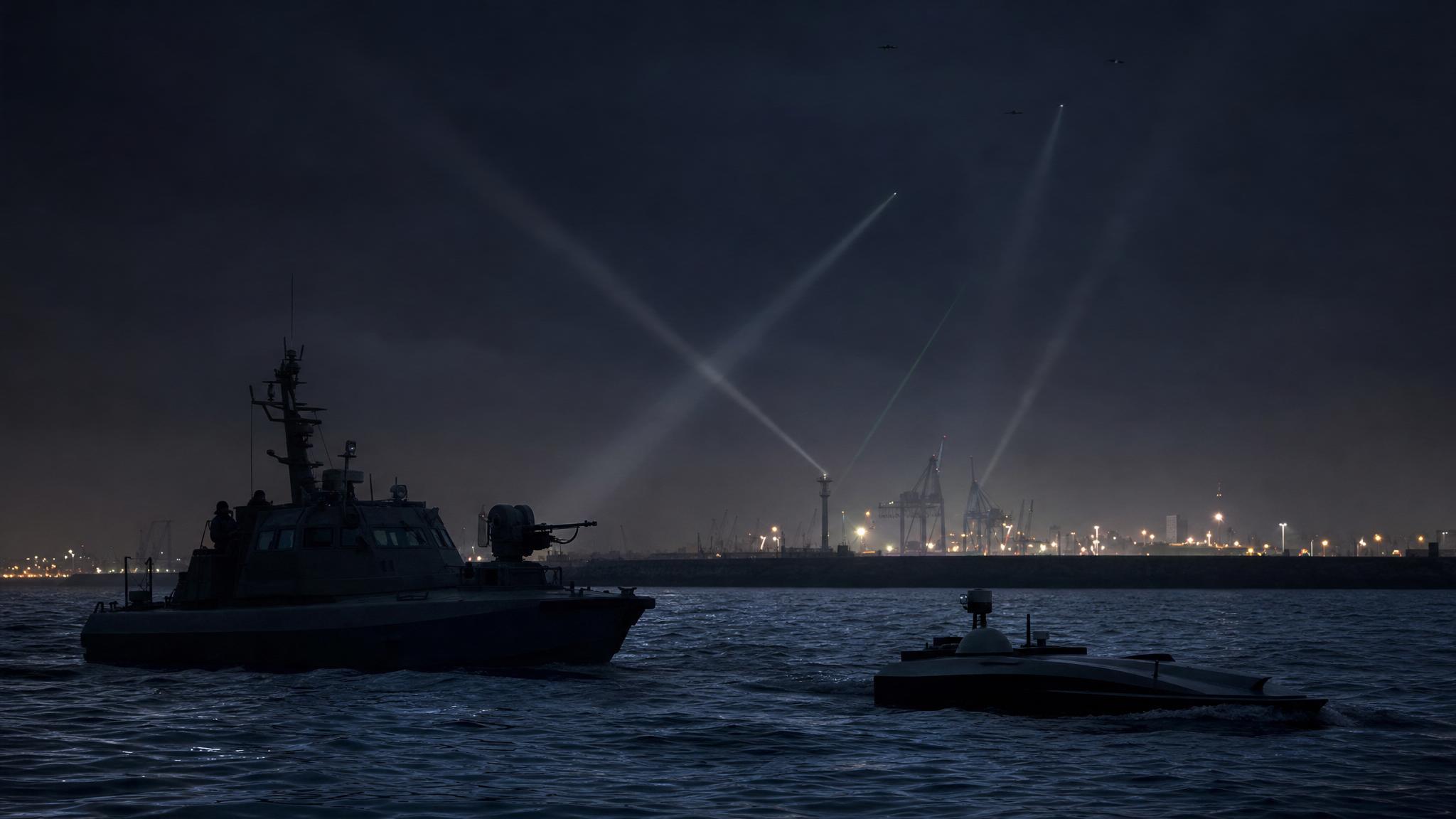
This is the main military significance of the events. The Russian Black Sea Fleet lost the ability to dominate the Ukrainian coast without consequences after 2022. Ukrainian naval drones, missile strikes, and the constant threat to ships forced Moscow to withdraw a significant portion of its major units and act more cautiously. However, the fleet's departure did not mean a rejection of maritime strategy. It merely changed the tool. If the fleet cannot block trade through physical presence, it can attempt to do so with missiles, "Shaheds," and strikes on transshipment infrastructure. As Ukrainian interlocutors noted to the Kyiv Independent, Moscow is trying to impose an air embargo where a classic naval blockade has proven too risky.
It is characteristic that the Russian campaign targets not only warehouses or grain terminals but also the very psychology of maritime communication. According to data provided by Ukrainian sources in July, from June 20 to July 20, 28 civilian vessels were attacked in the ports of Greater Odesa, resulting in 21 deaths and 34 injuries. The Atlantic Council reported in August on more than seventy strikes on port infrastructure and more than sixty strikes on commercial vessels. Even if some of these estimates are later refined, the trend is clear: the object of the war is not just one cargo but the very predictability of maritime trade. For Russia, this is a cheap way to compensate for the loss of initiative at sea.
Economics as an extension of fire
Here we come to what Russian military thought traditionally understands better than is commonly believed in the West: logistics can provide a strategic effect no less than a breakthrough on the front. The Ukrainian grain corridor, according to industry representatives, accounts for about 90 percent of the country's agricultural exports. The agricultural sector alone brought Ukraine about 22 billion dollars in revenue last year. Under normal conditions, approximately 60 percent of monthly exports worth around 3.5 billion dollars pass through Odesa, Chornomorsk, and Pivdenny. When this hub begins to operate intermittently, the damage does not only occur at the moment of the strike. It accumulates in tariffs, in downtimes, in overflowing elevators, and in farmers' decisions to plant less next spring.
The spike in freight rates is particularly telling. According to the Kyiv Independent, the cost of transporting grain has risen from about 24 to 47 dollars per ton in just a few days. For the cabinet of ministers, this is statistics; for a farmer in Poltava or Kirovohrad regions, it is a question of whether there will be enough working capital for the new planting season. Alternative routes through the Danube, railroads, and road crossings exist, but they are more expensive and slower. And here it becomes clear why today's topic differs from the morning story about Moldovan crossings. On land, Russia is pressuring the periphery of Ukrainian logistics. At sea, it strikes at the central valve of the entire export system.
Why the Kremlin chose this moment
The answer is quite prosaic. In recent months, Ukraine has been striking painfully at Russian oil and shadow maritime logistics, and Moscow is looking for a symmetrical but more sensitive response for Kyiv. A strike on the export infrastructure of Odesa provides several advantages at once. First, it weakens the Ukrainian budget without the need to occupy new territory. Second, it increases internal pressure on Kyiv from the agricultural and metallurgical lobbies. Third, it raises the global price of risk in the Black Sea, thereby forcing external players to discuss the "maritime security regime" again on terms where Russia retains a veto right.
Hence the nervous reaction from Turkey. Ankara has already called for a moratorium on strikes against vessels in the Black Sea, acknowledging that the conflict is spreading throughout the basin, and foreign flags are also under threat. For Moscow, this is a double-edged sword. On one hand, escalation raises the price of Ukrainian exports. On the other hand, it increases the irritation of shipowners, insurers, and regional intermediaries, including Turkey, which is not interested in turning the Black Sea into a permanent gray zone for commercial shipping. But in the Kremlin's logic, short-term pressure is usually valued more than long-term reputation. This is an old Russian ailment of state thinking.
What this means for the fall of 2026
I do not think that Moscow aims for an absolute and legally formal closure of the Ukrainian maritime corridor. That would be too straightforward and politically costly. A much more likely model is to maintain a level of threat such that the corridor formally exists but operates below normal, costs more than normal, and is more nerve-wracking than normal. A few strikes on vessels, a few hits on terminals, fuel supply disruptions, attacks on railway approaches — and exports do not collapse all at once but slowly lose profitability. For the military bureaucracy, this is almost the ideal scenario: the enemy is exhausted, and responsibility is diluted.
Therefore, the strike on five ships on August 25 should be read not as an isolated report but as another paragraph in a longer text. This text is titled: Russia is trying to turn the Black Sea from a space of failed naval superiority into a space of managed economic strangulation. Whether it can carry this strategy through to the end depends not so much on the number of missiles but on whether Ukraine can find sufficient air defense for its ports and maintain the trust of carriers. If not, in the fall we will see not a spectacular naval battle but something even more useful for Moscow — the quiet strangulation of Ukrainian exports accompanied by the usual military reports.
Sources: Reuters / U.S. News (August 25, 2026), Kyiv Independent, Atlantic Council, Anadolu / statements from the Turkish side.
On August 25, 2026, the Russian Navy targeted five ships in the ports of Odessa and Pivdenny, marking a strategic shift towards an air blockade against Ukraine. This operation aims to disrupt Ukrainian agricultural exports and create a climate of fear among shipping companies. The attacks are part of a broader strategy to weaken Ukraine's economy without occupying new territory.
- Five ships were reportedly hit in the ports of Pivdenny and Odessa on August 25, 2026.
- The Russian Navy is targeting commercial vessels and fuel depots as part of a broader military strategy.
- Ukraine's agricultural exports are significantly impacted by these attacks, affecting the economy.
- The report indicates a shift from naval dominance to an air blockade strategy by Russia.
- Insurance rates for shipping have increased dramatically due to the heightened risk in the Black Sea.