
France Begins Construction of New Nuclear-Powered Aircraft Carrier, Most Key Aspects Utilize Indigenous Technology
[Global Times Comprehensive Report] On the 18th local time, French President Macron announced at a aircraft carrier construction site in the western city of Nantes that France has initiated the construction of a new nuclear-powered aircraft carrier, naming it "Charles de Gaulle." He stated that this new aircraft carrier is a "guarantee of independence" for France in the coming decades. According to the French newspaper Le Monde, this naming echoes the "Free France" resistance movement led by General de Gaulle during World War II, carrying significant historical symbolism.
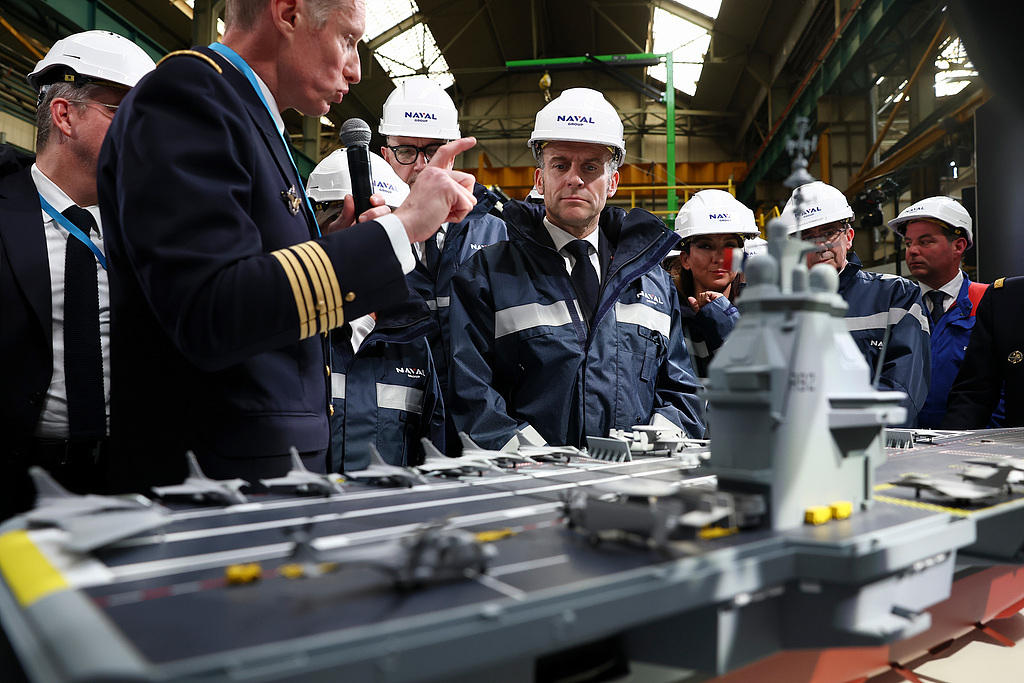
In December last year, the French presidential office officially approved the construction plan for the new generation aircraft carrier. According to information previously released by the French Defense Procurement Agency, the new aircraft carrier construction project has entered a substantial advancement phase. Sea trials for the ship are expected to take place around 2036, with commissioning anticipated around 2038, to replace the current nuclear-powered aircraft carrier "Charles de Gaulle," becoming the core platform for France's maritime power projection, nuclear deterrence support, and blue-water combat system for decades to come.
According to reports from France 1 Television, the "Charles de Gaulle" is significantly larger than the current "Charles de Gaulle." The new aircraft carrier is expected to be approximately 310 meters long, with a full-load displacement of over 70,000 tons, a flight deck area of about 17,000 square meters, a maximum speed of about 27 knots, capable of carrying around 30 carrier-based fighter jets, and equipped with early warning aircraft, helicopters, and various drones, with a total onboard personnel of up to about 2,000. French media stated that the new ship will achieve significant improvements in terms of carrier-based aircraft operational space, living conditions for personnel, and future weapon compatibility compared to the current aircraft carrier.
On a technical level, the "Charles de Gaulle" will adopt French indigenous technology in most key areas such as hull construction, carrier-based aircraft manufacturing, weapon systems, and nuclear propulsion. However, French media also noted that the new aircraft carrier will still use the electromagnetic catapult system from General Atomics. Compared to the steam catapult system currently used by the "Charles de Gaulle," the electromagnetic catapult is lighter, has lower maintenance costs, imposes fewer constraints on the airframe structure, and is more suitable for future drone operations. However, this arrangement has once again sparked discussions in French public opinion about the dependence on the U.S. for critical military technologies.
The French newspaper Le Parisien reported on the 18th, recalling that in 2003, France faced U.S. retaliation for opposing the invasion of Iraq. The U.S. suspended the supply of certain related spare parts for the "Charles de Gaulle," particularly components needed for aircraft catapults, leading to a temporary halt of the French aircraft carrier. This experience is still seen as a warning for France to achieve military technological independence. (Yu Chaofan)
On October 18, 2023, French President Macron announced the initiation of construction for a new nuclear-powered aircraft carrier named 'Charles de Gaulle' in Nantes. The carrier is set to enhance France's naval capabilities and is expected to be operational by 2038, replacing the current carrier. It will incorporate advanced French technology and is historically significant, named after the WWII resistance movement.
- France has started building a new nuclear-powered aircraft carrier named 'Charles de Gaulle'.
- The carrier is expected to be operational by around 2038.
- It will replace the current carrier and enhance France's naval capabilities.
- The carrier will utilize French technology for most key systems, but will include an American electromagnetic catapult.
- The project has historical significance, named after the WWII resistance movement led by Charles de Gaulle.