
French startup develops pneumatic-wing cargo drone
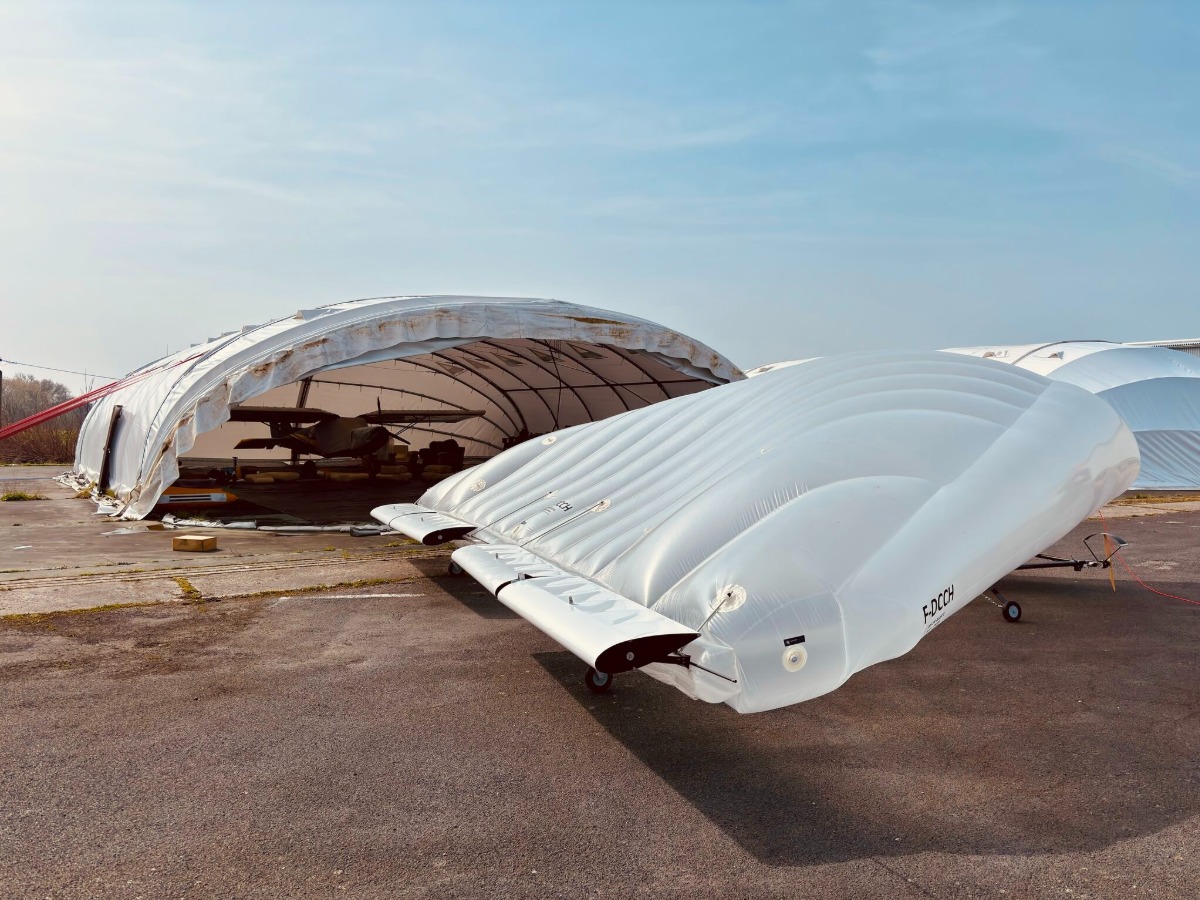
A French startup has completed ground avionics testing of an unusual hybrid aircraft that combines the lifting principles of a blimp with the aerodynamic structure of a fixed-wing drone, targeting long-endurance cargo logistics missions with a design that trades speed for dramatically reduced energy consumption per kilogram transported.
Celeste Ecoflyers, a French aerospace startup, announced the successful ground activation of the dAS10’s avionics system at Le Havre airport, where the company has been conducting development work with support from avionics partner ROAV7, according to the company’s LinkedIn post. The testing session involved taxiing trials at graduated speeds, ground control validation, and a short hop flight, marking a key milestone in the dAS10’s development toward its intended role as a sustainable long-range logistics drone. The aircraft, registered in the French civil aviation register as F-DCCH, is qualified under French UAS regulatory framework.
The dAS10’s fundamental engineering premise is built around a pneumatic wing, a pressurized textile envelope that generates lift through its inflated form rather than through a rigid composite structure. Celeste explained the logic in its LinkedIn post with engineering specificity: a composite wing is precise and aerodynamically efficient but heavy relative to its lifting surface area. For a given mass, extending flight endurance requires reducing wing loading, which means more lifting surface, but scaling up a composite wing adds structural mass that cancels the efficiency gain. A pressurized textile envelope inverts that equation: the structure is the air inside it, and the textile provides lifting surface at a fraction of the weight of an equivalent rigid wing. The result, according to the company, is very low wing loading, slower flight, and significantly reduced power consumption per kilogram transported — the fundamental lever for endurance.
The dAS10 operates within a more restricted flight envelope than conventional drones, is more sensitive to atmospheric conditions, and presents considerable aerodynamic challenges in achieving acceptable performance from a form that is not naturally optimized for efficiency, per the company’s own assessment. The advantages come in durability and repairability that rigid-wing designs cannot match: the wing folds for transport, and a puncture in the textile requires only a patch to restore integrity rather than structural repair or component replacement.
Celeste claims six hours of battery autonomy, a range of 300 kilometers, and solar panels on the aircraft’s upper surface that can potentially extend flight duration beyond the battery-only envelope. The solar integration on the upper surface of a slow-moving, flat-topped pneumatic wing is geometrically logical: the inflated envelope presents a large horizontal surface area to sunlight throughout a daytime flight profile, harvesting energy that a faster, more steeply banked conventional drone could not capture effectively. Payload capacity figures are not specified in the available source material and remain unconfirmed.
The hybrid classification that Celeste applies to the dAS10 reflects a genuine design synthesis. The aircraft draws on lighter-than-air technology principles by using an inflated envelope as its primary structural and lifting element, while operating as a fixed-wing heavier-than-air vehicle that generates aerodynamic lift from forward motion rather than buoyancy. The flexible wing envelope can be filled with various gases tailored to specific mission profiles, per the company’s technical summary, opening the possibility of neutral or positive buoyancy configurations for different operational requirements. This places the dAS10 in a small category of aircraft that deliberately blur the boundary between aerostat and airplane, a design space that has attracted periodic attention from researchers and startups over several decades without yet producing a widely fielded operational system.
The dAS10’s design philosophy accepts slower speed and restricted weather operations in exchange for the endurance and energy efficiency that conventional multi-rotor and fixed-wing drones struggle to achieve simultaneously. Whether that tradeoff finds customers willing to plan their logistics around a slow, weather-sensitive platform in exchange for dramatically lower energy costs per delivery is the market question that follows the engineering one.
Content preview only. Full article available at source. View Full Article
Celeste Ecoflyers successfully conducted ground avionics testing of the dAS10 hybrid cargo drone at Le Havre airport. The drone features a pneumatic wing design aimed at reducing energy consumption and increasing flight endurance. It is registered in the French civil aviation register and is designed for long-endurance cargo logistics missions.
- Celeste Ecoflyers completed ground avionics testing of the dAS10 drone at Le Havre airport.
- The dAS10 features a pneumatic wing design for reduced energy consumption.
- The drone has a claimed battery autonomy of six hours and a range of 300 kilometers.
- The aircraft is registered in the French civil aviation register as F-DCCH.
- The dAS10's design allows for various gas configurations for different mission profiles.