
Germany's $900 Million Saab Deal Shows NATO's Frigate Problem
 Alexandra Reeves
Germany's $900 Million Saab Deal Shows NATO's Frigate Problem
Germany has found the most German possible way to admit a procurement disaster: it has bought a cleaner, smaller, more realistic warship package and is pretending this was always the sensible plan.
Saab said on 16 July that it had signed a contract with TKMS to equip four new German Navy MEKO A-200 DEU frigates with combat systems, composite structures and sensors. The order is worth about SEK 8.7 billion, or roughly $900 million, with deliveries scheduled from 2029 to 2032. Defense News reported the same day that the package follows Berlin's decision to scrap the troubled F126 frigate programme and pivot toward a smaller off-the-shelf design.
That sounds like an industrial update. It is more than that. It is a quiet confession that NATO's European naval plans are being dragged back toward a basic wartime truth: a ship that arrives late does not deter anyone.
What Berlin Bought
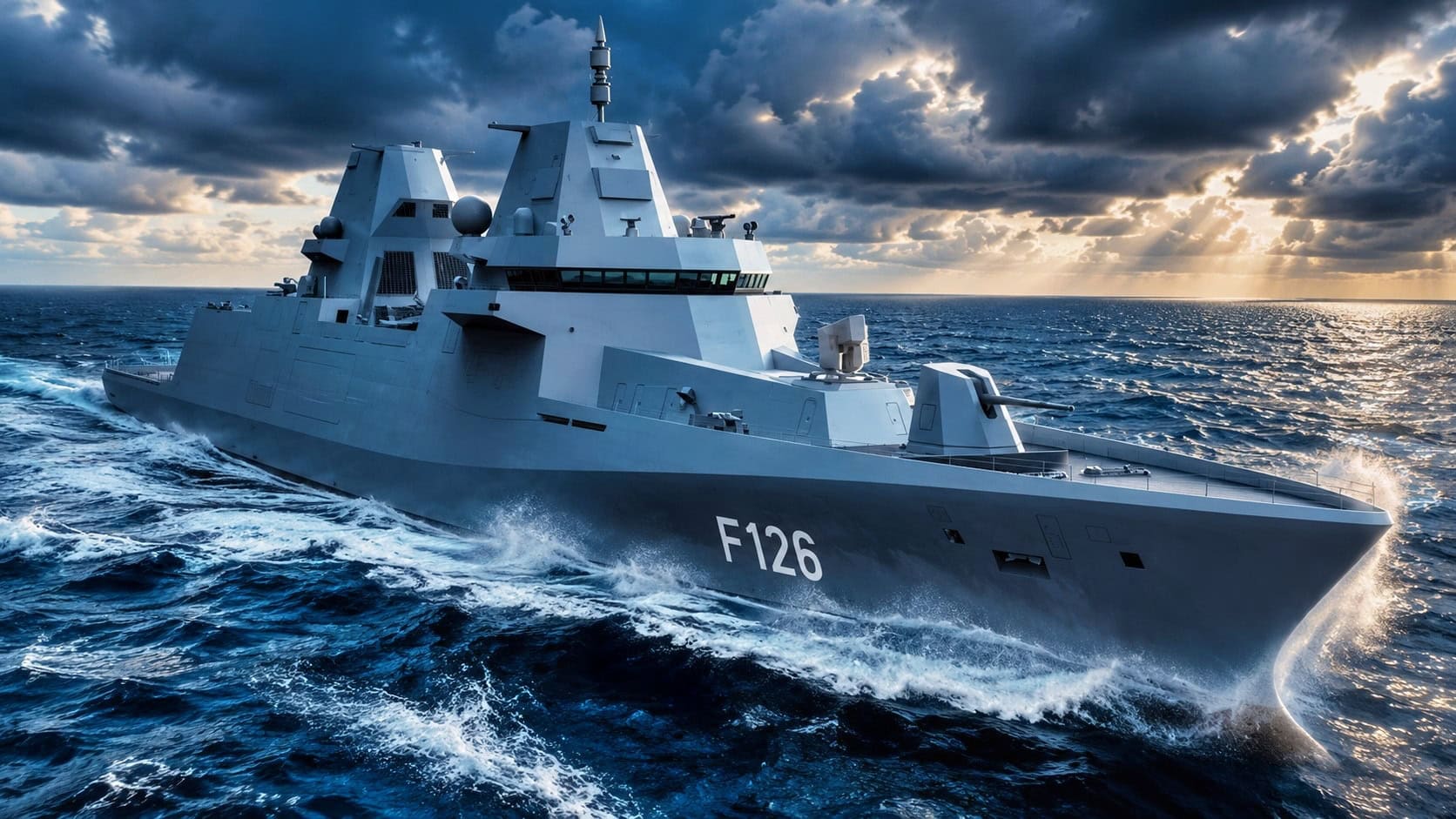
The Saab package is not cosmetic. According to the company's announcement, the order covers 9LV combat systems, including fire-control and combat-management systems, plus the long-range Sea Giraffe 4A Fixed Face radar, the lightweight Sea Giraffe 1X multi-mission radar and passive sensors. Saab will also supply composite superstructures. In plain English, Saab is providing much of the digital nervous system that turns a hull into a fighting ship.
The new frigates will be built in Germany by TKMS as prime contractor. The initial order covers four ships, with an option to integrate and equip more. Defense News reported that the Bundestag budget committee approved a roughly 6.3 billion euro, or $7.2 billion, procurement on 8 July for the four TKMS-built vessels, with an option for four additional hulls.
The timing matters. Saab says its deliveries run from 2029 to 2032. Berlin wants the first ship in the water by the end of the decade. For a navy that needs anti-submarine capacity in the Baltic, the North Sea and the North Atlantic, that is not exactly fast. But compared with the F126 saga, it is an attempt to rejoin the real world.
The F126 Lesson Was Brutal
The cancelled F126 programme was supposed to give Germany a large, highly capable multi-role frigate. Instead, it became a case study in how European defence procurement can turn ambition into delay. The F126 design had grown into a roughly 10,000-ton class, larger than many destroyers, while costs and delivery problems mounted. Berlin's decision to move toward the 4,000-ton MEKO A-200 DEU is therefore not merely a platform change. It is a change in philosophy.
The old assumption was that Germany could buy exquisite ships slowly and still meet alliance needs. That assumption looks worse every year. Russia's submarine force may be smaller and more stressed than it wants outsiders to believe, but the Kola-based nuclear fleet remains a central part of Moscow's deterrent. Russian undersea activity also forces NATO to think about reinforcement routes, energy infrastructure and seabed cables. The war in Ukraine has made land warfare look urgent. It has not made the sea less important.
Saab CEO Micael Johansson said the deliveries would enhance the German Navy's anti-air, anti-submarine and anti-surface warfare capabilities. The important word is not enhance. It is deliveries.
Smaller Is Not Automatically Easier
There is a temptation to present the MEKO pivot as common sense triumphing over bureaucratic fantasy. Partly, it is. A mature design, a known shipbuilder and a sensor package from a company with deep naval-radar experience should be easier to manage than another bespoke monster vessel with too many national preferences welded into the hull.
But smaller does not mean simple. Integrating Saab's 9LV combat-management architecture, Sea Giraffe radars, passive sensors and fire-control systems into TKMS-built German ships still creates a multinational engineering problem. Germany is trying to compress time, reduce risk and preserve capability all at once. Usually you get to choose two.
The 4,000-ton MEKO A-200 DEU will also need to carry a heavy burden for its size. The political sales pitch is anti-air, anti-submarine and anti-surface warfare. The alliance demand is even broader: protect sea lines, contribute to Baltic deterrence, watch Russian undersea movement, plug into NATO command networks and do it without eating the entire German naval budget. That is a lot to ask from a ship class selected partly because the previous answer became unaffordable and late.
NATO Needs Hulls Before It Needs Slogans
Everyone in Brussels likes to talk about readiness. The uncomfortable part is that readiness often comes down to boring industrial sequencing: steel, radars, software, shipyard capacity, trained crews and maintenance cycles. Germany's Saab order sits exactly there, in the unglamorous middle between strategic speeches and usable force.
This is also why the deal has a wider European meaning. France and Germany are struggling over combat aircraft cooperation. Missile-defence projects are multiplying because Europe does not trust that American interceptors and American political will are infinite. Naval procurement is now part of the same story. European NATO members are not just short of equipment. They are short of procurement systems that can produce relevant equipment before the threat picture changes again.
There is a sharper point here. Germany is Europe's largest economy and one of NATO's essential logistics hubs. If Berlin cannot get surface combatants into service on a credible timeline, smaller allies will draw the obvious conclusion: European rearmament is still more promise than production.
What To Watch Next
The first thing to watch is whether the MEKO schedule survives contact with German politics. A first ship by the end of the decade is plausible only if Berlin avoids turning the replacement programme into another custom-built national prestige project. The second is whether the option for four additional frigates becomes real. Four ships help. Eight would say Germany is serious about restoring fleet mass.
The third is integration. Saab's radars and 9LV system are proven pieces of kit, but the test will be how quickly the German Navy can turn the new frigates into deployable NATO assets rather than impressive dockside acquisitions.
So yes, the $900 million Saab contract is good news. It points Germany toward a more practical shipbuilding path and gives NATO a chance at more usable anti-submarine and air-defence capacity in the early 2030s. But it is also a warning. Berlin did not choose speed because everything was going well. It chose speed because the old way failed.
The real question is whether Germany has learned that lesson deeply enough to stop redesigning the answer before the ships are built.
Germany signed a $900 million contract with Saab to equip four new MEKO A-200 DEU frigates with advanced combat systems and sensors. Deliveries are scheduled from 2029 to 2032, following the cancellation of the troubled F126 program. This shift reflects a change in Germany's naval procurement strategy to enhance its capabilities in anti-air, anti-submarine, and anti-surface warfare.
- Germany signed a $900 million contract with Saab for four MEKO A-200 DEU frigates.
- Deliveries are scheduled from 2029 to 2032.
- The contract includes advanced combat systems and sensors.
- The decision follows the cancellation of the F126 frigate program.
- The new frigates aim to enhance Germany's naval capabilities.